Abstract
The eight trigrams present a remarkable conjunction of formal simplicity and semantic richness. This paper explores how their three binary lines might articulate meaningful distinctions within a relational whole. Taking complementary polarity as a cosmological starting point, I develop a framework in which the sources of those distinctions, and the ways they qualify one another, become explicit. Chinese cosmological writings and Western elemental philosophy inform the enquiry, while mathematical analysis allows us to examine what follows from the choices made.
The framework opens a comparative reading of elemental qualities, psychological functions, creative manifestation, organic life, and the emotional categories of the Human Compass. These vocabularies approach meaning from different directions, yet their expressions may resonate with a shared archetypal essence. Words, natural images, and traditional correspondences serve as ways of approaching that essence without exhausting it. Reading across them gives each trigram a richer qualitative portrait, whose specificity emerges both through its varied expressions and through its relationships with the other seven. Three ways of qualifying a pair of sources give each vocabulary a different compositional reading. Holding those readings fixed in turn lets us compare three successions. Earlier and Later Heaven assign the work of phase mediation to different members of the same repertoire. The Human Compass circle shows how the same phases can be connected without any one of them mediating the rest. Under explicit conditions on succession, double qualification also recovers the Later Heaven circuit.
The paper culminates in a provisional atlas of all eight trigrams. Its contribution is a method for bringing formal structure, historical interpretation, and archetypal resonance into sustained conversation. The construction makes its commitments and alternatives available for scrutiny; the portraits give those commitments substantive interpretive content. Together, they offer a way to investigate how complementary distinctions acquire meaning through one another, while keeping the exact consequences of a model distinct from the broader cosmological possibilities it invites us to consider.
Keywords: trigrams; Earlier Heaven; Later Heaven; Four Images; Five Phases; elemental qualities; compositional semantics; qualified bi-duality; archetypal sememes; Human Compass.
Part I · The framework
1 The enquiry: how does a trigram come to mean?
The eight trigrams have intrigued and baffled me for most of my life. Their construction appears simple enough: three yao (爻) positions, each occupied by a yin (陰) or a yang (陽) line. Yet their meanings encompass natural images, family relationships, directions, and modes of change. What has concerned me is how we pass from the simplicity of the construction to this differentiation of meaning. How can three binary distinctions support such varied meanings?1
We cannot answer this merely by counting yin and yang. Dui (兌), Li (離), and Xun (巽) each contain two yang lines and one yin line, yet they remain distinct trigrams. The positions of the lines matter, as does the convention through which we read the figure. Turning a drawing over, for example, is not automatically the same as reversing a process. My starting question therefore concerns composition: what distinctions might the yaos carry, and how might their combination make meaning available?
Qualified bi-duality is one proposed answer. It is a modern framework that makes the provenance of each contribution explicit; it does not derive the full received significance of each trigram from its lines. Once the figures have acquired this stated compositional interpretation, we can bring them into a substantive comparison with the received arrangements and correspondences. Earlier Heaven (先天, Xiantian, here XT) and Later Heaven (後天, Houtian, here LH) then enter the enquiry as different organisations of the same eight identities. The enquiry culminates in a provisional atlas of all eight trigrams, in which five semantic palettes, including Human Compass[29], are brought into relation with received Chinese images. Its completeness concerns the coverage of the eight positions. It does not imply that their meanings have been exhaustively defined.
1.1 Duality as a philosophical commitment
Underlying this enquiry is a cosmological commitment: I take complementary polarity to be a basic principle through which reality differentiates and transforms. It is therefore more than a convenient way to number eight objects. It leads me to ask how differences arise within a relational whole, and how a third contribution might qualify two sources already present. The construction is an attempt to articulate this commitment in a form that can be examined. Its point of departure has textual precedents in the Xici (繫辭) and in the account of polar differentiation given by Zhou Dunyi (周敦頤).[1, 5]
What I mean by duality is complementary differentiation, rather than the existence of two independent substances. The Xici shang (繫辭上), chapter 5, states “一陰一陽之謂道”: yin and yang in alternation are called the Way. In the same chapter, change is connected with continuing generation, “生生之謂易”. Taken together, these passages place polarity within an account of how things arise and continue. They offer more than a classification into two kinds. Chapter 11 gives the progression from two modes through four images to eight trigrams.[1]
Zhou Dunyi’s Taijitu shuo (太極圖說) develops this reciprocity further. Activity and stillness alternate, and, in Joseph Adler’s translation, “each is the basis of the other”. Their differentiation establishes yin and yang; their combination generates the Five Phases and the transformations of the myriad things.[5] Here we have a substantive textual rationale for considering differentiation, mutual dependence, and generation together. It is this philosophical possibility that I take up, while making my own compositional choices explicit. A particular semantic polarity need not exhaust yin and yang, and neither text supplies the encoder developed below.
The commitment also suggests a discipline for the construction. Before introducing a new semantic source for each additional line, we can investigate how sources already present might be combined, reiterated, and qualified. This is a principle of constructive economy. It neither proves that there must be exactly two sources nor excludes a model with three bipolar sources: three binary axes remain binary. In its treatment of Heaven, Earth, and Humanity as three domains, each doubled, the Shuogua (說卦) reminds us that a cosmology founded on polarity need not exclude threefold organisation.[3]
The philosophical claim and the mathematical result consequently ask different things of the argument. We can assess a cosmological interpretation through its coherence, its explanatory scope, and the distinctions it helps us articulate. A calculation can establish what follows from specified choices. Success in the calculation gives us a worked instance of the philosophical proposal, without proving that every phenomenon must have this structure. Equally, making the formal result conditional does not remove the cosmological motivation that led to it.
1.2 An archetypal vocabulary
The meanings proposed here form a vocabulary of archetypes. From the source poles upwards, I use words such as cold, moist, Aqua, cognition, and growth as handles for qualitative distinctions. Each draws attention to an essential aspect of a pattern, without exhausting the things to which that pattern may apply. An elemental profile is therefore neither a chemical definition nor a requirement that every instance belong exclusively to one class. Considered in different respects, the same situation may disclose different qualities.
I call the shared qualitative meaning that we approach through these expressions an archetypal sememe. This names what we are seeking to discern; it does not name a definition we have already secured. Under the original pole assignment and returning-source rule developed below, the elemental qualities, psychological, creative manifestation, and organic palettes are proposed as expressions of one underlying map. No single palette exhausts it. Temperature and moisture disclose one range of meanings, judging and perceiving another, and reading across them may allow us to appreciate a common essence more fully than any isolated name could. The Human Compass supplies a fifth repertoire, with a distinct origin in emotional experience. Table 5 puts each of the five repertoires through all three encoders. Section 17 returns to the eight glyphs to ask what their different readings disclose together. Their possible participation in the same sememes remains an interpretive proposal: a shared glyph alone cannot establish it.
It is resonance, rather than resemblance, that I am seeking in this comparison. Things that appear quite different can still disclose something of the same qualitative relation. A marsh, an act of judgment, and a way of giving form need neither look alike nor denote similar objects. Their possible resonance lies in how openness, distinction, participation, or qualification is experienced through them. These words, too, are provisional handles. Resonance need not depend on a common phrase, nor can such a phrase give an exhaustive account of it.
There are pertinent textual companions to this approach. The opening of the Laozi (老子) cautions that the name that can be named is not the constant name; the Xici shang, chapter 12, considers the limits of words and the use of images to express meaning.[2, 1] Both encourage us to attend through an image to what it makes available. They do not, however, establish that every tradition expresses an identical hidden vocabulary. Historical meanings retain their particularity, and it is their possible resonance that we are comparing.
This understanding already matters at the beginning of the construction. Moisture can suggest receptivity and fluidity; it can also suggest the potential for life and generation. These different emphases can motivate different yin–yang valuations without emptying the word of meaning. In assigning a pole, we select a respect in which we are making the distinction. Section 9.9.2 develops this example in detail. I regard the recurring difficulty of remaining oriented through such reversals as part of the enquiry itself. A fixed pronouncement can obscure the very relation through which it first became intelligible.
None of this removes the need for precision. Once we have declared a valuation, the same pole must retain the same meaning throughout a calculation. If we change the respect in which we are interpreting it, we must state an explicit alternative, rather than substitute meanings unnoticed halfway through the argument. The finite model specifies exact relations among its handles; whether those handles are adequate depends on the qualitative distinctions they help us recognise. We can therefore be exact about a composition without claiming that its language has captured the whole of an experience.
Three questions guide a proposed reading. Does it retain the base’s two constitutive meanings? Does the qualifier perform the declared reinforcement or counterbalance, rather than introduce an unrelated association? And does the resulting distinction make a different aspect available from the neighbouring base or qualification? If a description fits every state equally well, it has explained little. In the worked contrasts below, I therefore identify both what remains and what changes. These are exercises in interpretive discrimination, rather than tests of whether all concrete things fall into eight exclusive kinds. What we are asking is whether the different expressions deepen and differentiate a common apprehension. Section 9.6 develops a procedure for bringing that apprehension into dialogue with received images.
To keep these distinctions clear, I use bi-duality for the conjunction of two distinguishable bipolar sources, each with two complementary poles.2 The term names their relational organisation; four-pole identifies their total repertoire. In qualified bi-duality, the two sources establish four bases, and a further binary choice distinguishes two qualifications of each base. The bi-dual trigram framework gives these distinctions three compositional roles and an explicit correspondence with three-line figures. The framework admits more than one class of qualification. Trigram genesis, denoted \(\mathcal G\), chooses between the complementary poles of a source assigned by a rule; constituent selection in the Human Compass, denoted \(\mathcal H\), chooses between the two source poles already present in its base. A third construction, double qualification, denoted \(\mathcal L\), pairs the outer lines and lets the middle qualify their relation (Table 1). Bi-dual trigram genesis, or simply trigram genesis, names the particular returning-source construction first motivated by the elemental qualities. Its temperature–moisture interpretation is the elemental qualities model (4E, for four elements); the arranged figures form an elemental qualities bagua (八卦). Distinguishing framework, rule, and interpretation in this way lets us carry a rule into another interpretation without implying that every interpretation has the same origin or justification.
Three questions guide the enquiry. What does each encoder require of the three lines? What can a particular vocabulary make of those requirements? What changes when we carry the same eight meanings into a different succession? The distinction matters even where the same name occurs twice. Human Compass designates a vocabulary of emotional experience, constituent selection (\(\mathcal H\)) designates an encoder, and the Compass succession (\(\Gamma_{\mathcal H}\)) designates a directed circle. One can use any one of these without adopting the other two.
2 From one polarity to four bases
2.1 What a single source can distinguish
Consider cold and hot as the two poles of one source. Two positions give four ordered words: cold–cold, cold–hot, hot–cold, and hot–hot. If interpretation retains only an equal-weight sum of signed contributions, their values are \(-2,0,0,2\). Under this aggregation, the two mixed words coincide. We have lost the distinction through our chosen interpretation, rather than through binary notation itself.
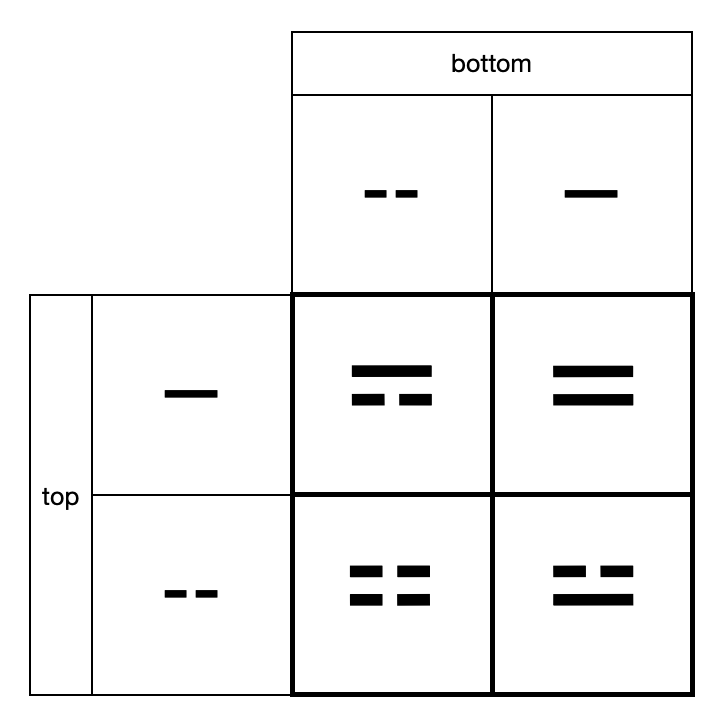
An ordered transition reading distinguishes all four without adding another source: cold remaining cold, cold becoming hot, hot becoming cold, and hot remaining hot. It treats persistence and change within the same relation. Once bottom means “from” and top means “to”, reversing the order in which we visit the four words does not change what each word means. Exchanging the positional roles does. We can distinguish these operations and still recognise the coherence of the single-source alternative while exploring a bi-dual proposal.
The question pursued here is different: can the two positions jointly describe a basis whose constituents remain distinguishable, without having to treat the positions as successive moments of one variable? This invites a second source.
2.2 Two distinguishable sources
Conceptually, I understand this move as applying duality to the source distinction itself: the first polarity is considered in relation to another polarity. This self-referential dualisation is a philosophical construction, not a logical operation that uniquely generates moisture from temperature. A choice of sources therefore needs its justification in the field of meanings we are considering.
We now record which poles are combined and where they are placed. The notation makes these distinctions exact without measuring qualities or replacing the cosmological account of change.
Let the sources be \(x\) and \(y\), with poles \(x^0,x^1,y^0,y^1\). Superscripts are pole indices, not powers: they record yin (\(0\)) and yang (\(1\)), while source letters record provenance. Write \(\mathbb B=\{0,1\}\) for the bit set. Signed notation writes the same poles \(x^-,x^+,y^-,y^+\). Both sources are bipolar and functionally equivalent; neither is inherently stronger or prior in value. In the proposed semantic reading they are complementary: each acquires a more determinate meaning through its relation to the other. The complementarity here belongs to the source roles in a conjunction, rather than making the two sources opposite poles of one variable. In genesis I retain \(x\) below \(y\), the stacking selected for its semantic fit with received trigram attributes (Table 8). The source-indexed pole bits \(p_x,p_y\in\mathbb B\) specify a base \((p_x,p_y)\), which records the lower pole \(x^{p_x}\) and upper pole \(y^{p_y}\).
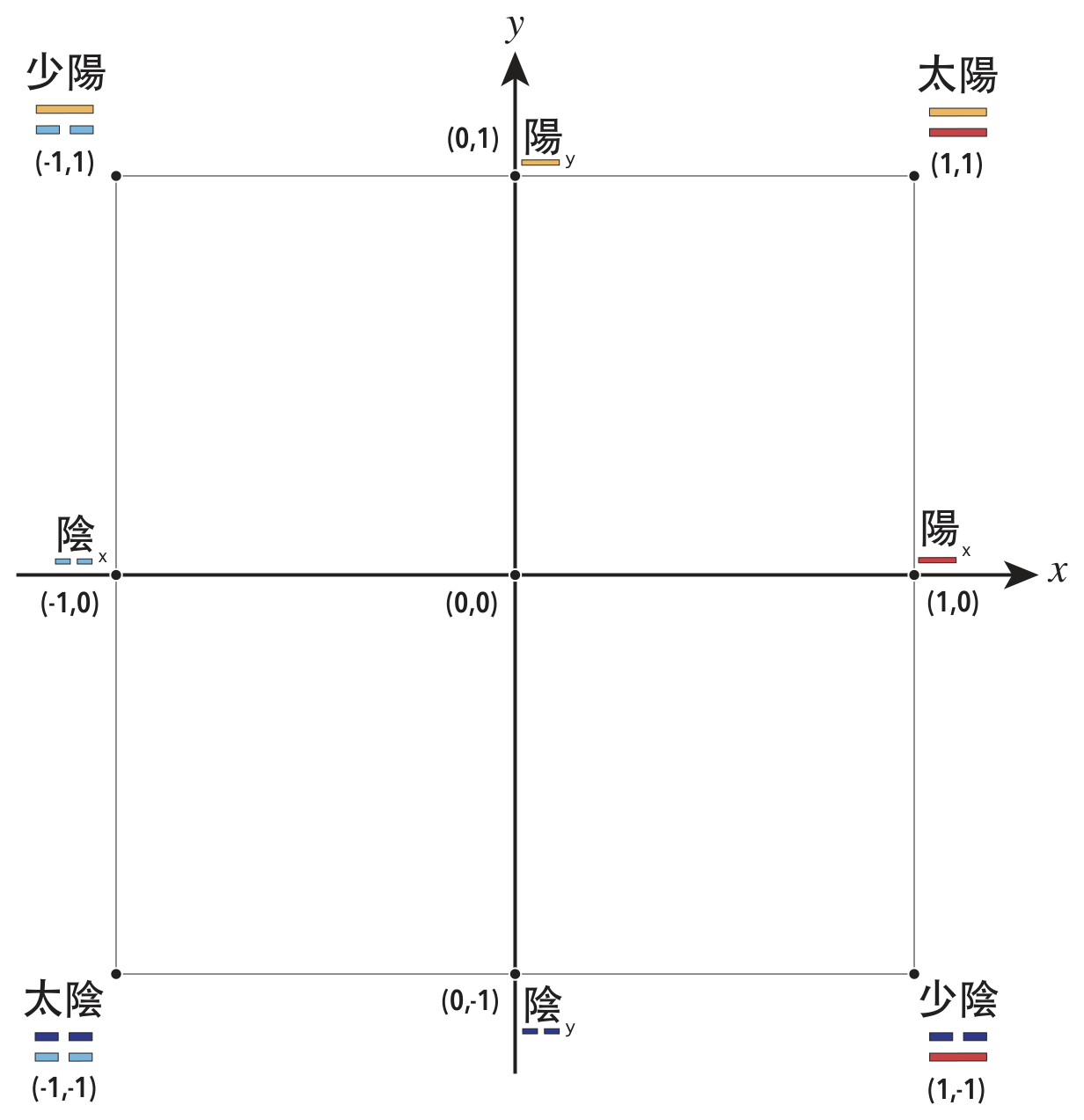
I use the original Human Compass source palette across the three encoders. Light blue identifies \(x^0\), red \(x^1\), dark blue \(y^0\), and gold \(y^1\). A bigram’s hue blends its constituents. Letters and line positions provide a second way to identify the contributions. Colours assigned to the Five Phases in the pentagonal drawings belong to a separate key. The comparative register in Figure 3 (p. 9) gives all twenty-four compositions in the common palette.
2.3 Situating and operative sources
What makes two source polarities belong together? We can certainly combine two binary sources in four ways; the question is what makes that combination meaningful. I propose a further organising principle: one source distinguishes the relation in which something occurs, while the other distinguishes its manner of occurring. I call these the situating and operative roles. Through these roles, we can articulate two respects of one phenomenon and consider why a particular source pair belongs together before examining the trigrams it generates.
A situating source may distinguish a medium: that through which an expression becomes possible and takes form. It may instead distinguish an orientation: the relation from which, towards which, or relative to which an activity proceeds. Medium asks through what or within what; orientation asks from where or towards what. Their common concern is the relational context of activity. The operative source distinguishes how the activity proceeds within that context. “Activity” is used broadly enough to include receptive, sustaining, and experiential modes alongside overt action.
The elemental model supplies a particular historical foothold. In On Generation and Corruption II.2, Aristotle distinguishes hot and cold as powers of acting, and dry and moist through susceptibility. His account of moisture and dryness concerns adaptability to shape and the retention of boundaries.[12] Here we can discern a distinction between transformative activity and the conditions through which it takes form. I use medium and activity to articulate that distinction comparatively; we cannot assume that Aristotle thereby establishes the same roles in every application considered here.
A medium participates in what occurs: it can receive, carry, constrain, and transform an expression. An orientation likewise makes a difference to what an activity means. Neither is simply an inert setting for an independently existing force. Conversely, being operative does not mean being exclusively yang. Each source remains bipolar, and each pole can contribute to the phenomenon being described. Their mutual implication gives the cosmological commitment a more definite constructive expression: differentiation can concern both a relation and the activity realised through it.
These roles are semantic, not permanent names for \(x\) and \(y\). In the elemental reading, temperature on \(x\) supplies the operative distinction; in psychology, Soma–Psyche on \(x\) supplies the experiential register. The mathematical equivalence of the sources permits these different assignments without making their meanings interchangeable within a fixed model. No change of stacking, sign, colour, or return rule follows merely from identifying the roles.
For this proposal to earn its place, it must help us discern what each source contributes. Holding one source fixed while varying the other should disclose an intelligible difference: a changed relation with the manner of activity retained, or a changed manner with the relation retained. This is an interpretive comparison, not a requirement that the factors be empirically independent. Table 6 and the applications develop these comparisons. If we can call either source situating or operative without changing what the account explains, we have gained little from the distinction. I offer it, therefore, as a rationale to investigate across the models, rather than a theorem about every possible pair of binary variables.
2.4 Two, relation, and the third role
To recognise two poles as a duality is already to recognise their relation: each becomes intelligible through its distinction from, and complementarity with, the other. We can attend to the two terms and their relation without positing three independent substances. This is the philosophical intuition I call a binary–trinity.
We nevertheless need to distinguish three uses of “two”. The poles of one polarity are complementary alternatives. Two bipolar sources, such as temperature and moisture, are distinguishable respects, not opposite poles of one scale. Two selected contributions, such as cold and moist, establish a base by conjunction. Recognising hot and cold does not, by itself, give us a moisture axis; to introduce that axis, we must make a further semantic choice.
The base is therefore already relational. A further choice can qualify the existing conjunction. In genesis it occupies the upper line. Constituent selection records it across the glyph, and double qualification gives it the middle position. It is this further articulation that I have in mind in the analogy with conjugation. Moist Aer and drying Aer share a hot–moist basis, but express different ways in which it is qualified. Like a verb specifying how terms bear upon one another, the third contribution makes that expression determinate. The sources need not literally be a grammatical subject and object, and qualification need not signify an event in time.
The Laozi, chapter 42, places the generation of Three from Two beside the ten thousand things bearing yin, embracing yang, and finding harmony through qi (氣). We can find here a resonance for relational generation, without treating the passage as an ancient specification of the third yao of this construction.[2]
The mathematical step is explicit: two binary choices give four bases, and a further binary choice gives two qualifications of each. An encoder specifies how the further choice qualifies the base and how to recover that choice from the three lines. Thus the model uses three bits of information while drawing its qualitative material from two sources. Relationality gives us a reason to explore this construction, but cannot by itself deduce the added bit or the rule governing it. Either situating or operative content may enter into qualification. Its position in the written figure depends on the encoder.
Parts II and III follow the construction from rules to meanings. The elemental reading of genesis and the constituent-selection reading of Human Compass are the two reference cases. Each of the five vocabularies can be read through all three encoders. Part IV places fixed meanings in three orders. Part V follows the comparison in the other direction, beginning with one named trigram and asking which distinctions survive a change of vocabulary or construction.
Part II · Three encoders
3 One glyph, three ways of reading its lines
A broken or an unbroken line tells us one bit. To interpret it as a contribution from a source, we need to know which question that line answers. Each encoder below distinguishes eight states within four bases. They differ in what constitutes a base and in what distinguishes its two members. Throughout, a string such as \(010\) gives the bottom, middle, and top bits in that order.
| Choice | Genesis \(\mathcal G\) | Constituent selection \(\mathcal H\) | Double qualification \(\mathcal L\) |
|---|---|---|---|
| Base | Bottom and middle | Two sourced constituents | Bottom and top |
| What varies | Pole of the assigned returning source | Which present constituent is repeated | Middle contribution within the outer frame |
| Glyph | The qualifier supplies the top bit | A mask recovers the selection. The base bits agree in two of four cases | The middle bit and outer frame determine the middle source |
| Treatment | Section 4 | Section 5 | Section 6 |
Consider Kan (坎), the elemental state called Aqua. Its glyph has a solid middle line between two broken outer lines. In genesis the two lower lines supply cold and moist, and cold returns above them. In constituent selection, Containment is emphasised within a base it shares with Animation. In double qualification, the two outside lines establish steady Substance. Activation in the middle qualifies what that substance can hold. Water carrying something into solution gives the last two readings a point of contact. Containment allows a concentration to disperse through a medium, while a medium has to persist for movement within it to be possible. Figure 2 shows exactly where the sources differ.
| Genesis \(\mathcal G\) | Constituent selection \(\mathcal H\) | Double qualification \(\mathcal L\) |

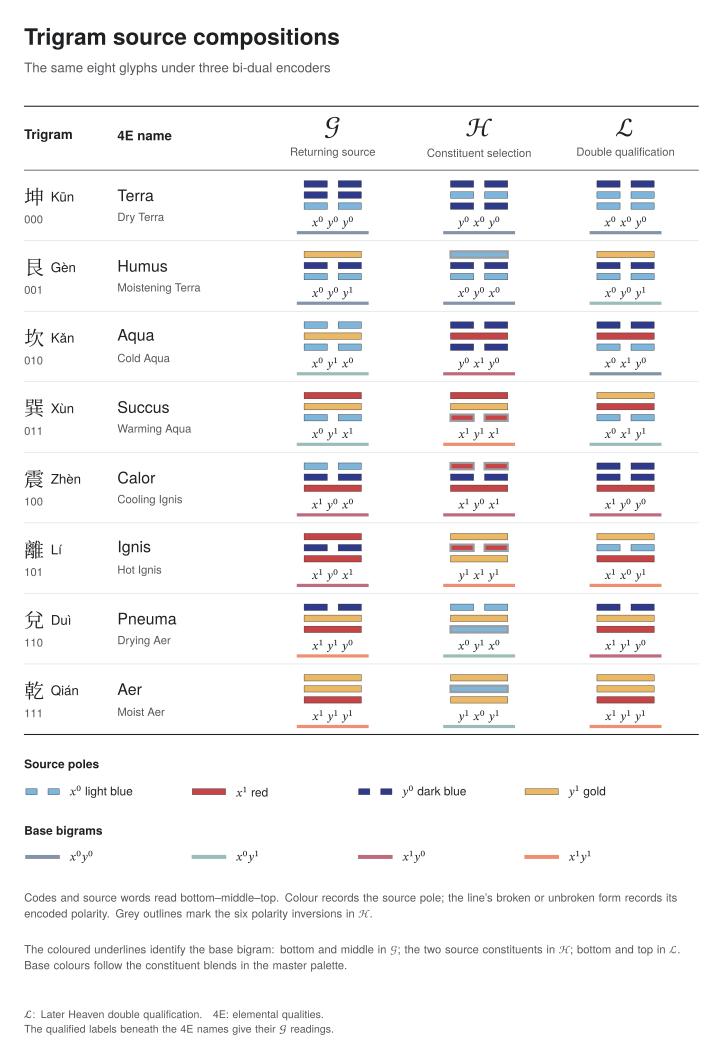
Figure 3 (p. 9) gives the same comparison for every glyph. A grey mark in the constituent-selection column flags a difference between a source pole’s polarity and the line displayed. The colour continues to identify the pole that actually participates. The sections that follow specify how to reconstruct each column.
4 Genesis: qualification by a returning source
The four bases now have stable compositions regardless of the direction in which they are visited. I give the third contribution a further role: to qualify a retained basis. The elemental meanings suggest which source should return, while either of its poles remains available. This lets us distinguish moist Aer from drying Aer, hot Ignis from cooling Ignis, dry Terra from moistening Terra, and cold Aqua from warming Aqua.
Write a trigram as \(b=(b_1,b_2,b_3)\in\mathbb B^3\), always in bottom–middle–top order. The first two positions retain the base \(({p_x},{p_y})=(b_1,b_2)\). The genesis qualifier bit \(q=b_3\) selects the polarity of the third contribution. It is distinct from the source-indexed base bits \(p_x,p_y\) and from the relational status \(\varepsilon\) defined below. A third binary position need not introduce a third semantic source: it can return to one already present. I use triadic for these three compositional roles.
4.1 The returning-source rule
First we choose the returning source; then we choose one of its poles. For Terra, characteristic dryness selects the moisture source, which can supply dry or moist while the cold–dry base remains. Table 7 collects this semantically motivated selection: \(x\) at mixed-polarity bases and \(y\) at same-polarity bases. The rule below records that source choice while leaving the qualifier’s pole available: \[\mathcal G({p_x},{p_y},q)= \begin{cases} (x^{p_x},y^{p_y},x^q),&{p_x}\ne {p_y},\\ (x^{p_x},y^{p_y},y^q),&{p_x}={p_y}. \end{cases}\] Each selected source supplies either of its poles. Thus every base has two continuations and there are eight source compositions. Forgetting the source letters recovers the binary trigram, so the map is injective. For a bit triple \(b=({p_x},{p_y},q)\), \(\mathcal G(b)\) abbreviates \(\mathcal G({p_x},{p_y},q)\). A sourced word retains each contributions axis and pole; a binary glyph retains only three displayed bits. A semantic valuation gives the sourced word qualitative meanings, and an arrangement assigns its glyph a diagram position. When we say that a transformation preserves a trigram, we therefore need to distinguish these four objects. The rule itself remains an explicit premise, chosen for its semantic motivation. Allowing either source to return at every base gives sixteen source-labelled words. Section 9.9.1 examines their organisation into two directional constructions.
We can now ask whether the qualifier agrees with the pole already present. That pole always has value \({p_x}\): directly if the returning source is \(x\), and because \({p_x}={p_y}\) if it is \(y\). Let \(\oplus\) denote exclusive OR (XOR), or addition modulo two: it returns zero for agreement and one for difference. Then \[\varepsilon={p_x}\oplus q\] records the qualifier relation. The qualifier reinforces the existing pole when \(\varepsilon=0\) and counterbalances it when \(\varepsilon=1\). These terms mean agreement and opposition of contributions, without judging either to be more desirable. Tables abbreviate these relations as \(\mathrm{rnf}\) and \(\mathrm{ctr}\). Let \(\Phi^{\mathcal G}\) denote the retained bit encoder, also written \(\Phi^{\mathcal G}_{0,0}\) when stacking and return-rule choices are explicit. We can encode the same state as \[\Phi^{\mathcal G}({p_x},{p_y},\varepsilon)=({p_x},{p_y},{p_x}\oplus\varepsilon).\] Here \(\mathcal G\) maps a displayed bit triple to a sourced word; \(\Phi^{\mathcal G}\) maps source bits and a qualification status to a displayed bit triple. The inverse reads \({p_x}=b_1\), \({p_y}=b_2\), and \(\varepsilon=b_1\oplus b_3\).
| Code | Trigram | Source composition | Returning source | Relation |
|---|---|---|---|---|
| \(000\) | Kun 坤 | \(x^0y^0y^0\) | \(y\) | \(\mathrm{rnf}\) |
| \(001\) | Gen 艮 | \(x^0y^0y^1\) | \(y\) | \(\mathrm{ctr}\) |
| \(010\) | Kan 坎 | \(x^0y^1x^0\) | \(x\) | \(\mathrm{rnf}\) |
| \(011\) | Xun 巽 | \(x^0y^1x^1\) | \(x\) | \(\mathrm{ctr}\) |
| \(100\) | Zhen 震 | \(x^1y^0x^0\) | \(x\) | \(\mathrm{ctr}\) |
| \(101\) | Li 離 | \(x^1y^0x^1\) | \(x\) | \(\mathrm{rnf}\) |
| \(110\) | Dui 兌 | \(x^1y^1y^0\) | \(y\) | \(\mathrm{ctr}\) |
| \(111\) | Qian 乾 | \(x^1y^1y^1\) | \(y\) | \(\mathrm{rnf}\) |
The qualifier relation coincides exactly with reversal symmetry: \(\varepsilon=0\) if and only if \(b_1=b_3\), which is the condition for reversing the three positions to leave the trigram unchanged. Each literal upper-source pole occurs twice, once in each reversal class: \(x^0\) in Kan/Zhen, \(x^1\) in Li/Xun, \(y^0\) in Kun/Dui, and \(y^1\) in Qian/Gen. By retaining provenance, we can therefore discern a balanced fourfold distinction across the two symmetry classes.
The received family names give another concise reading of this register. Parents (Qian, Kun) have reinforcing \(y\) qualifiers; youngest children (Gen, Dui) have counterbalancing \(y\) qualifiers. Middle children (Kan, Li) have reinforcing \(x\) qualifiers; eldest children (Zhen, Xun) have counterbalancing \(x\) qualifiers. The family names come from the Shuogua; the source classification is a consequence of the present rule.[3]
4.2 Source contributions and binary configurations
We can now look at the construction in two complementary ways, each making a different aspect of its information visible. In the plane, we combine the contributions of the two sources; in the cube, we retain the three binary line positions independently. Having three spatial coordinates need not, therefore, mean that we have introduced a third semantic source.
4.2.1 Combined contributions in two dimensions
Represent \(x^0,x^1\) by \((-1,0),(1,0)\) and \(y^0,y^1\) by \((0,-1),(0,1)\). For a trigram put \(s_i=2b_i-1\) and \(r_0=b_1\oplus b_2\), the original returning-source indicator: \(1\) selects \(x\) and \(0\) selects \(y\). Adding the three contributions in \(\mathcal G\) gives \[\mathbf v(b)=\bigl(s_1+{r_0} s_3,\ s_2+(1-{r_0})s_3\bigr).\] The unit contributions have equal weight by convention. A repeated agreeing pole doubles its source coordinate; an opposed pole cancels it. The other source coordinate remains \(\pm1\).
Proposition 1 (Planar separation and opposition). The eight images of \(\mathbf v\) are distinct. Reinforced states form a square of radius \(\sqrt5\); counterbalanced states form a square of radius \(1\). Complementation acts as central inversion. Their interleaved angular order is XT.
Proof. In binary numerical order \(000\) to \(111\), the coordinates are \[(-1,-2),\ (-1,0),\ (-2,1),\ (0,1),\ (0,-1),\ (2,-1),\ (1,0),\ (1,2).\] The four reinforced points are successive quarter-turns of \((-1,-2)\); the remaining points lie on the unit axes. Complementing all bits preserves \({r_0}\) and negates all \(s_i\), hence negates \(\mathbf v\). Reading the points clockwise from Kun gives Kun–Gen–Kan–Xun–Qian–Dui–Li–Zhen. ◻
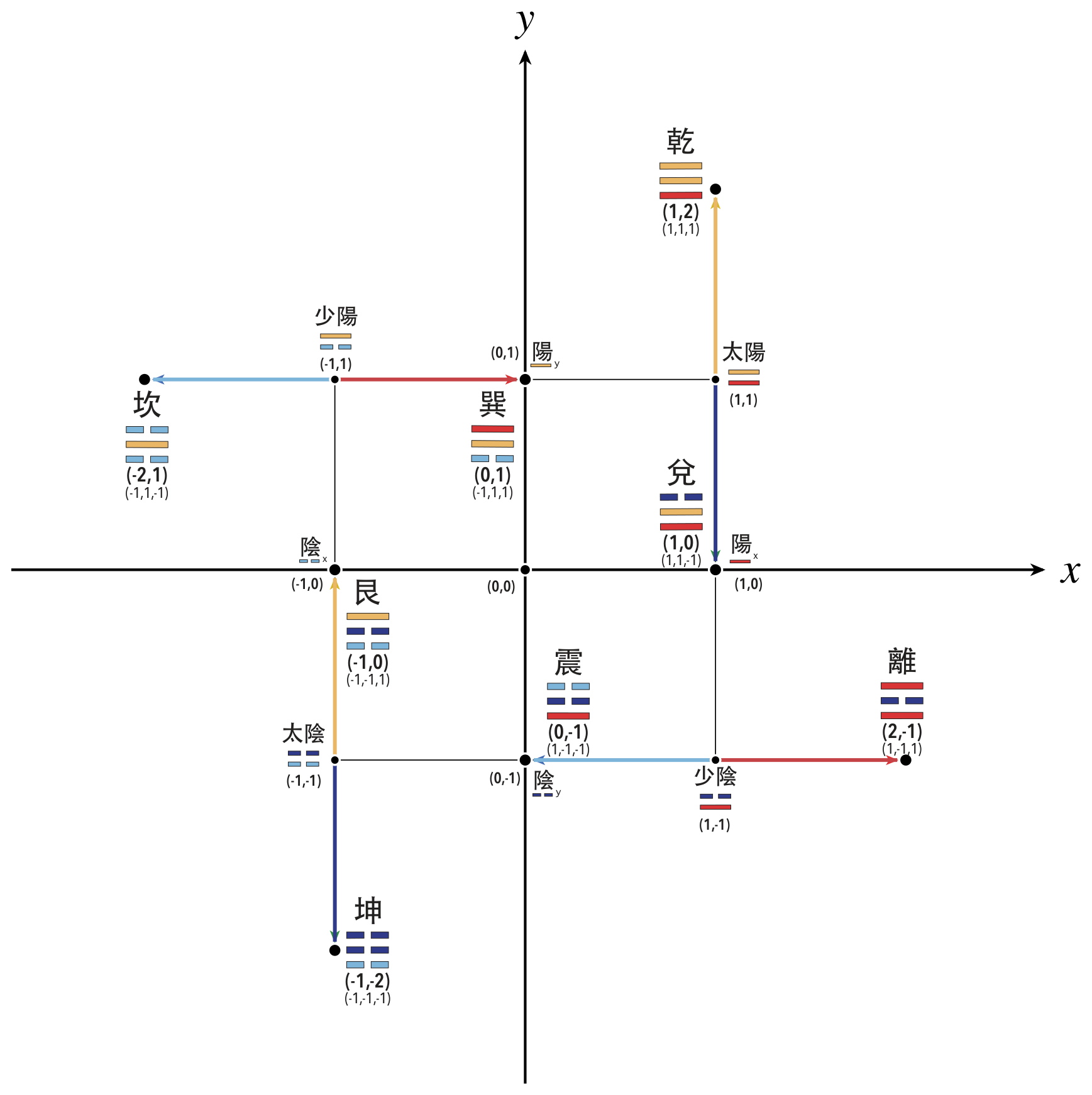
The point set has rotational symmetry but no planar reflection symmetry; Appendix B verifies this handedness property.
The map is not a linear projection of line-position coordinates: the destination axis of \(s_3\) depends on \(b_1\oplus b_2\). Likewise, when contributions cancel in this representation, we have no grounds for concluding that opposite qualities annihilate in a physical substance. Even where one sum is zero, we can still recover the provenance and the full source word.
4.2.2 The binary state cube
The glyph space is common to all three encoders. The source colours in this particular drawing follow genesis. The map \(b\mapsto(s_1,s_2,s_3)\) gives the vertices of a cube. An edge joins configurations differing in one line; a face diagonal changes two lines; a body diagonal changes three. Thus the cube represents configuration and change independently of the two-source sum. A cyclic ordering of its vertices need not follow cube edges.
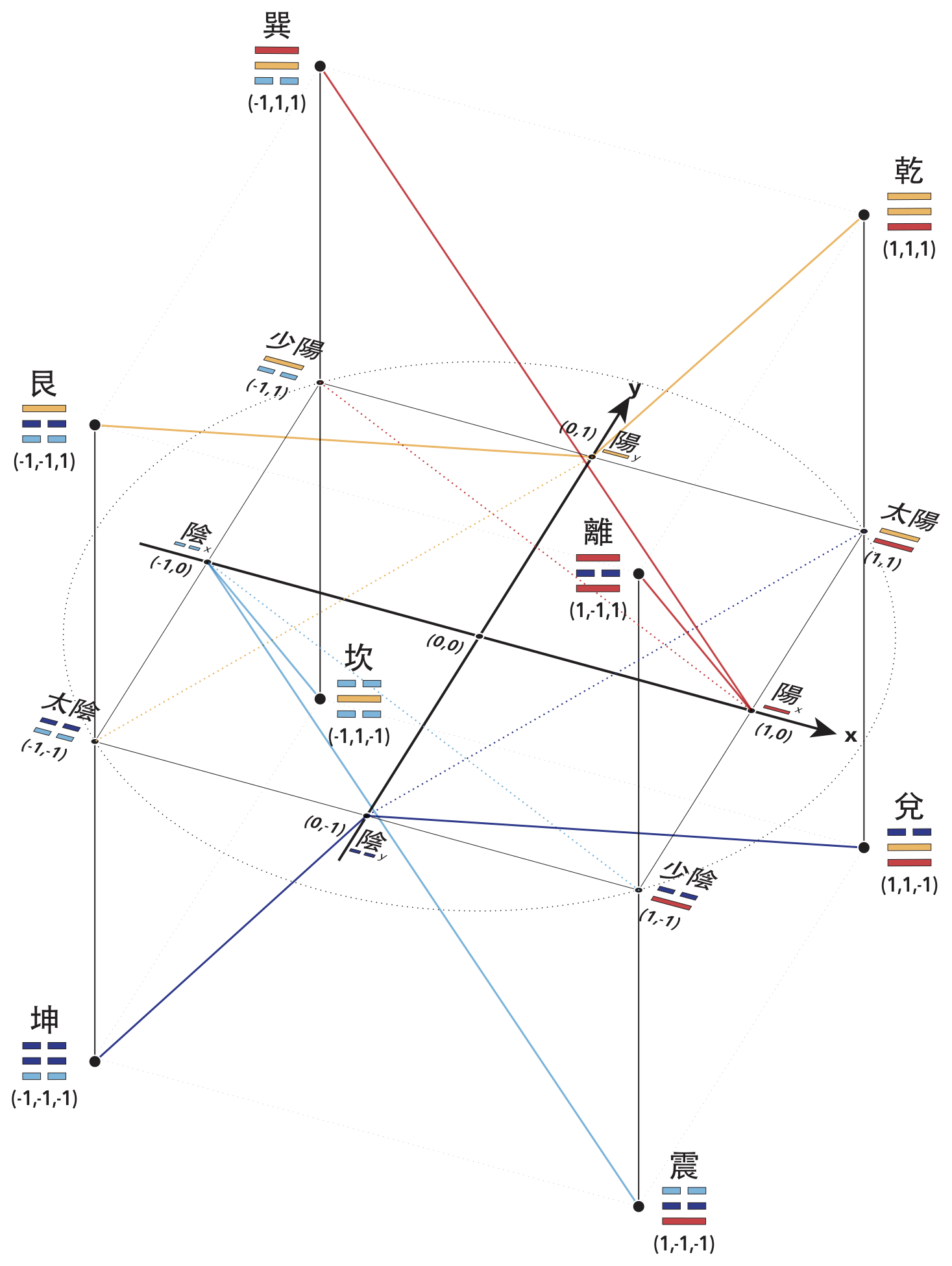
Complementation \(C_{\rm bit}(b)=b\oplus111\) exchanges opposite cube vertices. Line reversal \(R_{\rm line}(b_1,b_2,b_3)=(b_3,b_2,b_1)\) interchanges the outer positions. Both operations concern the configurations themselves. When we reverse a traversal, we instead change the order in which we visit them; that is a separate operation.
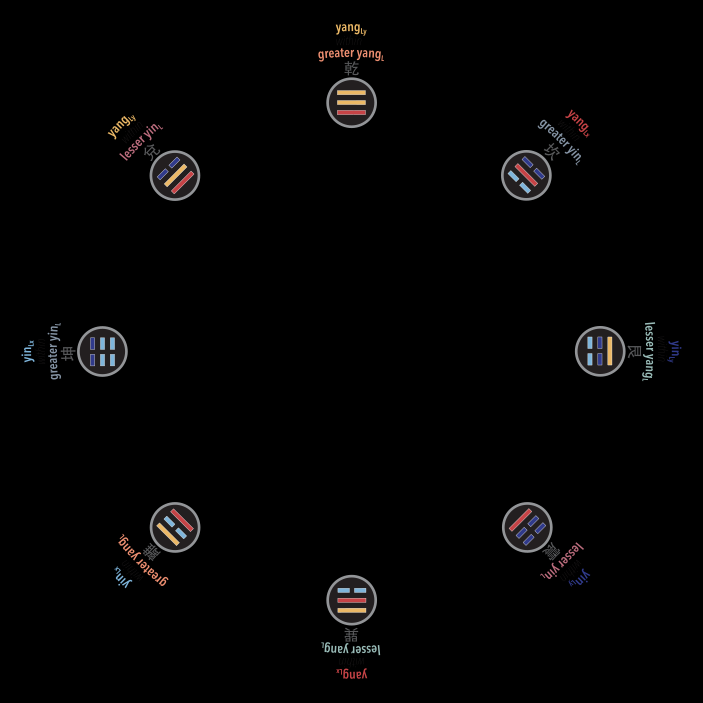
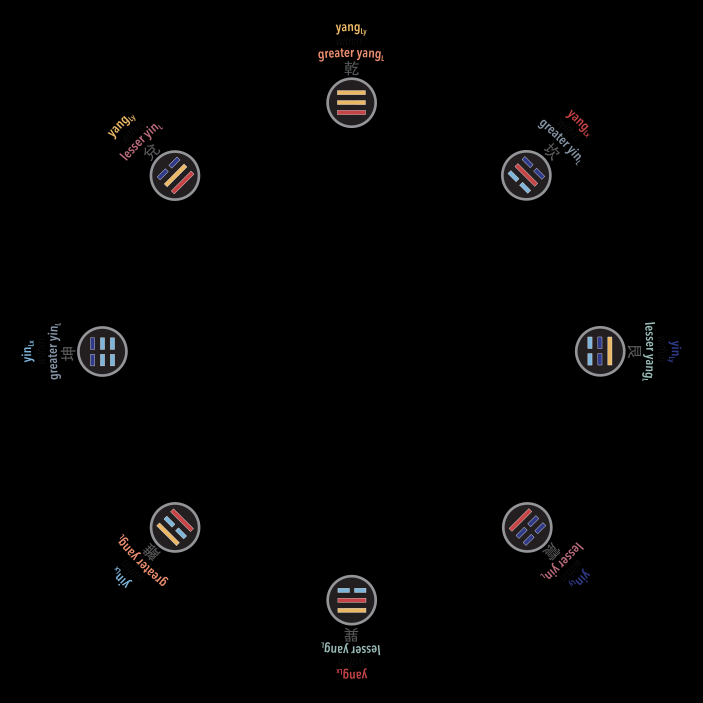
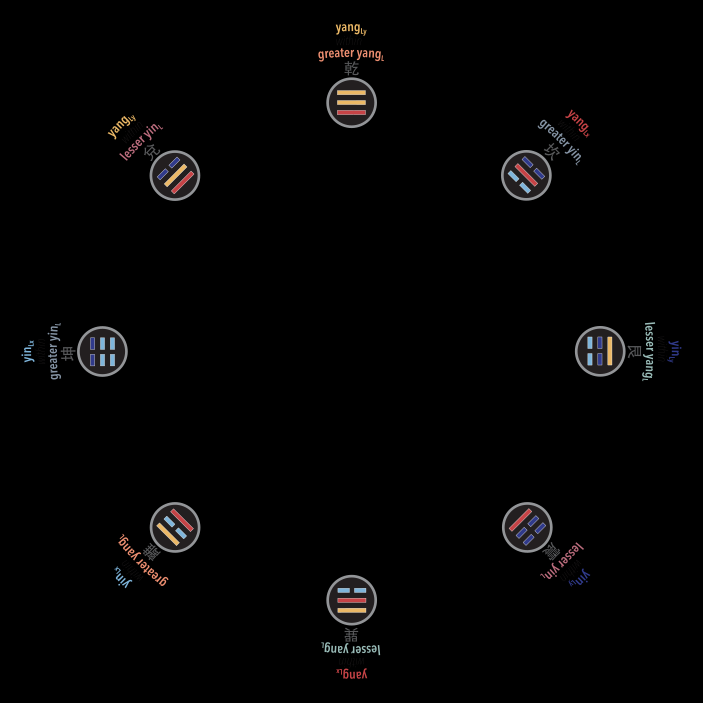
The generic overview in Figure 7 brings the source poles, bigram bases, and qualified trigrams back into one schematic arrangement. It follows the three construction views rather than replacing their coordinates. Its outer cyclic adjacency is XT; the square is a display convention, not the sum geometry of Figure 5.
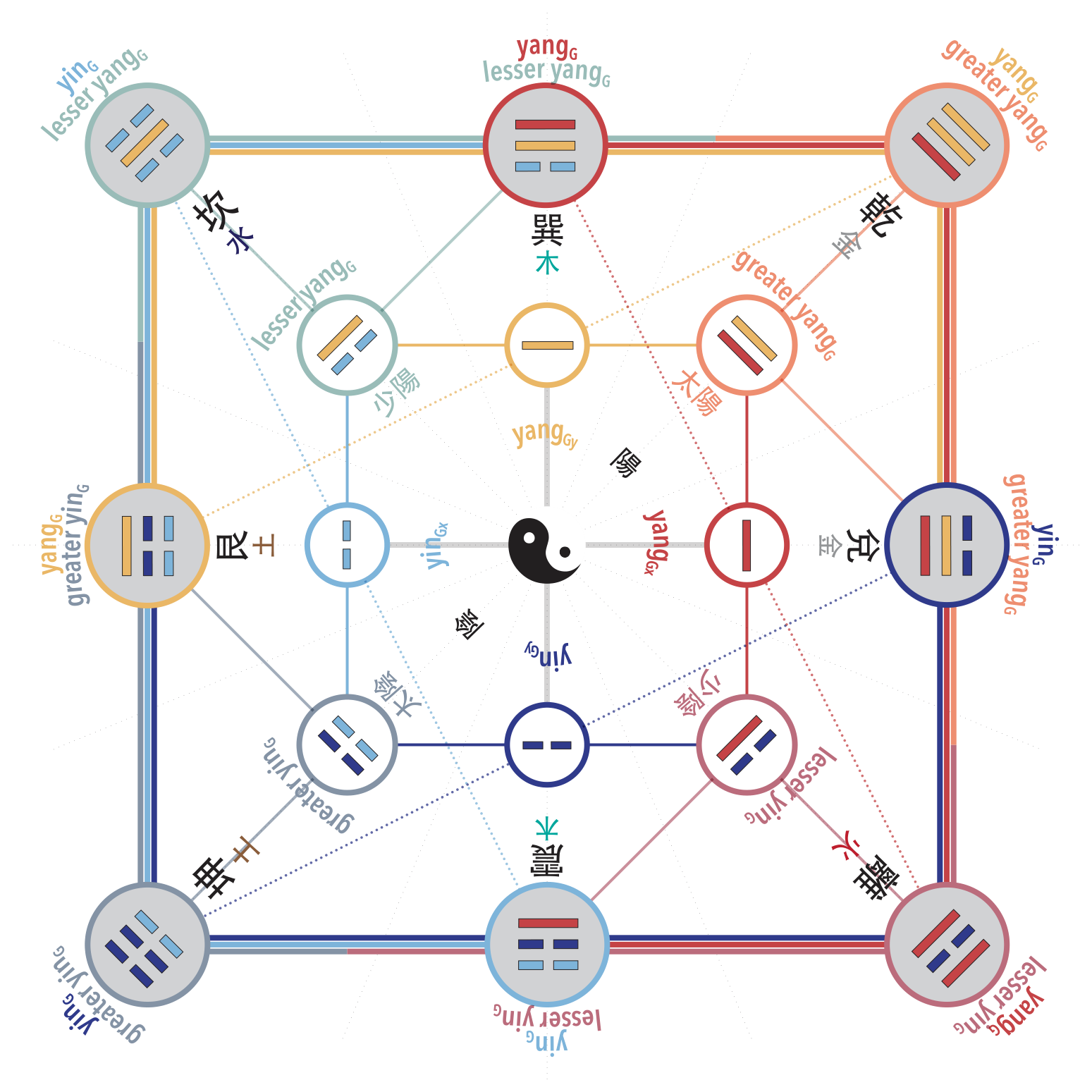
The distinction between these presentations helps us see why two semantic sources and three binary coordinates can coexist: the plane records combined contributions, while the cube retains the three line positions. Appendix B.4 gives a further representation of reversal and complementation by a Klein tetrahedron. That supplementary geometry is not required for the semantic construction or the comparison of orders.
5 Constituent selection: qualification by emphasis
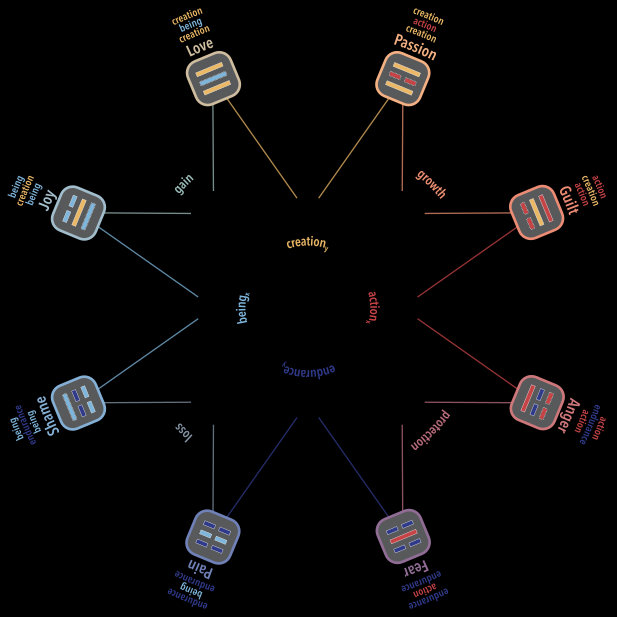
The Human Compass began with an established semantic framework, just as the elemental construction was guided by meanings before its rule was abstracted. The original chart organises eight emotional experiences through Participation, expressed as Creation and Endurance, and Animation, expressed as Action and Being. Its vocabulary and colour associations precede the present trigram comparison. The book manuscript The Human Compass, currently in preparation, develops the model’s account of emotions, values, and self-understanding; Chapter 3 and the optional systematic coda provide its fuller conceptual context.[29] The supplied 2020 chart remains the reference for the original circular arrangement and native colours.[30] The emotional correspondences with named trigrams were first guided by intuitive resonance; the encoder was subsequently developed to accommodate those assignments. In reconstructing the encoding below, I want to keep that order of discovery explicit and offer an intuitive way to understand what the encoding does: repeat the emphasised constituent, place it around the secondary constituent, and distinguish the resulting forms by a Participation-dependent pattern of line inversions.
5.1 Two sources and a source-selection qualifier
For \(\mathcal H\), let \(P\) name the Participation source and \(A\) the Animation source. These source labels are distinct from the received phase map \(\operatorname{ph}\). Write their poles as \[P^0=\text{Endurance},\quad P^1=\text{Creation},\qquad A^0=\text{Being},\quad A^1=\text{Action}.\] In abbreviated source words, \(\mathtt C\) and \(\mathtt E\) mean Creation and Endurance, while \(\mathtt A\) and \(\mathtt B\) mean Action and Being. These typewriter letters form a semantic alphabet, distinct from mathematical source or operator names. Using \(P,A\) for the sources keeps the models own names visible. Participation is consistently vertical (\(y\)), and Animation horizontal (\(x\)), in these diagrams. Endurance is dark blue, Creation gold, Being light blue, and Action red in the common palette. The cross-model overlay retains these same four source colours as it connects corresponding glyphs. A grey stroke marks an encoded line whose displayed polarity differs from that of its coloured source pole.
In the proposed source-role comparison, Participation supplies an orientation and Animation a mode of activity. Endurance concerns meeting encountered conditions; Creation concerns expression of an inward concern. Being and Action distinguish experiencing existence from movement, change, or correction. Holding Creation fixed, Being–Action distinguishes the Gain and Growth bases; holding Action fixed, Endurance–Creation distinguishes Protection and Growth. “Activity” here includes being affected and experiencing, so it must not be read as another name for the Action pole alone. Through these roles I interpret the native distinctions; neither the choice of a glyph nor the selection of a dominant contribution follows inevitably from them.
The native chart names the four bases Gain (Creation–Being), Growth (Creation–Action), Protection (Endurance–Action), and Loss (Endurance–Being). The eight experiences distinguish two emphases within each of these conditions. This gives us a semantic reason to retain the model’s own base structure as we compare it with trigram genesis.
Let \({p_P},{p_A}\in\{0,1\}\) select the Participation and Animation poles, respectively. The third choice \({\chi}\in\{0,1\}\) selects which present pole to repeat: Participation when \({\chi}=0\), Animation when \({\chi}=1\). The resulting source word is \[\mathcal W_{\mathcal H}({p_P},{p_A},{\chi})= \begin{cases} (P^{p_P},A^{p_A},P^{p_P}),&{\chi}=0,\\ (P^{p_P},A^{p_A},A^{p_A}),&{\chi}=1. \end{cases}\] Every word reinforces one of its base poles. Thus the third binary choice selects a source, whereas in trigram genesis it selects the agreeing or opposed pole of a source already determined by the base. In both cases we obtain eight states from four poles; what differs is where the freedom of choice lies.
5.2 Coloured repetition and four symmetric seeds
The source word \(\mathcal W_{\mathcal H}\) records the base first and the selected constituent last. To make its emphasis more immediately intelligible, we can draw it another way: put the repeated pole on the two outer lines, with the secondary pole between them. Creation–Being with Creation emphasised becomes Creation–Being–Creation; with Being emphasised it becomes Being–Creation–Being. Both retain the same base, but the source that frames the other changes. Call this the sandwich arrangement. We have reordered the contributions for display, while retaining both their meanings and the choice of which one is repeated.
With source colours or letters retained, the eight arrangements are distinct. Once provenance is erased, however, matching outer lines leave only four possible glyphs: \(000\) (Kun), \(010\) (Kan), \(101\) (Li), and \(111\) (Qian). Each is a two-to-one seed: two distinct sourced arrangements have collapsed into the same uncoloured pattern. For example, Endurance–Action–Endurance (Fear) and Being–Creation–Being (Joy) both give \(010\). The bits coincide, but the source constituents differ—even at mixed-polarity bases.
This four-image result must be distinguished from the six images obtained by literally transcribing the fixed order \(P,A,\text{selected source}\) in \(\mathcal W_{\mathcal H}\). In that order only the two equal-polarity bases collapse. Appendix D.1 gives both projections and the complete seed register. What accounts for the difference is the arrangement we transcribe; the eight semantic states remain the same.
We can now see more directly how this differs from genesis. Genesis chooses between the two poles of a base-assigned source; \(\mathcal H\) chooses between the two constituents already present. At an Endurance–Being base, selecting Endurance still differs from selecting Being even though both have bit \(0\). Simply copying the pole bits into an ordinary yin–yang glyph would leave that distinction invisible. If all eight distinctions are to be expressed through the eight unmarked trigrams, source relationships must become legible in the pattern of lines.
5.3 Four Participation classes and their differentiation masks
To recover those distinctions in the sandwich construction, we use four simple instructions. Each depends on Participation’s pole and whether it is repeated; the same instruction applies across Being and Action. Write EE for repeated Endurance, E for single Endurance, C for single Creation, and CC for repeated Creation. These are Participation classes, not full source words: a single E or C means that Animation is repeated, rather than that Animation is missing.
| Class | \(({p_P},{\chi})\) | Class code | Invert | Mask | Height |
|---|---|---|---|---|---|
EE |
\((0,0)\) | \(00\) | No line | \(000\) | \(-2\) |
E |
\((0,1)\) | \(01\) | Top line \(b_3\) | \(001\) | \(-1\) |
C |
\((1,1)\) | \(10\) | Bottom line \(b_1\) | \(100\) | \(+1\) |
CC |
\((1,0)\) | \(11\) | Middle line \(b_2\) | \(010\) | \(+2\) |
The class code is a two-bit description of Participation’s relational role. Write the class code \((p_P,\kappa)\), where \(\kappa=p_P\oplus\chi\). Its first bit is the pole \(p_P\); its second agrees with \({p_P}\) when Participation is repeated and differs when Animation is repeated. Thus EE, E, C, CC become \(00,01,10,11\). The second bit is a marker of emphasis, not an additional semantic pole: \(01\) does not introduce Creation into an Endurance composition. We can draw these four codes as a quartet of bigrams, so long as we distinguish their relational use from that of the source bigrams establishing the bases.
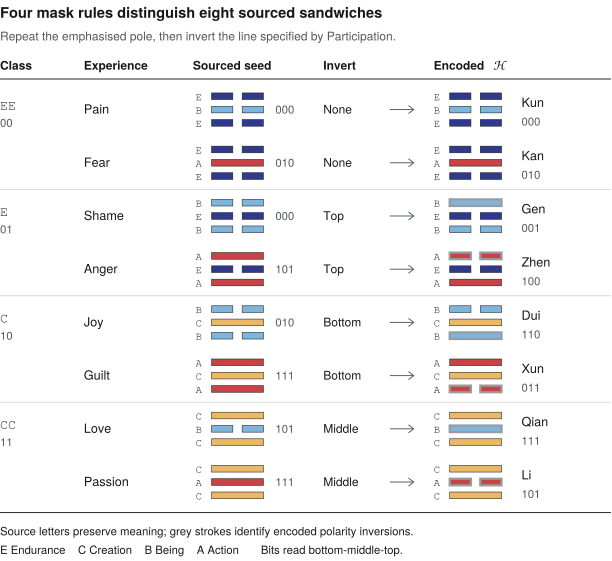
E = Endurance, C = Creation, B = Being, A = Action. The comparison palette is \(P=y\), \(A=x\). A grey stroke marks an inverted line while its fill retains the source colour. The bit strings read bottom–middle–top. Every semantic word still repeats a present constituent. Inverting a line for the encoding does not introduce the opposed semantic pole.We can follow the process through Love. Creation–Being–Creation has raw polarity \(101\). Its class is CC, so its middle line is inverted, yielding Qian \(111\). The blue middle contribution still means Being; its encoded yang line does not turn it into Action. Joy has the same base but sandwiches Creation between two Being contributions, giving \(010\). Its class is C, so inversion of the bottom line yields Dui \(110\). We can now distinguish the two experiences and still recover their common base. Figure 9 applies the same procedure to every state.
The four classes also explain the four vertical levels in the signed-contribution view. Counting each Endurance contribution as \(-1\) and each Creation contribution as \(+1\) gives EE at \(-2\), E at \(-1\), C at \(+1\), and CC at \(+2\). Their horizontal position distinguishes Being and Action. The coordinates let us see emphasis through the number of contributions. Writing Participation twice does not mean that we have measured twice as much feeling.
5.4 The glyph as a relational record
Denote the resulting Human Compass encoder by \(\Phi_{\mathcal H}\). \(\mathcal H\) names the original Participation-reference construction throughout the paper. Its Animation-reference alternative is written \(\widehat{\mathcal H}\), with encoder \(\Phi_{\widehat{\mathcal H}}\); Appendix D.6 records that alternative without changing the semantic assignments used in the main comparison. We can now understand the rule before turning to its coding equations: arrange the repeated pole around the secondary pole, identify the Participation class, and apply its mask. The piecewise formula and its equivalence to this construction are given in Appendix D.1. A compact inverse states what the resulting glyph records.
Proposition 2 (Human Compass bijection). Let \(\operatorname{maj}\) denote the majority value of three bits. The sandwich-and-mask construction is bijective, with inverse \[{p_P}=\operatorname{maj}(b_1,b_2,b_3),\qquad {p_A}=b_1\oplus b_2,\qquad {\chi}=b_1\oplus b_3.\]
To parallel the genesis sourced-word map, define \(\mathcal H(b)=\mathcal W_{\mathcal H}(\Phi_{\mathcal H}^{-1}(b))\). This is the fixed-order record (Participation, Animation, selected constituent). Figure 3 arranges those same constituents as the sandwich before masking, with the repeated one outside. The two conventions preserve the same multiset and emphasis. The map \(\mathcal H\) here returns the fixed-order word, while \(\Phi_{\mathcal H}\) encodes the semantic choices as displayed bits. The selector \(\chi\) records which constituent is emphasised; it is not a qualifier-polarity bit \(q\).
Participation is recorded by the glyph’s majority polarity. Animation is recorded by agreement or difference between its lower two lines. Agreement of the outer lines records Participation emphasis; their difference records Animation emphasis. Through these three features, we recover all three choices, including the source distinctions lost in the raw seeds. Once we adopt these recording conventions, they also specify the displayed pattern uniquely.
Participation thus provides a reference throughout the encoding, even when Animation is the repeated constituent. This gives a precise sense to the proposal that situational orientation precedes operational mode: Endurance or Creation supplies the frame within which Being or Action is differentiated. The priority I am proposing is interpretive and representational. We cannot infer a temporal sequence or an ontological hierarchy from the bits. Foregrounding Participation as the reference must also be distinguished from emphasising it through repetition. Both sources remain necessary to the meaning.
These conventions reconstruct the resonance-guided trigram assignments; they are not forced by the emotional vocabulary alone. Their value lies in allowing us to accommodate all eight assignments through a compact, intelligible rule whose relationships we can examine. Source colours preserve the semantic constituents while grey strokes reveal the work required of an uncoloured glyph. The displayed polarity of an individual line need not reproduce the polarity of its coloured contribution.
6 Double qualification: a middle contribution within an outer frame
Which two lines shall we read together first? In double qualification, \(\mathcal L\), the bottom and top establish a frame. Two glyphs with those same outer lines can still differ in the middle. Keeping this frame in view gives a third way of organising a bi-dual distinction. Its source words can be read before we specify any successor. The separate constraints through which they recover the Later Heaven circuit are given in Section 15.2.
6.1 Reading the outside before the middle
Write \((b,m,t)\) for a glyph’s bottom, middle and top bits. Start with \(x^b\) at the bottom. The top, \(y^t\), first qualifies that pole. The middle then qualifies the relation established between them. Thus the written source word is ordered bottom–middle–top, and the interpretation proceeds bottom–top–middle. The middle takes polarity \(m\) from an axis chosen by the rule. With axis index 0 for \(x\) and 1 for \(y\), that index is \(b\oplus t\) when \(m=0\), and \(b\) when \(m=1\). This definition makes the source of every line recoverable from the glyph. Calligraphic \(\mathcal L\) designates the complete rule. The plain \(L_{\mathcal H}\) used in the Human Compass appendix designates its literal projection.
With \(e_0=x\) and \(e_1=y\), the sourced composition is \[\mathcal L(b,m,t)=\bigl(x^b,e_{\iota(b,m,t)}^{\,m},y^t\bigr),\qquad \iota(b,m,t)= \begin{cases} b\oplus t,&m=0,\\ b,&m=1. \end{cases}\] Dropping the source letters returns \((b,m,t)\), so the eight outputs are distinct. Holding \((b,t)\) fixed leaves exactly two middle contributions, listed below in middle-bit order. This is the formal sense in which all four frames are complete.
| Outer bits | Elemental frame | Middle \(0\) | Middle \(1\) |
|---|---|---|---|
| \(00\) | Holding | Kun \(\ (x^0)\) | Kan \(\ (x^1)\) |
| \(01\) | Nourishing | Gen \(\ (y^0)\) | Xun \(\ (x^1)\) |
| \(10\) | Sustaining | Zhen \(\ (y^0)\) | Dui \(\ (y^1)\) |
| \(11\) | Emanating | Li \(\ (x^0)\) | Qian \(\ (y^1)\) |
In its elemental reading, the horizontal pair is Substance–Activation, the vertical pair Steady–Quickening. A steady substance can hold; a quickening substance can nourish. Steady activation can sustain; quickening activation can emanate, giving something forth. Steadiness admits strong heat and quickening admits a quiet breath. The return of a pole in the middle must retain the sense it has on the outside. The elemental drawing itself names these four frames. The other four palettes have so far been developed in words. Their outer-frame names are proposed readings in the companion register.[37] Figure 10 shows where each middle enters. The three source compositions can be compared line by line in Figure 3 (p. 9).
(b) The outer frame
(c) The middle pole
Xun (Succus) and Li (Ignis) make the difference between an ingredient and its role particularly clear. Both contain \(x^0,x^1,y^1\). In Succus, substance is quickened and activation qualifies the resulting nourishment. We can think of sap making nourishment available to growth. In Ignis, activation is quickened and substance qualifies what emanates. A flame gives forth light through its fuel. Exchanging the positions of substance and activation changes what is qualified while preserving the inventory of ingredients.
7 What source provenance lets us compare
7.1 What the genesis–\(\mathcal H\) overlay reveals
The overlay in Figure 28 (p. 100) connects each genesis trigram with the same named glyph in \(\mathcal H\). The common source palette makes the difference between constituents and code particularly visible. In genesis, a line’s polarity directly transcribes its sourced contribution. In \(\mathcal H\), a line may be inverted while its source colour remains. Following an arrow preserves glyph identity, but need not preserve the base, the selected pole, or the semantic word.
Nevertheless, the two encodings have an exact relationship. A genesis trigram whose returning source is \(x\) corresponds to an \(\mathcal H\) state with Action; one whose returning source is \(y\) corresponds to Being. Genesis reinforcement corresponds to Participation emphasis in \(\mathcal H\), and counterbalancing to Animation emphasis. Finally, the glyph’s majority distinguishes Creation from Endurance. These relationships follow exactly from the stated encoders. I have not inferred additional psychological attributions from temperature or moisture. Appendix D.5 supplies the full register and the invertible coordinate conversion.
We can also recognise a structural echo, while attending to a difference that matters. Genesis assigns one source to return at each base and lets its two poles qualify that base. \(\mathcal H\) retains either present constituent, while using Participation uniformly to distinguish the resulting relationships. Selection governs which source qualifies in the first construction; the mask governs how constituent emphasis becomes visible in the second. Both organise three contributions from two bipolar sources, but they place their third binary freedom differently.
The two architectures can be described more precisely as contrastive qualification and constituent-emphasis qualification. Genesis varies agreement with a base-assigned returning source; \(\mathcal H\) varies which present constituent is emphasised. Four \(\mathcal G\) words contain three distinct signed poles and four contain two, whereas all eight \(\mathcal H\) words contain two. We can therefore give a definite meaning to greater interweaving in genesis and differentiation by emphasis in \(\mathcal H\). Both nonetheless support complete alternating base/pole circuits, so the distinction is not one between a cyclic and a static architecture.
Section 17 examines what the different articulations bring to a reading of each named glyph. Its worked Kan comparison uses the differing shared-base relations to develop, rather than merely assert, the proposed resonance.
To see particularly clearly how the selection rules differ, we can place them in the sixteen-state space \(\mathscr D\) defined in Section 9.9. At each base it permits reinforcement or opposition through either source. A directional genesis rule takes both signs of one source. \(\mathcal H\) takes the two reinforcing choices. With the overlay alignment \(A\mapsto x\), \(P\mapsto y\), write the base contributions in \(x,y\) order for this word-set comparison. \(\mathcal H\) then occupies the reinforcing half of \(\mathscr D\): four words belong to \(\mathcal G\) and four to \(\widehat{\mathcal G}\). This ordering compares source compositions; it does not restack the encoded \(\mathcal H\) glyphs. Four \(\mathcal G\) words contain opposed poles of one source; no \(\mathcal H\) word does. Consistent renaming or a fixed permutation of positions cannot remove that difference.
7.2 Counting what a source contributes
All three columns of Figure 3 use each of the four poles six times. Occurrence and incidence answer different questions. In \(\mathcal H\), a glyph always contains two distinct poles, one twice. Under \(\mathcal G\), four glyphs contain two distinct poles and four contain three. Under \(\mathcal L\), three contain two distinct poles and five contain three. Even an equal number of occurrences can distribute a pole differently among the glyphs. For example, \(x^1\) occurs in six different \(\mathcal L\) glyphs and in four \(\mathcal H\) glyphs. The counts follow from the rules and can be reproduced in Appendix I. Whether the distribution illuminates a particular archetypal meaning still depends on what \(x^1\) means in that palette.
Part III · Five semantic schemas
8 How to read the fifteen maps
For each schema I retain eight names while varying the account of what each name means. Reading a row of Table 5 holds the semantic question fixed across three encoders. Reading a column holds the compositional rule fixed while moving between domains. Neither reading commits us to an order around a circle. The companion register gives all eight states in every cell, the vocabulary of their bases and qualifications, and the points at which a proposed reading is still uncertain.[37]
| Schema | Genesis \(\mathcal G\) | Constituent selection \(\mathcal H\) | Double qualification \(\mathcal L\) |
|---|---|---|---|
| Elemental qualities | Reference case Cold–Hot Dry–Moist |
Configuration–Animation Containment–Extension |
Substance–Activation Steady–Quickening |
| Human Compass | Retreat–Advance Articulation–Integrity |
Reference case Being–Action Endurance–Creation |
Exposure–Investment Encounter–Concern |
| Psychology | Soma–Psyche Synthesis–Analysis |
Rational–Holistic Corporal–Conceptual |
Impression–Import Contact–Articulation |
| Creative manifestation | Acceptance–Engagement Manifestation–Possibility |
Appraisal–Attentiveness Constraint–Intention |
Presence–Latitude Conditions–Prospect |
| Organic life | Inward–Outward Assimilation–Differentiation |
Recognition–Economy Sustenance–Contribution |
Resources–Use Fit–Specification |
The two reference cases have different origins. The four elemental qualities guided the returning-source construction. The emotional functions of Human Compass took shape independently and guided its constituent-selection assignments. Double qualification has its first full drawing in elemental qualities. The four other double-qualification readings are developed in words in the register. These differences in the evidence available matter when we assess a particular reading. All three rules have the same standing as constructions.
Medium, orientation, and activity across the models.
Table 6 gathers the proposed roles introduced in Section 2.3. Medium/activity describes the elemental, psychological, and creative manifestation readings. Orientation/activity better describes organic life and Human Compass: their situating sources identify a relation of participation rather than a medium in which something is contained. The operative role concerns the manner of proceeding, including experiencing and receiving. In describing the roles this way, we retain the existing pole meanings without adding coordinates or prescribing new encoders.
| Model | Situating source | Operative source |
|---|---|---|
| Elemental qualities | Dry–moist (\(y\)): conditions of retaining or receiving form | Cold–hot (\(x\)): contrasting transformative powers |
| Psychology | Soma–Psyche (\(x\)): bodily or psychological register | Synthesis–Analysis (\(y\)): perceiving or judging |
| Creative manifestation | Manifestation–Possibility (\(y\)): expressed or possible conditions | Acceptance–Engagement (\(x\)): receptive or contributive participation |
| Organic life | Inward–Outward (\(x\)): orientation relative to a focal whole | Assimilation–Differentiation (\(y\)): integration or articulation of organisation |
| Human Compass | Endurance–Creation (\(P\)): meeting encountered conditions or expressing an inward concern | Being–Action (\(A\)): experiencing existence or proceeding towards change |
Some of these interpretive groupings are more immediate than others. Soma–Psyche names registers of experience relatively directly. Manifestation–Possibility concerns the status of what participation encounters or entertains; “medium” is used more broadly there. Inward–Outward already involves activity, but distinguishes its orientation rather than its integrating or differentiating character. I am distinguishing the aspect foregrounded by each source, rather than dividing reality exclusively between context on one side and activity on the other. The source roles in Table 6 refer to the four genesis readings and the native Human Compass reading. Table 5 gives the pole assignments for each of the other readings as well.
9 Elemental qualities
9.1 The route from meanings to a formal construction
Trigram genesis began with meanings, and its order of discovery matters. Two bodies of meaning informed that rule. Aristotelian qualities supplied the elemental bases and suggested which source should return as qualifier. The trigrams’ received attributes, including their Five Phase correspondences, informed the allocation of the sources to the lower two yao positions.3 With temperature on \(x\), moisture on \(y\), and moist assigned to yang, placing \(x\) below \(y\) allows Aqua to generate Kan (坎) and Xun, and Ignis to generate Zhen (震) and Li. At the same time, Terra generates the complete Tu pair, Kun (坤) and Gen (艮), while Aer generates the complete Jin pair, Dui and Qian (乾). These two pairwise correlations also contributed to the construction’s semantic appeal.
The correlations do not all distinguish between the alternatives in the same way. If we hold the pole meanings fixed and reverse the stacking, the Aqua and Ignis pairs exchange, whereas the Terra and Aer bases, whose two bits agree, retain their memberships. Aqua–Kan and Ignis–Li thus helped me select a stacking. Terra–Tu and Aer–Jin support the broader correspondence, but do not choose between those stacks. Recognising what each affinity contributes allows us to retain the full semantic motivation without asking every correlation to do the same work.
The choices, then, were formed through an encounter between Western elemental meanings and received trigram meanings. They were subsequently abstracted so that their consequences and alternatives could be examined; they were not simply attached to an independently discovered combinatorial scheme. This also means that correspondences which helped me select the construction must be acknowledged as selection criteria. We cannot count them again as wholly independent confirmation. The Human Compass reference case follows the same route from an existing field of meanings to a formal articulation (Section 10).[29]
9.2 The elemental basis and its characteristic qualities
Assign temperature to \(x\) and moisture to \(y\): \[x^0=\text{cold},\quad x^1=\text{hot},\qquad y^0=\text{dry},\quad y^1=\text{moist}.\] Aristotle’s On Generation and Corruption II.2–3 supplies both these quality pairs and their four elemental combinations. Moisture there concerns receptivity to shape as well as what we might now call wetness. At the end of II.3, he distinguishes a characteristic quality for each element: Earth by dryness, Water by cold, Air by moisture, and Fire by heat.[12]
| Base | Element | Qualities | Characteristic pole | Source |
|---|---|---|---|---|
| \(00\) | Terra | Cold–dry | Dry \(y^0\) | \(y\) |
| \(01\) | Aqua | Cold–moist | Cold \(x^0\) | \(x\) |
| \(10\) | Ignis | Hot–dry | Hot \(x^1\) | \(x\) |
| \(11\) | Aer | Hot–moist | Moist \(y^1\) | \(y\) |
Call this original valuation \(V_0\). The Latin names Terra, Aqua, Ignis, and Aer keep these profiles distinct from the Chinese Five Phases. In identifying moist with the positive pole, I am foregrounding its generativity and vitality in contrast to desiccation. This valuation is semantically motivated, but makes no claim to account for every traditional use of yang or to exhaust what moisture can mean. Section 9.9.2 contrasts this respect with a valuation foregrounding receptivity. Ptolemy, for example, groups hot and moist together for one classificatory purpose, but associates moisture with the feminine for another.[14]
Once we allocate the sources, we also determine which named trigrams can grow from each elemental base. We make this choice before selecting the returning source, since either sign of the top line remains available under either return rule.
| Base | \(x\) below \(y\) (selected) | \(y\) below \(x\) |
|---|---|---|
| Aqua (cold–moist) | Kan 坎 \(010\); Xun 巽 \(011\) | Zhen 震 \(100\); Li 離 \(101\) |
| Ignis (hot–dry) | Zhen 震 \(100\); Li 離 \(101\) | Kan 坎 \(010\); Xun 巽 \(011\) |
| Terra (cold–dry) | Kun 坤 \(000\); Gen 艮 \(001\) | Kun 坤 \(000\); Gen 艮 \(001\) |
| Aer (hot–moist) | Dui 兌 \(110\); Qian 乾 \(111\) | Dui 兌 \(110\); Qian 乾 \(111\) |
Kan’s water and Li’s fire associations favour this stacking under \(V_0\); their phase memberships also informed the choice. These correspondences are documented in the Shuogua and the scheme discussed in Section 9.7.[3, 6] They are selection criteria, not a proof of identity between Chinese phases and Aristotelian elements. Stacking selects the base pair; returning source determines its qualification.
Binary positions
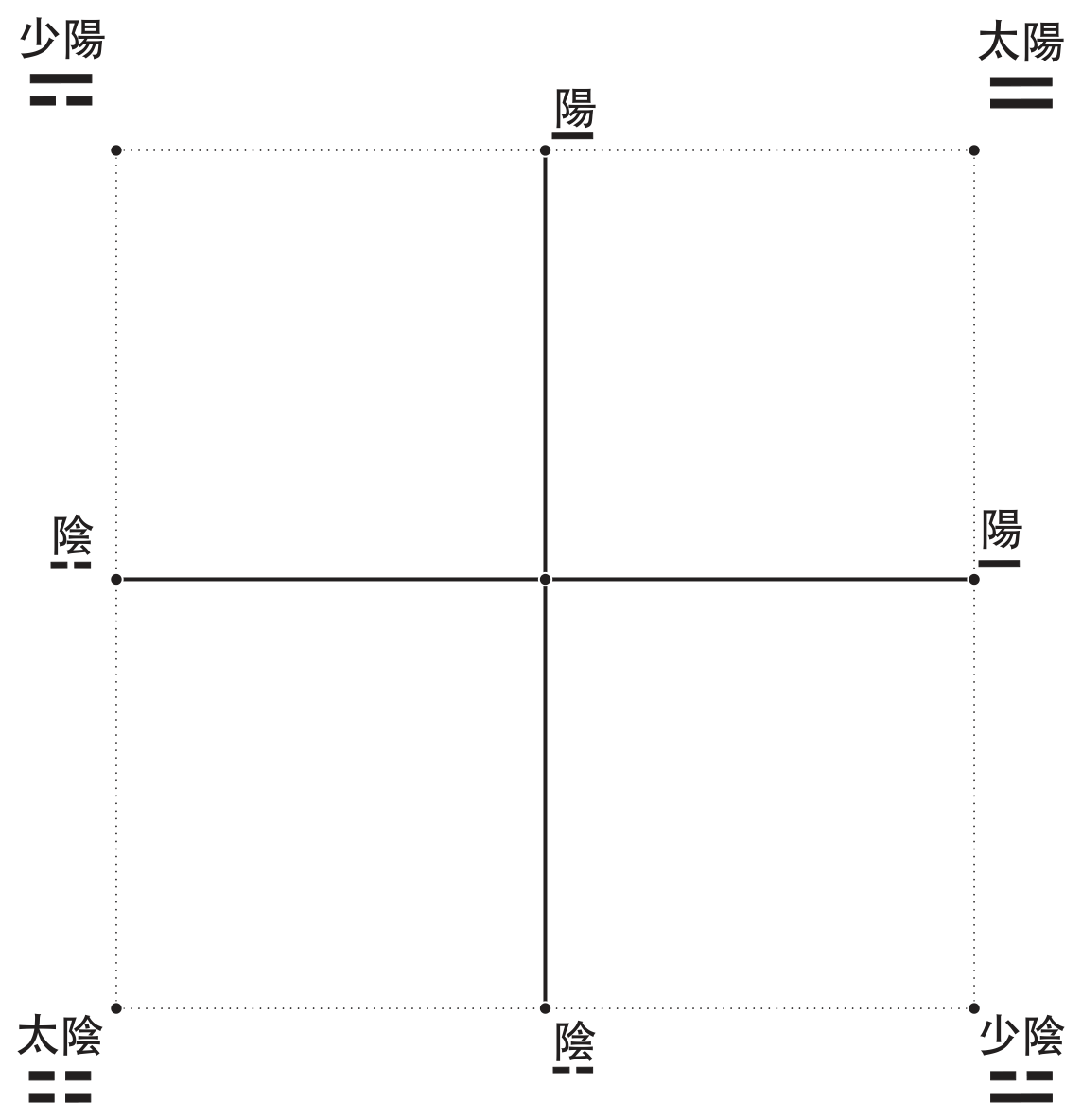
Two semantic sources
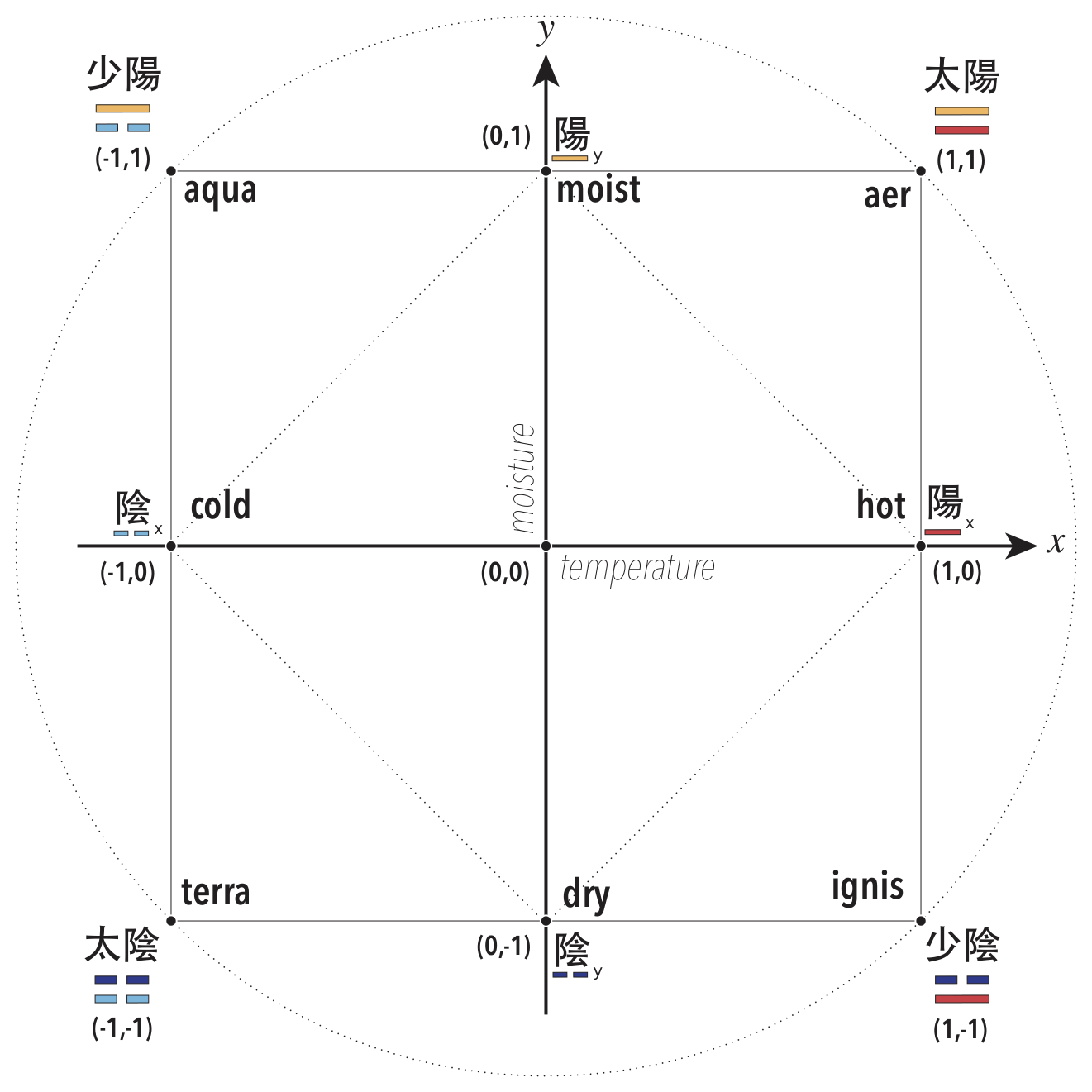
We can now bring the qualities introduced in Section 9.2 to bear on the complete source compositions. Formally, write the valuation as \(V_0\) and apply it componentwise: \(\mathcal E(b)=V_0(\mathcal G(b))\). In doing so, we separate the abstract rule from its meanings so that we can examine each clearly, while remembering that this was not their order of discovery.
9.3 Eight qualified elemental states
Let \(\mathtt c,\mathtt h,\mathtt d,\mathtt w\) abbreviate cold, hot, dry, and moist. Typewriter letters form a semantic alphabet: \(\mathtt{cwh}\) is an ordered word, not a product of variables. The qualifier gives two expressions of each elemental base.
| Trigram | Code | Word | Qualification | Name | Phase |
|---|---|---|---|---|---|
| Kun 坤 | \(000\) | \(\mathtt{cdd}\) | Dry Terra | Terra | 土 |
| Gen 艮 | \(001\) | \(\mathtt{cdw}\) | Moistening Terra | Humus | 土 |
| Kan 坎 | \(010\) | \(\mathtt{cwc}\) | Cold Aqua | Aqua | 水 |
| Xun 巽 | \(011\) | \(\mathtt{cwh}\) | Warming Aqua | Succus | 木 |
| Zhen 震 | \(100\) | \(\mathtt{hdc}\) | Cooling Ignis | Calor | 木 |
| Li 離 | \(101\) | \(\mathtt{hdh}\) | Hot Ignis | Ignis | 火 |
| Dui 兌 | \(110\) | \(\mathtt{hwd}\) | Drying Aer | Pneuma | 金 |
| Qian 乾 | \(111\) | \(\mathtt{hww}\) | Moist Aer | Aer | 金 |
I call the four reinforcing states pures. Each bears its elemental name. For the four counterbalanced states I use vitals. Humus evokes the earth that can receive moisture, Succus the sap or juice through which growth is sustained, Calor the heat in which life can continue, and Pneuma the breath through which air takes a particular course. These handles name capacities I discern in the compositions. The base in warming Aqua is Aqua, while the particular qualified state has the name Succus. This distinction will matter when the eight names recur under another construction.
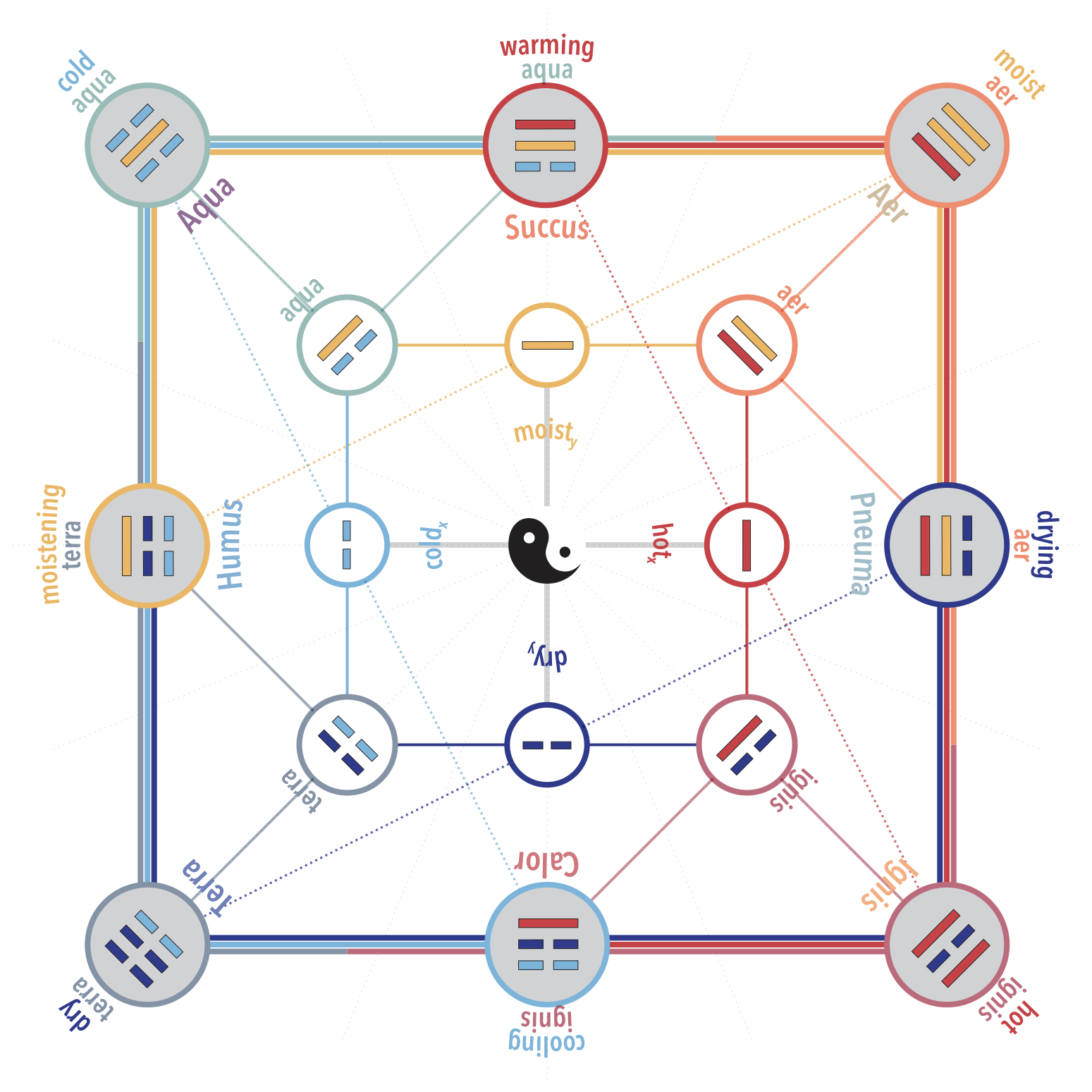
The selected base cycle becomes Aqua–Aer–Ignis–Terra–Aqua: warming, drying, cooling, and moistening. The returning source is the one whose pole changes at the next base step. We can thus see how selecting the characteristic quality does more than divide each base into two expressions: it also allows us to organise a traversal.
This sequence also echoes the Hippocratic–Galenic seasonal scheme. In his commentary on On the Nature of Man, Galen associates winter with cold and wet, spring with hot and wet, summer with hot and dry, and autumn with cold and dry (Kühn XV, pp. 87–91, 98). He also qualifies the description of spring elsewhere as a balanced season, with hot and wet understood comparatively (pp. 83–84).[15] Read as transitions between ideal profiles, the correspondence is \[\underset{\text{winter}}{\mathrm{Aqua}} \xrightarrow{\text{warming}} \underset{\text{spring}}{\mathrm{Aer}} \xrightarrow{\text{drying}} \underset{\text{summer}}{\mathrm{Ignis}} \xrightarrow{\text{cooling}} \underset{\text{autumn}}{\mathrm{Terra}} \xrightarrow{\text{moistening}} \mathrm{Aqua}.\] The four verbs are my way of articulating the changes between those profiles, rather than Galen’s own four-stage formula. We can recognise this historical qualitative correspondence without fixing universal seasonal boundaries or making a climatic or medical claim for the archetypal construction.
To make sense of the opposed words, we need to read them relationally. Xun’s \(\mathtt{cwh}\) names a cold–moist base qualified by emerging heat. It does not posit an equilibrium substance that is both hot and cold in the same respect. Nor does the zero temperature coordinate of its planar sum assert a measured temperature. The source word records the contribution and its provenance; the phrase “warming Aqua” states the proposed direction of qualification.
9.4 What qualification adds to the base
Warming Aqua and moist Aer make the distinction between qualification and replacement especially clear. Aqua’s cold–moist basis can be read archetypally as a receptive capacity in which something is held without yet being actively expressed. Its hot qualifier introduces animation into that capacity. The word still begins with Aqua: what becomes active does so within a receptive basis, and the tension between its cold constituent and hot qualifier is retained. Moist Aer begins instead with hot–moist. Activity and openness already constitute its basis; the moist qualifier reinforces the openness through which that activity can extend.
We might distinguish these readings by considering an enquiry. Material may have been received and held while an impulse to work with it begins to arise: warming Aqua attends to activation within that receptivity. An enquiry already expanding through exchanges and possibilities can remain especially open to further connections: moist Aer attends to the receptivity of an active field. The same enquiry could be described in both ways at different moments or in different respects. We must, however, attend to a different respect in each reading. If we merely notice activity and openness somewhere in the situation, we have not yet distinguished the two compositions.
The word order thus does conceptual work. Warming Aqua does not mean “Aer with less heat”, and moist Aer does not mean “Aqua with more heat”. There are no temperature magnitudes in the model. What we distinguish is an opposed contribution within a retained basis, as against the reinforcement of a constituent in a different basis. If the cold basis is no longer doing any interpretive work, the first description has become an unexplained relabelling of Aer. Conversely, if the qualifier is treated as an unrelated external influence, the composition has ceased to explain how the base itself is expressed.
Drying Aer asks us to exercise the same care in a more difficult case. Its base remains hot–moist while dryness qualifies it. We might read this archetypally as the articulation or delimitation of an otherwise open activity. It does not mean merely that air dries something else: that would change the object of qualification. Hot Ignis begins with hot–dry and reinforces heat within an already delineated basis. This distinction is intelligible without identifying an ideal profile with a physical sample or insisting that every transition is an observable process. The directed elemental circuit offers one way of connecting the profiles, but we must first be able to make sense of each state on its own.
9.5 Holding a meaning fixed while changing its sources
What would have to change in the account of Aqua if its two constituents were the ones selected by \(\mathcal H\)? The lower part of the genesis glyph gives cold and moist. In the Human Compass construction the very same glyph selects the positive horizontal and negative vertical poles, repeating the latter. Carrying the names hot and dry across would beg the question. What I want to carry across is Aqua. We can then ask what pair of distinctions allows it to take its place alongside the other seven under this different rule.
I distinguish three steps in making this comparison. The equations identify the same glyph exactly. Retaining a repertoire of eight meanings is a decision made before selecting the second vocabulary. Whether each new reading discloses a capacity recognisable in the first is the question the comparison opens. A word that works for one especially evocative trigram still has to make sense in every other composition in which that pole occurs.
The element held in common.
In the elemental reading of \(\mathcal H\), Terra and Humus are the two ways of composing a form within bounds. Aer and Pneuma let configuration extend or diffuse. Ignis and Succus bring activity into expression. Aqua and Calor pose a harder question. I provisionally call their common base Equilibration. Aqua can receive what is locally concentrated and allow it to dissolve and spread through a medium. Its repeated constituent is Containment. What the receiving medium can hold makes this evening-out possible. Calor repeats Animation. Think of warmth tempered to a degree at which it can be sustained. Here what acquires measure is the activity of heating. The work of the proposed term is to accommodate both capacities. If it presupposes a controller correcting a deviation, Aqua has already dropped out of the comparison. Nor need the warmth of Calor equal that of its surroundings. The elemental drawing names its four bases. The companion register spells out the two readings of each.[37]
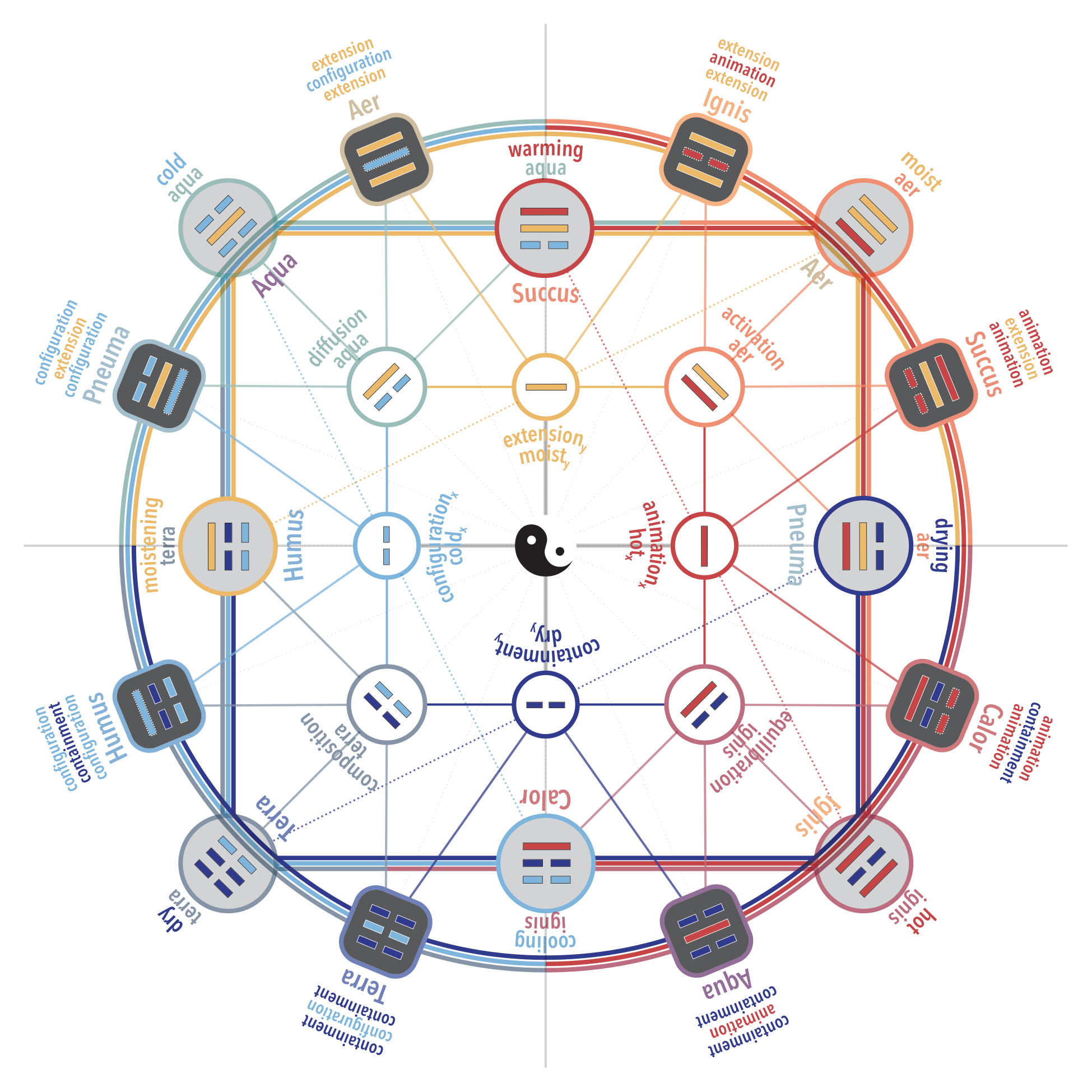
Revisiting Aqua through double qualification.
Under \(\mathcal L\), Holding is shared by Terra and Aqua. Both have steady Substance outside. In Terra it is substance itself that the medium provides. Aqua permits activity within the medium it sustains. In \(\mathcal H\), by contrast, Aqua is paired with Calor in Equilibration. Asking what the neighbouring member contributes gives greater precision to a reading of Aqua as receptive in both cases (Figures 2 and 10).
9.6 Received images and archetypal resonance
If we are to compare these meanings with received trigram images, we need to attend to the level at which the model speaks. Asking whether Aer resembles a lake, or whether metal resembles air, cannot settle the enquiry. Received trigram images are poetic and culturally situated expressions, capable of evoking more than one qualitative essence. The palettes proposed here are likewise partial expressions. The task is to discern a possible resonance between them while attending closely to the differences that give each expression its particular force.
We can approach the comparison methodically through four movements. First, retain a trigram’s exact source composition and read its vocabulary across the four palettes, rather than letting the elemental label speak for all of them. Second, examine a received image alongside the functions, contrasts, and circumstances attached to it in specified texts. Third, articulate what may resonate across these expressions, including what the qualifier contributes beyond the base. Finally, ask whether that reading distinguishes the trigram from its neighbours and whether the received material also points elsewhere. In this way, we may find that a resonance illuminates one aspect without explaining the whole traditional repertoire.
The Dui comparison begins with a qualitative question: how does an open capacity take on definition through what it encounters? Its historical witnesses retain their own scope. Section 17 extends this method through a combined register of the four unchanged palettes and Human Compass, developing all eight provisional portraits.
Dui: attending through 澤.
Dui gives us a particularly revealing place to begin. “Lake” is a legitimate but narrowing rendering of 澤 when it encourages attention only to a body of water. The lexical range includes gathered water, land thick with aquatic vegetation, moisture, lustre, and beneficence.[31] A wetland can thus be approached as an expanse where land, water, vegetation, and atmosphere meet. I find resonance in its exposure to sky and wind, in dryness meeting moisture, and in the tension between an apparently desolate openness and quiet fertility. This is my apprehension of the image. “Heath”, “moor”, and “meadow” can help evoke it for a present reader; the cited evidence does not establish them as interchangeable translations or desolation as the original image’s defining intention.
Chinese commentary provides a more specific comparison. Xiang Anshi (項安世), in the Zhouyi Zhezhong (周易折中, hereafter Zhezhong), distinguishes 澤’s delight from 水’s moistening: the former concerns colour or lustre manifest outwardly, with vapour rising and radiance overflowing; the latter concerns the deep, continuing work of moisture within (juan 17, fol. 15b).[6] We can thus retain their watery relation while distinguishing outward appearance from inward penetration. It gives us a historically situated reason to attend to what 澤 expresses, beyond the material that an English noun appears to designate. Dui’s mouth and delight associations further open an enquiry into expression and encounter. The Shuogua’s more resistant images, including breaking and hard, saline ground, prevent an exclusively placid or fertile interpretation.[3]
The four palettes approach this field from different directions. Drying Aer brings delimitation into hot–moist openness; integrative cognition admits perceiving within judgment; strategic imagination relates possibility to expressed conditions; consolidating reproduction admits integration within outward differentiation. We need not suppose that these constituents disguise identical meanings. What I find potentially resonant is an extending or articulating capacity becoming answerable to a relation that sustains, receives, or gives it coherence. The contrast with Qian helps us make this more precise. We are attending to what happens when an open articulation admits a qualifying other, rather than to openness alone. Neither drying nor integration exhausts that movement. They offer different ways to attend to it.
The Aer–Jin correlation also deserves more than a comparison of substances. In the Suwen (素問), chapter 5, Jin belongs to a network linking the west, dryness, and the lungs; chapter 2 describes autumn through gathering and restraint.[32] These attributions invite a comparison through respiration and the gathering or delimiting of expression. Articulation, distinction, and the conditions of exchange offer further avenues for resonance with Aer. “Analysis” or “reductionism” are modern comparative handles here, not translations of Jin or meanings supplied by Aristotle’s hot–moist profile. A later Western witness, the Heindels’ Message of the Stars, includes the lungs in Gemini’s bodily correspondences.[33] This is a suggestive cross-traditional echo, not evidence that the two entire correspondence systems coincide or share an origin. To dismiss it because metal and air look unlike would be to overlook the possible resonance; to treat the shared organ name as proof would take us further than the evidence allows.
What I am seeking through this comparison is a qualitative resonance disclosed by distinct expressions, each retaining what makes it meaningful in its own setting. Neither a claim of literal equivalence nor an inventory of similarities would adequately serve that purpose. The Tu discussion below develops the same procedure through sustained attention to Kun and Gen (Section 15.10).
9.7 Four elemental classes and five phase classes
For the phase comparison, hold the rule \(\mathcal G\) and valuation \(V_0\) fixed. This choice retains the characteristic-quality reading that motivated the construction and the semantically selected stacking. The received phase assignments already helped guide that selection; their detailed distribution can now be examined without treating every agreement as independent confirmation. The received phase map \(\operatorname{ph}\) assigns each trigram in \(\mathbb B^3\) to one of 木, 火, 土, 金, and 水. A fibre \(\operatorname{ph}^{-1}(\varphi)\) is the set assigned to phase \(\varphi\): \[\begin{aligned} \operatorname{ph}^{-1}(\text{木})&=\{100,011\},&\operatorname{ph}^{-1}(\text{火})&=\{101\},\\ \operatorname{ph}^{-1}(\text{土})&=\{000,001\},&\operatorname{ph}^{-1}(\text{金})&=\{110,111\},\\ \operatorname{ph}^{-1}(\text{水})&=\{010\}.&& \end{aligned}\] Xiang Anshi’s comment preserved in Zhouyi Zhezhong, juan 17, fol. 12b, states the complete assignment and its seasonal interpretation. I cite that witness to a mature correlative scheme, without attributing the entire synthesis to the earliest layers of the Zhouyi (周易).[6]
The elemental and phase partitions cross-cut one another. Terra and Tu have the same two members; Aer and Jin have the same two members. Aqua contains Shui and one Mu state; Ignis contains Huo and the other Mu state. Neither partition refines the other. We cannot, therefore, identify the two systems one to one, although substantial archetypal correlations remain available to us. Terra and Tu can be compared through sustaining form, Aqua and Shui through receptive and moistening capacities, and Ignis and Huo through heat and activation. The Aer–Jin pairing is exact in membership and invites a more indirect comparison through openness and delimitation. The common English names may prompt us to enquire into these correlations, but cannot settle the enquiry. Correlation is precisely what we are trying to interpret; the difference between the partitions does not make it a mistake to be excluded.
The received phase map already contains a distinction independent of the proposed semantic construction. Of its three two-member fibres, 木 alone pairs fully complementary trigrams: Zhen \(100\) and Xun \(011\) differ at all three positions. The two 土 members, Kun \(000\) and Gen \(001\), and the two 金 members, Dui \(110\) and Qian \(111\), differ only in the upper line. Thus the received classification places complete binary opposition within one phase, while the other paired phases retain a common lower bigram.
The qualifier distinctions give that contrast a particular semantic expression. Jin and Tu use \(y\) qualifiers, each with one reinforcing and one counterbalancing state. Mu uses \(x\) qualifiers and is counterbalanced in both members; Shui and Huo use \(x\) qualifiers and are reinforced. Under \(V_0,\mathcal G\), Zhen’s cooling Ignis \(\mathtt{hdc}\) and Xun’s warming Aqua \(\mathtt{cwh}\) exchange every quality with its contrary. Opposition within one received phase is articulated as tempering an active basis and activating a receptive basis. In proposing a common function, I retain the opposition between their compositions.
It is helpful to be clear about what each of these two claims depends upon. 木’s unique complementary pair follows from received membership and ordinary trigram complementation, regardless of the source valuation or return rule. Its collection of two counterbalanced temperature modes follows from the selected semantic construction. The first provides a structural point of contact for the second without entailing the quintessence interpretation. Section 9.9 examines the alternatives.
9.8 Quintessence as an interpretive proposal
The received Mu pair brings together warming Aqua and cooling Ignis. Its members are already distinguished as the only fully complementary pair within a two-member phase. What might this opposition within a class allow us to recognise? I propose that the two members share a function: a transformative capacity embedded in the elemental world. Warming Aqua suggests animation within a cold–moist basis; cooling Ignis suggests tempering within a hot–dry basis. One awakens a latent capacity, while the other moderates an intensity that might otherwise exhaust what sustains it. I offer these as archetypal possibilities, without suggesting that warming and cooling are invariably beneficial.
The source-role distinction makes this proposal more specific. Temperature on \(x\) is operative in the elemental reading; moisture on \(y\) concerns the conditions through which form is received or retained. Mu collects both counterbalanced operative modes. Tu and Jin instead each collect the reinforced and counterbalanced qualifications of a situating source. Although we can discern transformation throughout the schema, animation and tempering emerge here as a particular paired capacity. This rationale belongs to the elemental valuation; it is not a theorem that an operative source must occupy the same axis in every model.
To understand this proposal, we need to keep the compositional roles distinct. Xun retains cold and moisture in its base while heat qualifies it; Zhen retains heat and dryness while cold qualifies it. In neither case does the qualifier erase the basis or reduce the opposed contributions to an undifferentiated average. Calling their shared function quintessence proposes a fifth capacity within the four elemental profiles. Accounts of burning water, sustaining heat, and conjunction give this proposal a historical vocabulary.
A fifth capacity within the elemental world.
Aristotle’s celestial body in On the Heavens I.2–3 is distinguished from changeable terrestrial bodies by its circular motion. Ordinary elemental conversion already occurs through changes of quality in On Generation and Corruption II.4. Warming Aqua or cooling Ignis therefore does not, on Aristotelian grounds alone, establish a fifth essence. The further question I want to pursue concerns a preserving and transforming power understood as present within earthly things.[13, 12]
John of Rupescissa’s De consideratione quintae essentiae offers such a development. In Book I, pp. 16–18 of the 1597 edition, burning water, spirit of wine, and water of life name an essence without the ordinary complexion of any one element. It burns, yet can also cool hot conditions. His comparison with a human heaven describes a power preserving the body’s qualities as heaven preserves the world.[19] The medieval English Book of Quinte Essence likewise connects burning water with preservation, but distinguishes the distilled liquid from the quintessence subsequently extracted from it (pp. 2–4, 21). Its preparation can begin with several elemental materials (pp. 12–13).[16] What interests me in this comparison is the qualitative logic of contrary effects within a preserving capacity. We need neither accept these medical claims nor identify quintessence with ordinary alcohol to examine that logic.4
Activating water and sustaining fire.
The Rosarium philosophorum, first printed in 1550, brings the comparison close to qualification. Its permanent water can dry and moisten, heat and cool, with contrary effects occurring “according to the measure of its regimen”. The passage asks us to attend to preparation and condition, distinguishing what the water does when living, dead, or sublimed. Elsewhere water protects its contents from burning, while gentle heat brings water and fire into a sustainable relation. The Conjunction or Coupling passage calls the tincturing spirit the fifth essence and associates it with penetration and transformation.[21]
This vocabulary helps articulate warming Aqua as more than replacement of cold by hot. A watery basis can harbour activating power while remaining the basis being qualified. Cooling Ignis approaches the relation from the other side: fiery activity can be tempered without being abolished. The Rosarium’s repertoire includes all four qualitative operations, so it does not single out the Mu pair considered here. What it offers us is a precedent for reading elemental names through their operations as well as their ordinary profiles.
The distinction between generative heat and combustion also has classical antecedents. Aristotle distinguishes the vital heat involved in generation from ordinary fire and relates the principle in seminal pneuma to the element of the stars. Cicero’s Stoic speaker reports Zeno’s conception of nature as fire working methodically towards generation.[17, 18] Across these different doctrines, we can discern fiery activity as formative as well as consuming.
Thomas Vaughan gives an especially suggestive account in Coelum Terrae (1650). Life is fire incorporated in an incombustible aerial moisture; a water is “fire inwardly, but outwardly very cold” (1919 edition, p. 218). His comparison with maternal gestation requires temperate, moist warmth, harmed by overheating or excessive cold (pp. 220–221). The external means of preparation is distinguished from the inward fire it awakens (p. 222).[23] What sustains activity in this account is its relation with moisture; the hottest attainable flame would not fulfil that role.
Here warming Aqua and cooling Ignis approach a shared possibility from distinct compositions: activity within a receptive basis, and moderation through which activity becomes bearable and sustaining. Their affinity can be expressed as generative warmth that neither stagnates nor consumes its conditions. We are still considering two qualified states, rather than identifying a single measured temperature or proposing a recipe for a substance.
Michael Maier’s salamander gives us a reason to pause before privileging counterbalance indiscriminately. Emblem 29 of Atalanta fugiens contrasts the reputed cold–moist animal’s resistance to fire through contrariety with the hot–dry philosophical salamander’s endurance through affinity.[22] The analogy concerns kinds of relation: opposition can temper a capacity, while reinforcement can consolidate it. The selected phase correspondence places the opposed temperature modes in Mu and their reinforced counterparts in Shui and Huo. Maier does not supply those trigram assignments.5
Mu as generation and the ordering of growth.
Turning to the Chinese material, we encounter a distinct question about this proposed fifth capacity. In the Shuogua, chapter 5, things emerge in Zhen and become ordered in Xun. The text couples movement and entrance with stages in the articulation of life; chapter 6 describes the powers of thunder and wind as participating with the other trigrams in transformation and completion.[3] Chunqiu fanlu (春秋繁露), chapter 60, associates Mu with spring, a generative disposition, and the basis of agriculture. Its surrounding prescriptions concern seasonal government, including releasing restraints and attending to growth.[10] This is a political and cosmological account of cultivation, not a statement that Mu is a hidden substance inside Shui and Huo.
The affinity I am proposing concerns the conditions under which formation can proceed. Activation within receptivity and tempering within activity can both contribute to growth that sustains its own conditions. The Mu pair then names two routes to that capacity across opposed elemental bases. Read in this way, the Chinese membership contributes to the interpretation proposed here alongside the Western accounts of preserving and transforming power. We are asking what it brings to the comparison, rather than borrowing its name simply to supply a fifth item.
The fit is indirect: neither Zhen’s emergence nor Xun’s ordering names the temperature qualifiers proposed here. The proposed resonance concerns what makes activity generative and receptivity active. To connect these different expressions, we therefore need the intervening interpretation developed through their opposed compositions.
Conjunction and the third role.
The alchemical marriage gives the relation another form. In the Rosarium, Sol and Luna require one another, and their conjunction produces a child distinguished from its parents. The Rebis names one thing arising from two, expressed through body and spirit or Sol and Luna; the composed stone associates fifth essence with conversion.[21] Transformation becomes intelligible through conjunction rather than the isolated power of either term.
Jakob Böhme’s Mysterium Magnum, chapter 14, §§6–9, offers a theological articulation. Fiery and watery tinctures depend on one another: “their right life consists in their conjunction”. Their union is described through an oily essence in which light shines, proceeding to the generation of a third from two.[24] Within his Christian cosmology, life belongs to the relation of differentiated properties.
Through these passages, we can return to the Two–Three intuition that motivates this paper. Once two terms enter a relation, that relation can itself become an object of attention. The qualifier yao articulates a particular relation: a pole returns to reinforce or counterbalance its earlier contribution. The third yao is not literally an alchemical child, and the encoder does not combine the two Mu trigrams into a Rebis. The comparison concerns relational function: the two modes offer complementary ways for a base to admit its contrary, and the imagery makes the generative possibility of that admission intelligible.
Taken together, these sources develop activity within water, the tempering of fire, and generation through conjunction. They help us articulate the proposed quintessence function, although they do not yield one universal alchemical definition. Drying Aer and moistening Terra are also transformative; the distinctive claim for Mu concerns its two counterbalanced operative qualifications across fully opposed bases. Received membership selects the pair, while \(V_0,\mathcal G\) gives that pair this expression. Under \(\widehat{\mathcal G}\) the same Mu trigrams instead reinforce Aqua’s moisture and Ignis’s dryness. We should therefore recognise the chosen quintessence reading as a possibility opened by the comparison, rather than a necessity established by either the historical material or the formal result.
The other two vitals qualify moisture. Humus (moistening Terra) opens bounded form to what can enter it. Pneuma (drying Aer) gives open extension enough definition to take a course, as air does in a breath. This provides a second comparison alongside the thermal moderation of Succus and Calor. The moisture pair spans Tu and Jin, while Mu alone gathers both members of a complementary vital pair. Calor also has a particularly apt classical resonance. In Cicero’s dialogue Balbus reports Cleanthes’ distinction between fire that consumes and the warmth of a living body that preserves and nourishes. What interests me in this passage is the difference the manner of heating makes to what can live through it. The trigram assignment is my own.[18, II.40–41]
We also need to distinguish this compositional function from Mu’s mediating position in XT. The first concerns sourced meanings and phase membership; the second concerns adjacency projected through the phase map. A phase can retain its compositions while ceasing to articulate the graph. We can test that distinction in LH, where Tu assumes the mediating position while the individual meanings remain fixed.
9.9 Alternatives within the elemental genesis reading
The choices retained in this construction.
In the elemental comparison one can alter the rule, alter the valuation of a source pole, or carry an already specified composition to another glyph. The flow chart in Section 9.9.3 follows these decisions separately from a change of succession. Appendix B gives the geometric equivalences.
9.9.1 Exchanging the returning source
In privileging the characteristic quality, I selected one possibility within a base. Aer, after all, is hot as well as moist. What happens if the other source supplies its qualifier? Hold the poles, their meanings, and \(x\) below \(y\) fixed, but replace \(\mathcal G\) by \[\widehat{\mathcal G}({p_x},{p_y},q)= \begin{cases} (x^{p_x},y^{p_y},y^q),&{p_x}\ne {p_y},\\ (x^{p_x},y^{p_y},x^q),&{p_x}={p_y}. \end{cases}\] At a fixed glyph, this exchanges the upper line’s source while retaining its displayed polarity. Kun remains three yin lines, but its qualifier now means cold instead of dry.
The selected existing pole now has value \({p_y}\), so the qualification status is \(\varepsilon=p_y\oplus q\). The bit encoder for this alternate rule, with the original stack retained, is \[\Phi^{\mathcal G}_{0,1}({p_x},{p_y},\varepsilon)=({p_x},{p_y},{p_y}\oplus\varepsilon).\] The same symbol \(\varepsilon\) always records agreement with the source chosen by the stated rule. At a fixed glyph its decoded values are \(p_x\oplus q\) under \(\mathcal G\) and \(p_y\oplus q\) under \(\widehat{\mathcal G}\); they need not agree. Here we have the second directional candidate while retaining the original stacking. We have changed the returning source, without moving \(y\) below \(x\). Under the same next-changing-source convention, the newly selected source is precisely the one that changes under the inverse base step \[\mathcal R_1(p_x,p_y)=\mathcal R_0^{-1}(p_x,p_y)=(1-p_y,p_x).\] This gives Aer–Aqua–Terra–Ignis–Aer. Reading reinforcement and then counterbalance at each base produces Table 10. Aristotle’s II.4 describes single-quality conversions in this same elemental direction, beginning with Fire to Air. His account also permits reciprocal conversion; it does not prescribe the eight-state expansion developed here or establish one orientation as uniquely legitimate.[12]
| Trigram | Code | Word | Elemental reading | Relation |
|---|---|---|---|---|
| Qian | \(111\) | \(\mathtt{hwh}\) | Hot Aer | \(\mathrm{rnf}\) |
| Dui | \(110\) | \(\mathtt{hwc}\) | Cooling Aer | \(\mathrm{ctr}\) |
| Xun | \(011\) | \(\mathtt{cww}\) | Moist Aqua | \(\mathrm{rnf}\) |
| Kan | \(010\) | \(\mathtt{cwd}\) | Drying Aqua | \(\mathrm{ctr}\) |
| Kun | \(000\) | \(\mathtt{cdc}\) | Cold Terra | \(\mathrm{rnf}\) |
| Gen | \(001\) | \(\mathtt{cdh}\) | Warming Terra | \(\mathrm{ctr}\) |
| Zhen | \(100\) | \(\mathtt{hdd}\) | Dry Ignis | \(\mathrm{rnf}\) |
| Li | \(101\) | \(\mathtt{hdw}\) | Moistening Ignis | \(\mathrm{ctr}\) |

We can therefore give the inverse direction a coherent elemental reading. Each counterbalancing qualifier anticipates the changed quality of the next base, while the other quality persists. Cooling Aer approaches Aqua; drying Aqua approaches Terra; warming Terra approaches Ignis; moistening Ignis approaches Aer. In these readings, we interpret the structure of contributions and succession, without claiming to describe measured intermediate substances.
We need, however, to distinguish what it means to reverse a base cycle from what it means to reverse a cycle of named trigrams. Let \(\Gamma^{\mathcal G}_\rho\) denote the construction list for return rule \(\rho\), with \(\rho=0\) original and \(\rho=1\) alternate. Rooted at Qian, these give \[\begin{aligned} \Gamma^{\mathcal G}_0&=(111,110,101,100,000,001,010,011),\\ \Gamma^{\mathcal G}_1&=(111,110,011,010,000,001,100,101). \end{aligned}\] The latter is Qian–Dui–Xun–Kan–Kun–Gen–Zhen–Li. It is not the same named cycle as XT read backwards. If \(\Sigma({p_x},{p_y},q)=({p_y},{p_x},q)\), then \(\Gamma^{\mathcal G}_1=\Sigma(\Gamma^{\mathcal G}_0)\) entry by entry. This equality relates the binary sequences; it does not exchange the source allocation in this model, which remains \(x\) below \(y\). A mere reversal of traversal would leave every source word unchanged; exchanging the returning source changes every word’s third provenance.
Sixteen sourced states over eight binary figures.
The two constructions together occupy the complete space \[\mathscr D=\{(x^{p_x},y^{p_y},\ell^q):{p_x},{p_y},q\in\{0,1\},\ \ell\in\{x,y\}\}.\] There are four bases, two choices of qualifier source, and two choices of its pole: \(4\cdot2\cdot2=16\). Forgetting source provenance leaves only eight ordinary trigram figures. By “sixteen trigrams”, I therefore mean sixteen sourced compositions; the distinct three-line yin–yang patterns remain eight.
Proposition 3 (Directional partition of the sourced states). With the pole meanings and \(x\)-below-\(y\) stacking fixed, the images of \(\mathcal G\) and \(\widehat{\mathcal G}\) are disjoint sets of eight whose union is \(\mathscr D\). Each projects bijectively onto the eight binary figures. Exactly two base-dependent return rules generate a complete four-base circuit when each next step flips the selected source: \(\mathcal G\) and \(\widehat{\mathcal G}\), corresponding to the two orientations of the base square.
Proof. For any fixed base the two rules choose different sources, and each uses both possible signs. They therefore exhaust the four qualifiers at that base without overlap. Forgetting source labels gives \(({p_x},{p_y},q)\) in either case. Under \(\mathcal R_0\) the changing source is \(x\) precisely when \({p_x}\ne {p_y}\); under \(\mathcal R_1\) it is \(y\) precisely then. A complete four-base circuit with one coordinate changing at each step is a directed Hamiltonian cycle of the square. Once its first edge is chosen, visiting every base exactly once forces the remaining edges; the only choice is its orientation. Thus the two stated rules are the only complete-circuit selections among the \(2^4=16\) base-dependent source selectors. This proves the partition and the conditional two-direction result. ◻
Through direction, the other eight compositions thus acquire a systematic place. Whether all sixteen have equally persuasive meanings in every application remains a further question. The association also depends on the declared dynamic convention: the qualifier concerns the next-changing source. The other fourteen base-dependent selectors still yield eight-state selections if both qualifier signs are retained, but they do not generate one complete four-base circuit by flipping the selected source. Four poles alone therefore license more than the two directional constructions. Nor can we infer from this result that both candidates are equally plausible when considered against all received trigram attributes.
As we extend the framework, we also find that some properties of the first eight states change. Reinforcement there coincides with reversal symmetry, \({p_x}=q\). In the alternate model it is \({p_y}=q\). The qualifier classifications of the traditional families must likewise be recomputed. We can recognise this as an extension of the framework without silently giving a fixed named trigram two interchangeable meanings.
The alternate named cycle also admits a three-swap route to LH, with bases retained by every moved state. Appendix C.4 records the figure, reversal-class comparison, and minimum-swap calculation. We will treat this as a secondary relation between orders, keeping it distinct from the fixed-meaning comparison already established.
9.9.2 Moisture-pole assignment and the seasonal comparison
To understand the seasonal comparison, we need to return to a choice distinct from both stacking and returning source: which moisture quality is assigned to yin and which to yang? In the original elemental qualities model (4E), \(y^0\) means dry and \(y^1\) moist. If we reverse those meanings, the source letters, binary figures, stacking, and return rule remain unchanged. Every elemental base and every contribution drawn from \(y\) nevertheless acquires a different meaning.
Let \(V_0\) denote the original valuation and \(V_1\) its moisture-reversed alternative: \[\begin{array}{c|cccc} &x^0&x^1&y^0&y^1\\\hline V_0&\text{cold}&\text{hot}&\text{dry}&\text{moist}\\ V_1&\text{cold}&\text{hot}&\text{moist}&\text{dry} \end{array}\] Thus \(V_0\) assigns moist to yang and \(V_1\) assigns moist to yin. The colours identify poles throughout a change of valuation. In the common palette, dark blue \(y^0\) consequently reads dry under \(V_0\) and moist under \(V_1\), with gold \(y^1\) taking the other meaning. The plate illustrating \(V_0\) takes the first valuation.
The respect in which moisture is read.
Wetness considered through fluidity, receptivity, cooling, and absorption readily lends itself to a yin reading; dryness can suggest rigidity, definite boundaries, and distinctness, supporting a yang reading. In recognising these archetypal associations, we are selecting a respect in which to read wetness and dryness, rather than claiming universal properties for every wet or dry substance. Aristotle’s contrast between moisture’s adaptability and dryness’s retention of a boundary offers a comparison, while his discussion recognises multiple senses of the terms.[12]
In \(V_0\), I attend instead to moisture as a condition of generation, growth, and vitality, against the loss of living potential evoked by desiccation. Its yang assignment concerns this generative respect. Moisture’s receptivity is still present; what changes is the respect in which we speak of it. Neither respect establishes a universal Chinese coding law. The Laozi, chapters 76 and 78, associates life with softness and suppleness, death with hardness and withering, and yielding water with a power to overcome the hard.[2] We cannot, therefore, confine vitality and receptivity to mutually exclusive sides of a fixed classification.
Such reversals have often made it difficult to remain oriented in this enquiry. Rather than eliminate the difficulty through a definitive pronouncement, I propose stating what each valuation attends to. Formal notation then prevents a change of archetypal emphasis from becoming an unnoticed change of meaning within a calculation.
With positive \({t_{\rm E}}\) for hot and positive \({m_{\rm E}}\) for moist, valuation reversal acts as \({J_{\rm moist}}({t_{\rm E}},{m_{\rm E}})=({t_{\rm E}},-{m_{\rm E}})\), a semantic reflection with \({J_{\rm moist}}^2=I\) and \(\det {J_{\rm moist}}=-1\), where \(I\) is the identity map and \(\det\) denotes the determinant. The source drawing need not move. Its elemental allocation changes exactly by \[\mathrm{Aer}\longleftrightarrow\mathrm{Ignis},\qquad \mathrm{Terra}\longleftrightarrow\mathrm{Aqua}.\] Both valuations retain all four Aristotelian quality combinations. Appendix C records all eight qualified modes.
Two distinct seasonal agreements.
Ptolemy assigns predominant moisture to spring, heat to summer, dryness to autumn, and cold to winter. Combined with Aristotle’s characteristic qualities, this yields the comparison Aer–spring, Ignis–summer, Terra–autumn, Aqua–winter; the Galenic support for the full seasonal pairs was discussed in Section 9.[14, 12] The received XT arrangement places Li east, Qian south, Kan west, and Kun north.[4] Under \(V_1\), their elemental bases agree with the corresponding equinoctial and solstitial anchors. The agreement concerns the base classes. It need not extend to the qualifier’s predominant quality, nor does it establish a universal boundary between seasons.
| Order / valuation | Cardinal anchor | Trigram | Qualified elemental reading |
|---|---|---|---|
| XT / \(V_1\) | East / spring equinox | Li 離 | Hot Aer: hot–moist base |
| XT / \(V_1\) | South / summer solstice | Qian 乾 | Dry Ignis: hot–dry base |
| XT / \(V_1\) | West / autumn equinox | Kan 坎 | Cold Terra: cold–dry base |
| XT / \(V_1\) | North / winter solstice | Kun 坤 | Moist Aqua: cold–moist base |
| LH / \(V_0\) | South / summer solstice | Li 離 | Hot Ignis: hot–dry base |
| LH / \(V_0\) | North / winter solstice | Kan 坎 | Cold Aqua: cold–moist base |
LH supplies a different agreement. The Wuxing dayi (五行大義), chapter 17, quoting the Yi tonggua yan (易通卦驗), explicitly places Li at south/summer solstice and Kan at north/winter solstice. With \(V_0\), these are hot Ignis and cold Aqua. The same text places Zhen east at the spring equinox and Dui west at the autumn equinox. Their \(V_0\) readings are cooling Ignis and drying Aer, so the agreement is specifically on the summer–winter axis, not a complete identification of LH with the four Western seasonal elements.[7]
We still need to keep seasonal partition, geographical anchoring, and traversal direction distinct. An annual cycle is continuous; a named season is an interval within it, whereas an equinox or solstice supplies an astronomical anchor. The Chinese solar-term scheme, for example, places “Summer Commences” before the summer solstice and “Autumn Commences” after it.[9] Our figures should therefore distinguish seasonal arcs from cardinal anchors. Likewise, we need to retain the distinction between Qian’s Jin membership, its LH northwest placement, and its XT southern placement, rather than collapse them into one timeless seasonal attribute.
What the comparison establishes.
Under \(V_1,\mathcal G\), the reinforced modes emphasise the elements’ other constituent qualities: hot Aer, dry Ignis, cold Terra, and moist Aqua. The original \(V_0\) supports characteristic qualification and the Li–Ignis/Kan–Aqua crosswalk; \(V_1\) supports all four XT cardinal base correspondences. The discussion of dryness by Liu Wansu (劉完素) associates Qian with dry Jin and Kun with damp Tu, while elsewhere in the same discussion classifying dryness with yin.[8] This gives us a reason to compare particular received correspondences, although it establishes neither a universal polarity law nor an ancient source algorithm.
Mu remains entirely counterbalanced under \(\mathcal G\), but its \(V_1\) meanings are warming Terra and cooling Aer. Its specific quintessence reading within Aqua and Ignis belongs to \(V_0\). Phase membership and the articulation result are unchanged: they depend on named trigrams and adjacency, not their elemental valuation.
Write \(\mu=0,1\) for \(V_0,V_1\) and \(\rho=0,1\) for \(\mathcal G,\widehat{\mathcal G}\). At fixed stacking, characteristic qualification holds exactly when \(\mu=\rho\). Either moisture reversal or return-rule exchange reverses the elemental succession; doing both restores it. We are still performing different operations: in the former, we revalue every \(y\) contribution; in the latter, we change the qualifier’s source. Appendix C gives the four combinations and their derivation.
Finally, we must distinguish where a state is placed from the direction in which we traverse the states. The \(V_1,\mathcal G\) construction retains XT adjacency while its elemental succession runs oppositely to the spring–summer–autumn–winter reading. The alternate return rule has a different named cycle, even when its meanings are subsequently placed in XT positions. The two other-constituent branches share a vocabulary but attach it differently to named trigrams (Appendix C.5). These are exact correspondences of identities and cyclic order; the unequal angles of the contribution plot do not become a regular compass octagon by rigid rotation.
9.9.3 Compositional choices and their consequences
We can now gather the construction’s dependencies in a decision map (Figures 15–16). The branches remain available in combination. To judge whether two choices are equivalent, we must first say what we require to stay fixed. The map develops the genesis class of Table 1. Choosing the Human Compass (\(\mathcal H\)) constituent-selection class is an earlier branch: the third choice then selects a present source pole, and a relational encoder replaces literal transcription (Section 5.2). Double qualification (\(\mathcal L\)) makes a different first choice again. Bottom and top supply the frame and the middle qualifies it (Section 6). Reversing a returning-source rule is an operation within the genesis branch.
Sources and archetypal respect. Choose a semantic field and complementary polarities; state what their handles attend to. The proposed situating–operative relationship supplies one rationale to examine (Section 2.3), with medium/activity and orientation/activity as particular readings. Binarity alone cannot establish their coherence.
Axis allocation and pole valuation. Assign sources to \(x,y\) and qualities to \(0,1\). There are eight labelled allocations before equivalences. Consistent renaming transports meanings and rules; moisture reversal at fixed labels changes meanings.
Stacking. Choose \(x\) below \(y\) or the reverse. Pure restacking preserves the sourced constituents and qualifier, but may change the glyph. Received attributes informed my choice under \(V_0\).
Returning source. Sixteen base-dependent selectors are possible. Requiring the selected source to change next in a complete four-base circuit leaves only \(\mathcal G\) and \(\widehat{\mathcal G}\). These are the two directional candidates at fixed poles and stacking.
Qualifier polarity. Retain reinforcement and counterbalance at each base to obtain eight states. They are states within a schema, not two further schemas. Absolute yang does not always mean reinforcement.
Traversal convention. Reading the reinforcing mode before the counterbalancing mode makes the latter anticipate the next base. Reversing a fixed traversal changes no word but changes that reading. Starting point is arbitrary; visible clockwise direction depends on display orientation.
Arrangement and anchoring. Place fixed states in their construction order, XT, or LH; specify compass anchors and seasonal intervals. Changing order differs from changing a valuation or qualifier rule.
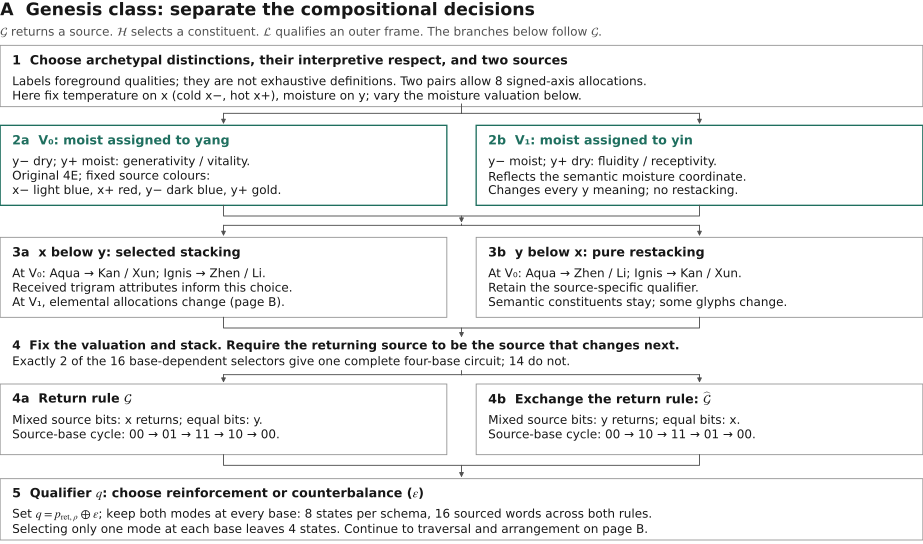
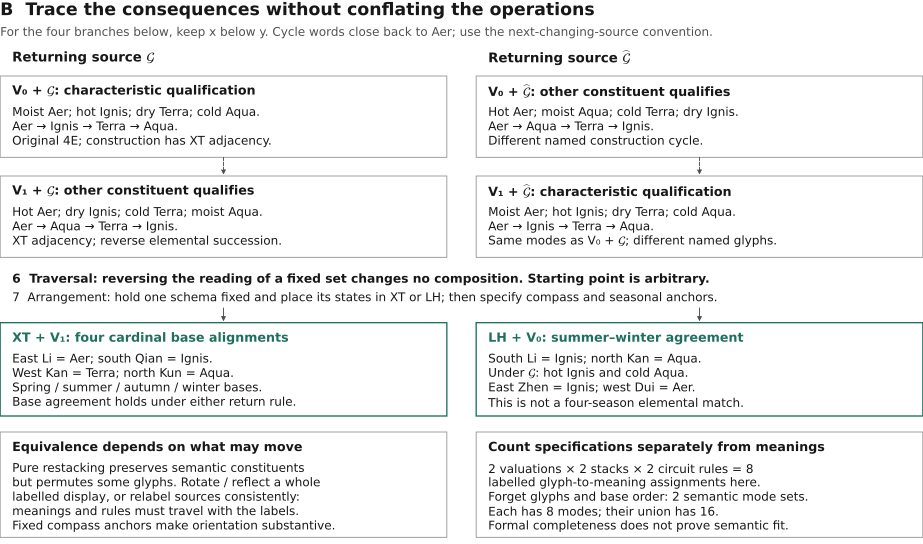
Counts and equivalences.
With the named qualities fixed, two moisture valuations, two stackings, and two complete-circuit return rules give eight assignments to named glyphs. If named glyphs and lower-position order are forgotten, they reduce to two semantic sets: characteristic-source and other-constituent qualification. Their union contains sixteen qualified compositions. These counts tell us how many of the specified formal objects are available; they do not establish equal plausibility for every interpretation. Appendix C provides the parameterisation and reduction.
| Operation | Preserves | Changes or requires care |
|---|---|---|
| Moisture valuation \(V_0\leftrightarrow V_1\) | Fixed glyph, source word, qualification relation | All \(y\) meanings; elemental class and directed semantic reading |
| Pure base restacking | Constituent pair and source-specific qualifier | Lower-position order; some named glyphs |
| Return-source exchange | Fixed glyph and base word | Qualifier provenance; reinforcing/counterbalancing role may change; induced base direction |
| Qualifier-sign exchange | Fixed base and return source | Top bit and glyph; \(\mathrm{rnf}\leftrightarrow\mathrm{ctr}\) |
| Reverse a fixed traversal | Every sourced and semantic word | Successor direction; anticipatory interpretation |
| Rearrange XT into LH | Every state and phase membership | Adjacency, separation and phase articulation |
| Rotate or reflect labelled display | Intrinsic labelled relations | Compass anchoring if its labels are held fixed; visible handedness under reflection |
| Relabel sources consistently | Semantic composition and relations | Notation only, provided meanings, positions and rule are transported |
We can rotate or reflect a labelled display while carrying all its meanings with it. If we instead hold compass labels or meanings in place, some of the same motions become substantive changes. Table 12 therefore distinguishes restacking, source exchange, valuation, traversal, and rearrangement even where two resulting diagrams look alike. The geometric details are supplied in Appendix B.
10 Human Compass
What can remain recognisable about an emotion when its sources are read differently? The reference reading begins with the established emotional categories and the two emphases available within each base. Section 5 explains how the source choices are recovered from the glyph. Here it is their significance in an encounter that matters.
| Trigram | Code | \(({p_P},{p_A},{\chi})\) | Word | Repeated source | Experience |
|---|---|---|---|---|---|
| Kun | \(000\) | \((0,0,0)\) | EBE |
Participation | Pain |
| Gen | \(001\) | \((0,0,1)\) | EBB |
Animation | Shame |
| Kan | \(010\) | \((0,1,0)\) | EAE |
Participation | Fear |
| Xun | \(011\) | \((1,1,1)\) | CAA |
Animation | Guilt |
| Zhen | \(100\) | \((0,1,1)\) | EAA |
Animation | Anger |
| Li | \(101\) | \((1,1,0)\) | CAC |
Participation | Passion |
| Dui | \(110\) | \((1,0,1)\) | CBB |
Animation | Joy |
| Qian | \(111\) | \((1,0,0)\) | CBC |
Participation | Love |
The distinctions become clearer in examples. Love combines Creation and Being with Creation repeated; Joy combines the same base with Being repeated. Passion and Guilt repeat, respectively, Creation and Action within the Creation–Action base. Fear and Anger make the corresponding distinction within Endurance–Action; Pain and Shame do so within Endurance–Being. These distinctions express the model’s interpretive definitions. I have not deduced emotional meanings from the shapes of the trigrams.
What a repeated constituent means.
To understand what this operation means, we can return to the book’s distinction between dominant and secondary directions. Creation concerns expression of an inward concern; Endurance concerns adjustment in relation to encountered conditions. Being concerns existence and being affected; Action concerns movement, change, or correction. These meanings intersect rather than divide experience into unrelated substances.[29, Coda C2–C5] In repeating a constituent, we record its emphasis without assigning a measured ratio or implying that the other constituent is absent.
The same base can admit different emphases: Love and Joy retain Creation–Being, while Passion and Guilt retain Creation–Action. Their distinction is not between having and lacking values, nor simply between pleasant and unpleasant feelings. The full functions, including the manuscript’s affliction and intelligence distinctions, inform the eight portraits in Section 17.
We encounter the same requirement in the Endurance bases. Fear and Anger both concern encounters in which something valued is at stake. Fear emphasises adjustment to a possible threat, whereas Anger emphasises a challenge calling for change. Pain and Shame share Endurance–Being, but an accommodation to injury or loss differs from an experience in which one’s very place or worth is called into question. These are the model’s archetypal readings, not diagnoses. In particular, the Shame position describes an experience of devaluation, not a conclusion that the person has less value.[29, Coda C1–C5]
A single encounter may disclose several of these relations. A regretted action may occasion Guilt while Pain concerns a relationship lost through it; a new pursuit may evoke Passion and Fear together. The distinction remains useful insofar as we can identify the relevant constituent and emphasis. If we instead select whichever emotion produces a desired trigram pattern, we reverse the model’s stated order of justification.
The converse experiment in Human Compass.
Since the Compass meanings preceded their trigram encoding, we can also ask how Pain or Joy would read through genesis. My candidate horizontal source is Retreat–Advance, the movement of participation. The vertical source is Articulation–Integrity, the direction in which significance passes. In Articulation something encountered acquires significance within my valuing. In Integrity something that matters inwardly seeks expression in how I participate. A concern can retain its importance even when expressing it has become painfully difficult.
Anger and Passion share Advance and Articulation. Anger’s returning Retreat is intelligible where I withdraw consent or availability in the very act of protesting. Passion reiterates Advance as I continue to give myself to a pursuit. Fear and Guilt both begin with Retreat and Integrity. In Guilt, Advance has to be discernible even in guilt about an omission: a value makes a claim upon my agency before I do anything to repair the situation. Joy presents the converse difficulty. The encounter may already answer a concern I carry, as when an unsolicited kindness is received with gratitude. Its returning Articulation admits the significance of that fit. The term would lose this instance of Joy if it required me to have produced the occasion. The eight readings are specified with their original emotional categories in the companion register.[29]
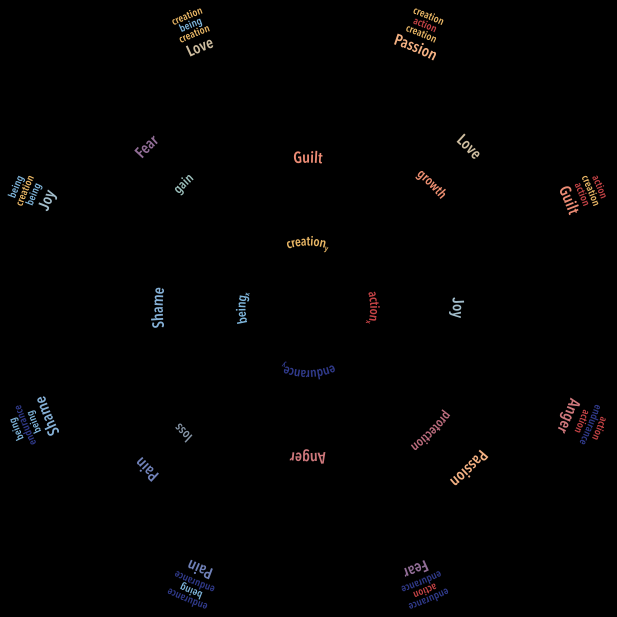
Exposure and investment within encounter or concern.
In double qualification, Shame and Guilt share the Self-reckoning frame. In Shame it is the encounter itself that presses the question of my worth, even as humiliation or humility may colour my response. In Guilt the middle contribution is Investment. An encounter can disclose how my involvement bears upon what I value, including where an omission still calls upon my agency. This retains the book’s distinction between encountering unconditional worth and taking responsibility. The two categories have different bases in constituent selection.[29, 37]
10.1 Symmetry, columns, and family classes
Before encoding, every sandwich is symmetric because its outer contributions repeat. After differentiation, the symmetric trigrams collect around the Participation poles: Endurance gives Kun/Pain and Kan/Fear; Creation gives Qian/Love and Li/Passion. The Animation poles instead collect the asymmetric pairs: Being gives Gen/Shame and Dui/Joy, while Action gives Zhen/Anger and Xun/Guilt. This follows directly from the masks. EE preserves every line and CC changes only the middle; E and C each change one outer line.
The encoding thus gives symmetry a new use: what first expressed the shape of repetition now distinguishes which source is repeated. Within each Participation-emphasised pair, the two glyphs differ only at the middle line. Within each Animation-emphasised pair, they are full binary complements. This is why binary complementation coincides with the shared-repeated-pole relation for Being and Action, but not for Endurance and Creation (Section 15.4).
The four raw symmetric seeds invite an archetypal reading as emblems of the Participation–Animation cross: Kun as Endurance, Qian as Creation, Kan as Being, and Li as Action. I offer this as a reading of resonance, rather than a claim that the constituents literally coincide. Raw Kan, for example, underlies both Fear and Joy; Fear’s composition contains Action, not Being. Erasing provenance retains the polarities of the repeated and secondary contributions, not their source identities. The proposed emblems may therefore orient our further enquiry, provided we do not mistake the two outputs from a seed for a pair sharing that named source pole. The seed register and the pole grouping above partition the states differently.
Rows, columns, and family classes.
The horizontal positions disclose a further relationship. Counting each Being contribution as \(-1\) and each Action contribution as \(+1\), the four columns run from repeated Being through single Being and single Action to repeated Action. In the overlay (Figure 28, p. 100), the dark, rounded \(\mathcal H\) glyphs consequently gather the youngest children, parents, middle children, and eldest children from left to right. These family memberships are received in the Shuogua; their arrangement into these columns follows from the stated encoder.[3, Chapter 10] Each column retains Animation and the emphasis choice while exchanging Participation, so its two glyphs are binary complements. This is the same vertical pairing discussed in Section 15.4.
| Column | Animation contribution | Trigrams | Family class | Minority line |
|---|---|---|---|---|
| \(-2\) | BB: Being repeated |
Gen 艮; Dui 兌 | Youngest | Top: \(001\) |
| \(-1\) | B: Being once |
Kun 坤; Qian 乾 | Parents | None: \(000\) |
| \(+1\) | A: Action once |
Kan 坎; Li 離 | Middle | Middle: \(010\) |
| \(+2\) | AA: Action repeated |
Zhen 震; Xun 巽 | Eldest | Bottom: \(100\) |
There is a closer connection between the two directions. The rule that assigns each row’s sandwich-inversion mask also specifies each column’s minority-line mask when Animation replaces Participation as its pole input. The reference patterns differ: one mask differentiates a raw sandwich; the other records how the encoded glyph differs from \(000\) or \(111\), according to its majority. Appendix D.1 derives the identity. We can therefore read Participation as supplying the prevailing polarity, with Animation and emphasis specifying the family distinction within it. Rows record \((p_P,\chi)\) and columns \((p_A,\chi)\). Their shared emphasis choice explains why eight positions of the four-by-four grid are occupied: Participation emphasis gives outer rows and inner columns; Animation emphasis gives inner rows and outer columns.
This ordering also invites a tentative developmental resonance. The youngest can evoke the immediacy of Being; parents an established, sustaining participation; middle children the mobilisation of participation through Action; and eldest children initiative and intervention. The image of parental vitality settling with age may contribute to this reading, although continuity and sustaining involvement give a broader account of that position. I understand the progression as an orientation towards Action: Being is itself one pole of Animation, and the contribution counts specify emphasis rather than quantities of vitality. These family images offer ways of approaching the distinctions; they do not assign emotional categories to chronological ages or establish a traditional doctrine of developmental activity.
11 Psychology: judgment, perception, and their qualification
Soma–Psyche and Synthesis–Analysis provide the four bases Sensation \((00)\), Emotion \((01)\), Intuition \((10)\), and Cognition \((11)\). We need to be particularly clear about the sense in which we read the second axis: Analysis means judging; Synthesis means perceiving. Analysis is not intellectual activity in general; Synthesis is not merely assembling parts into a whole. Either function can occur with either Soma or Psyche.
Jung classifies thinking and feeling as rational or judging functions, and sensation and intuition as irrational or perceiving functions. His “irrational” does not mean erroneous reasoning; it distinguishes perception from judgment. His discussion of auxiliary functions also allows judging and perceiving to assist one another.[28] I draw on that distinction here while retaining the model’s own Soma–Psyche axis and its names Cognition and Emotion. It is not a transcription of Jung’s eight attitude-types, and Soma–Psyche is not his introversion–extraversion distinction.
Cognition here centres judgment through Psyche: conceptual or symbolic determination. Emotion centres judgment through Soma: felt valuation, including attraction, aversion, fittingness, and unfittingness. Sensation centres bodily perception, while Intuition centres apprehension through Psyche. Soma and Psyche identify modes of experience, not independent substances. Nor does the name Emotion equate every emotional episode with Jung’s technical function of feeling. Its narrower purpose here is to distinguish felt valuation from the bodily perception of a sensation and from the conceptual assessment of a proposition.
We can compare the two source roles by holding each in turn fixed. Retain judging and change Soma to Psyche: felt valuation becomes conceptual judgment, Emotion to Cognition. Retain Soma and change perceiving to judging: bodily presentation becomes felt valuation, Sensation to Emotion. The first comparison changes the register of a function; the second changes the function within a register. In making these comparisons, we need neither assert a temporal progression nor suppose that one mode excludes the other in an actual experience.
Eight modes within four bases.
Figure 29 (p. 102) presents these modes. At the Sensation base, Kun’s holistic sensation reinforces perceiving: the bodily field is allowed to present itself before a judgment is settled. Gen’s differentiated sensation admits judging within that field, as when a sensed difference becomes relevant, welcome, or troubling. “Differentiated” therefore cannot mean that perception had no distinctions until judgment arrived; it names the added evaluative relation.
At the Emotion base, Kan’s somatic emotion reinforces felt valuation in its bodily register. Xun’s reflective emotion admits a psychological qualifier: what matters bodily can acquire an imaginal, symbolic, or reflective dimension while remaining a valuing experience. Reflection here is not synonymous with judging, because judging already belongs to both modes’ base. The contrast concerns how that valuation is expressed, not whether it contains mental activity.
At the Intuition base, Li’s psychological intuition reinforces apprehension through Psyche. Zhen’s embodied intuition admits Soma: an intuited possibility can acquire bodily resonance, an orientation or readiness that has not yet become a settled judgment. At Cognition, Qian’s analytical cognition reinforces judging, while Dui’s integrative cognition qualifies it with perceiving. The latter can mean a judgment remaining available to further presentation, rather than a completed determination closed to what has not yet appeared. These inherited handles remain useful insofar as we keep their functional readings in view. For greater exactness, we can always return to the constituent descriptions.
Through the selected-shared-pole pairs, I propose four possible bridges. Sensibility (Gen–Kan) connects bodily perception with felt valuation through Soma. Discernment (Xun–Qian) connects felt and conceptual judgment through Analysis. Conception (Dui–Li) connects judgment and intuition through Psyche. Attunement (Zhen–Kun) connects intuitive and bodily perception through Synthesis. These names describe relations, without introducing additional coordinates. The pole shared along an edge is not necessarily the pole supplying either endpoint’s qualifier.
A qualifier is not the neighbouring base.
We can see this distinction particularly clearly through the alternate rule. Under \(\widehat{\mathcal G}\), “synthesising emotion” is Emotion qualified by perceiving. Imagine an unwelcome response to another person’s words. A felt judgment is already present: something seems threatening, painful, or unfitting. A perceiving qualification makes room to notice tone, bodily response, or a further aspect of the encounter without immediately confirming that judgment. Valuation remains the basis being opened. Sensation, the neighbouring base, centres what is bodily perceived, without taking the felt judgment as its organising basis.
An actual experience need not separate cleanly into two episodes. What helps us distinguish the readings is a question: is perception qualifying a valuing response, or is bodily presentation itself the focus? If the valuation has disappeared entirely from the account, the proposed mode has silently become Sensation. If perceiving merely means a better judgment, the qualifier has lost its own meaning. The complete reverse register and its four proposed passages are supplied in Appendix E.
Constituent selection.
Rational concerns what can be apprehended in distinguishable units. The word has a different reach from Analysis in the genesis palette, where it names judging. An entire chord can present itself bodily while remaining available as distinct notes. Whether that availability suffices to place holistic sensation in the Rational family is an open question. Corporal names the bodily register, while Cardial names the Holistic–Conceptual base shared by Sentiment and Intuiting. Both can register the significance of a whole situation before its details are separately stated. For Zhen’s embodied intuition I use Inkling, the first bodily intimation of a pattern. One may hesitate in a conversation before being able to say what has changed. The inkling may concern something already present. Its placement alongside Feeling under the Holistic and Corporal poles asks what bodily apprehension as a whole contributes in each case.
Double qualification.
The psychological outer pair \(x^1,y^1\), Import and Articulation, I call Taking shape. The two members are Intuiting (Li) and Thinking (Qian). In one, a significance takes shape as an image whose bearings may be grasped at once. In the other, it takes shape as a distinction whose implications can be worked out. An intuition can be definite before it can be put into words. This differs from the Discernment frame in which a difference becomes palpable within something sensed or felt. It also leaves room for Zhen’s Inkling, where one can feel oneself turn towards a possibility before its shape is available. These are ways of apprehending an encounter and imply no compulsory sequence of psychological stages.
12 Creative manifestation: receiving, imagining, and giving form
The creative manifestation schema concerns the relation between possibility and expression through receptive and active participation. Acceptance names the capacity to admit what is presented; Engagement names contribution and involvement. Manifestation concerns what has become expressed, Possibility what may be entertained or brought forth. The source pole Manifestation retains this particular meaning within the broader schema. Its contrast with Possibility is relational: an expressed form can disclose possibilities that were unavailable before it existed.
The four bases are Actuality \((00)\), Stillness \((01)\), Activity \((10)\), and Imagination \((11)\). Actuality is manifestation admitted through acceptance. Stillness is acceptance in relation to possibility: openness need not yet become an intervention. Activity brings engagement into what is manifest. Imagination brings engagement into what is possible. These distinctions allow us to recognise capacities within a creative encounter. They neither separate existence into domains nor divide participation into passive and worthy forms.
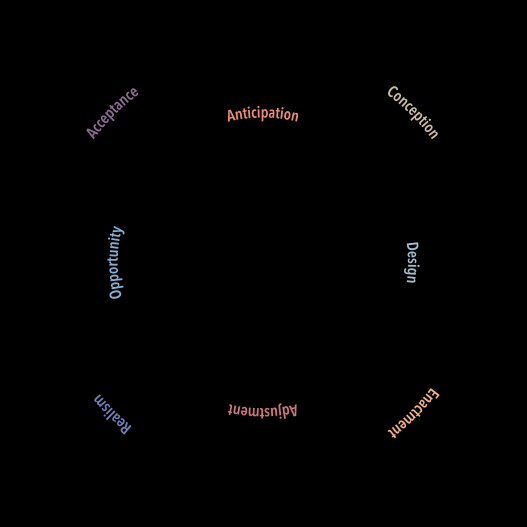
Holding Acceptance fixed, the contrast between Manifestation and Possibility distinguishes recognising expressed conditions from holding open what may be: Actuality and Stillness. Holding Possibility fixed, Acceptance and Engagement distinguish that receptive openness from active imagining: Stillness and Imagination. We can also use these comparisons to test what happens if we exchange the role descriptions. Calling Possibility the operative pole would blur patient stillness and exploratory imagination: both concern possibility, yet one holds it open and the other contributes to it. Calling Engagement the situating pole would obscure what changes between imagination and executive activity: engagement persists while the relation shifts from possible to expressed conditions. This is why Manifestation–Possibility situates and Acceptance–Engagement operates in this reading. Both sources participate in the phenomenon. What we distinguish is the work each does in explaining it.
The paired expressions.
Kun’s recognition of actuality reinforces manifestation: circumstances and consequences are admitted as they are encountered, including what was not wanted. Gen’s potential of actuality qualifies that basis with possibility. It asks what becomes possible from these actual conditions, rather than replacing them with an imagined situation. In both, we begin by accepting what has become present.
Kan’s patient stillness reinforces acceptance within possibility. It allows an unresolved possibility to remain open without demanding an immediate outcome. Xun’s pregnant stillness introduces engagement into the same receptive basis: readiness or incipient contribution is present while the possibility is still being held. This differs from executive activity because the basis has not shifted to engagement with an expressed form. Through patience and pregnancy, we distinguish ways of inhabiting openness rather than degrees of visible busyness.
Li’s executive activity reinforces engagement in manifestation: a contribution is carried into expression. Zhen’s adaptive activity qualifies the same active basis with acceptance. What one is doing becomes answerable to conditions, including other participants’ contributions. In admitting acceptance, we do not abolish the activity; we alter how it proceeds.
Qian’s exploratory imagination reinforces possibility within engagement, opening or pursuing what might be. Dui’s strategic imagination admits manifestation as qualifier: a possible course is related to expressed conditions, resources, and consequences. Strategy remains imagination because a possibility is being worked with. If the account is only of what has already happened, the basis has shifted to Actuality; if it is simply execution, it has shifted to Activity.
Constituent selection.
In creative manifestation, Attentiveness is an outward-facing disposition that can precede any particular object of attention. A painter laying down a stroke remains open to what the paint does as it meets the surface. This allows Attentiveness to enter Enactment as well as Acceptance. Appraisal, its counterpart, weighs what a condition or possibility affords. The more demanding question is whether this distinction can be maintained through all four pairings, including Anticipation while no overt act is taking place. The companion register gives the words so that each proposed distinction can be followed across all eight.
Double qualification.
The exchange of Substance and Activation in Succus and Ignis (Section 6) has a counterpart here. Consider Anticipation and Enactment. A composer hears a place for another voice in the phrase and then sounds it at the piano. In the first, an available prospect is qualified by the latitude it affords. In the second, that latitude becomes the ground of a prospect realised in an audible presence.
13 Organic life: maintaining a whole and enabling further life
To develop the organic schema, we first need to specify a focal living whole. Inward and Outward are relative to that whole; Assimilation means integration into its organisation, while Differentiation means articulation of distinct functions or units. Assimilation need not erase differences, and differentiation need not mean disintegration. As we interpret a composition, we must retain that point of reference: material can be outward relative to a parent and inward relative to an offspring, but those are two explicitly different descriptions.
The four bases are Incorporation \((00)\), Digestion \((01)\), Participation \((10)\), and Reproduction \((11)\). Inward assimilation incorporates what can belong to the whole. Inward differentiation works upon what is taken in, distinguishing what can be made available: the broad archetypal sense of Digestion. Outward assimilation places the whole in an encompassing relation, here Participation. Outward differentiation articulates further distinct units, here Reproduction. We can carry these meanings beyond anatomical digestion or sexual reproduction, provided we retain the declared direction and organisational respect.
We can make the orientation distinction clearer by holding Assimilation fixed. Inward assimilation concerns incorporation into the focal whole; outward assimilation concerns that whole’s participation in an encompassing organisation. Integration is retained, while the relation in which it occurs changes. Holding Inward fixed and changing Assimilation to Differentiation gives Incorporation and Digestion: the orientation persists while the organisational operation changes. We must keep the focal whole the same throughout these comparisons. If we silently switch from parent to offspring, we have begun a different account.
Eight organic modes.
Kun’s consolidating incorporation reinforces integration: what enters contributes to the coherence and maintenance of the whole. Gen’s differentiating incorporation admits articulation within that integration, allowing incorporated resources or structures to become differently available. The second is still incorporation; its differentiation is not simply expulsion or independent reproduction.
Kan’s conservative digestion reinforces the inward orientation of differentiated processing, serving maintenance and renewal of the focal whole. Xun’s productive digestion gives that processing an outward qualifier, making resources available for further contribution. “Conservative” and “productive” identify the direction of use, not a contrast between inactivity and metabolism or between inferior and superior vitality.
Li’s contributive participation reinforces outward involvement in a larger relation. Zhen’s receptive participation admits inward orientation within that participation: ecological belonging includes receiving conditions and exchanges through which the focal whole can live. It is not identical with Incorporation, because its basis is the whole’s involvement in an encompassing organisation.
Qian’s multiplicative reproduction reinforces differentiation in the outward production of further units. Dui’s consolidating reproduction admits assimilation, attending to coherence within what is being brought forth. We can thus distinguish two related contributions: differentiating units and making those units viable. Figure 30 (p. 104) and Table 34 preserve the full visual and coded register.
13.1 When a difference of emphasis changes an organic reading
The organic comparison exposed a difficulty that the diagrams alone could easily conceal. Sixteen constructed cases specified an activity and its purpose relative to a focal whole. The initial vocabulary distinguished Receiving and Contributing, and Recognition and Economy. Receiving and Contributing are the terms used in that exercise for the present Sustenance and Contribution poles. Recognition concerns the discernment or composition of intelligible form. Economy concerns obtaining or providing what a purpose calls for. The initial reading took the more salient concern to govern the emphasis.
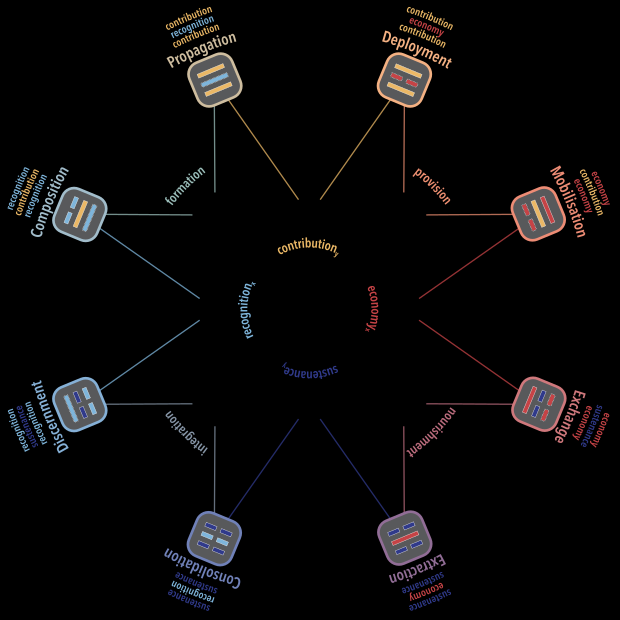
Consider someone retrieving material she already understands for her own use. Choosing just what she needs is the conspicuous feature of the task. Under the initial reading, emphasising Economy within the receiving base yields Zhen, Exchange. Yet her activity throughout is private selection for her own support, the very distinction made by Kan, Extraction. Imagine instead that she obtains the information by taking part in an exchange with another person. The inward purpose persists while the activity through which it is served is outward. This gives substance to the difference that the two glyphs require.
| Mode | Activity | Purpose | What can distinguish it |
|---|---|---|---|
| Kan · Extraction | Inward | Inward | Selecting privately for one’s own use |
| Zhen · Exchange | Outward | Inward | Participating to sustain one’s own capacity |
| Xun · Mobilisation | Inward | Outward | Preparing resources for a contribution |
| Li · Deployment | Outward | Outward | Making a contribution in the encompassing relation |
On this revised constituent-selection reading, the vertical constituent is repeated when activity and purpose agree in direction. The horizontal constituent is repeated when they cross. If only the purpose is given, two readings can remain open. The cases were constructed and initially read by the same assistant with knowledge of the encoding. They expose an ambiguity in what it means to emphasise a constituent. A fresh reading using the revised definition, and an equally explicit test of the Recognition family, remain to be made. The companion materials preserve all sixteen cases and the initial readings, including the alternatives that occasioned the revision.
Double qualification.
For Mobilisation and Deployment, the question is what makes resources serviceable in a particular setting. In Mobilisation, Resources are given Specification by an intended provision. Use in the middle directs their allocation. In Deployment, Use is specified and Resources in the middle allow that use to be realised. An organism can mobilise reserves before deploying them in a particular tissue. To distinguish the two we must still say which whole is being sustained and what the materials are for. The words alone cannot decide that question.
Part IV · Three successions
14 What changes when the successor changes?
A semantic map assigns a reading to a glyph. A succession assigns it a neighbour. We can now distinguish three questions that are easily conflated. Which circuit is received or specified? Under what conditions can an encoder recover it? What becomes visible if we keep one map in place and carry it through all three circuits?
At this point, we can draw on the distinction developed in State, Flux, and Pattern: a configuration, a change between configurations, and a phase class each tell us something different.[27] For the fixed rule \(\mathcal G\) used in this comparison, the state space is the affine binary cube. For states \(b,c,e\in \mathbb B^3\), the transition mask \[\delta(b,c)=b\oplus c\] identifies the lines that change. Its Hamming weight counts those lines. The mask is symmetric in its endpoints, so it does not alone tell us which state is the source. A directed event can instead be written \((b,\delta)\), with target \(b\oplus\delta\). Successive changes compose by XOR: \[\delta(b,c)\oplus\delta(c,e)=\delta(b,e).\]
Schöter’s Bipolar Change develops a richer account in which change itself can be separated into complementary aspects.[26] Let \(\land\) denote logical AND, which is \(1\) only when both bits are \(1\), and \(1-b\) the componentwise complement of \(b\). One elementary directional decomposition on the three positions is \[\delta_{\uparrow}=(1-b)\land c,\qquad \delta_{\downarrow}=b\land(1-c),\] where operations are componentwise. These masks are disjoint and their XOR is \(\delta\). They distinguish yin-to-yang from yang-to-yin changes. This applies Schöter’s lattice-direction distinction (expanded version, pp. 12–13) to three lines, using indicator masks for both directions. Write \(X_{\rm Sch},Y_{\rm Sch}\) for Schöters \(X,Y\) in this comparison only. Then \(X_{\rm Sch}\) corresponds to \(\delta_{\uparrow}\) and \(Y_{\rm Sch}\) to \(1-\delta_{\downarrow}\); both masks use \(1\) to mark an affected position. We are applying one specified decomposition here. This neither reduces his full treatment to that decomposition nor identifies the two directions with the two semantic sources.
Write \(\delta_i\) for the transition mask’s component at position \(i\). Source provenance supplies another distinction. Let \({r_0}(b)=b_1\oplus b_2\), with \(1\) denoting an \(x\) qualifier and \(0\) a \(y\) qualifier. Then \[{r_0}(c)\oplus{r_0}(b)=\delta_1\oplus\delta_2.\] An upper line can keep its broken/unbroken form while changing its source category. For example, Xun \(011\) to Qian \(111\) leaves the top bit at \(1\) but changes its source from \(x\) to \(y\). In the elemental model the upper contribution changes from hot to moist. We can thus distinguish bitwise change from source-qualified change, even though the source of every endpoint remains a fixed function of that endpoint. We have not reassigned a meaning to suit the transition.
Even directed line masks can coincide while their semantic contributions differ. In LH, Li–Kun and Qian–Kan both have \(\delta_{\uparrow}=000\) and \(\delta_{\downarrow}=101\). Their upper contributions change from hot to dry and from moist to cold, respectively. Appendix A gives the complete LH transition register. Retaining provenance leaves the binary calculation unchanged, while allowing us to specify which meanings undergo those changes.
When we move to the phase map, we take a coarser view still. Collapsing trigrams that share a phase allows us to retain a succession of phase classes, but we usually lose the information needed to determine the next event. In LH, for example, the Tu state Gen is followed by Mu, whereas the Tu state Kun is followed by Jin. A phase graph records possible projected transitions; it is not by itself a deterministic five-state replacement for the eight-state cycle.
15 Earlier Heaven, Later Heaven and the Compass succession
For comparison, root all three directed cycles at Kan and read each row from left to right, returning from its last entry to its first. The first two rows record the received directional circles. The third records the order of the emotional categories in Human Compass with their selected glyphs.[3, 6, 30]
| Earlier Heaven \(\Gamma_{\rm XT}\) | \(010,\ 011,\ 111,\ 110,\ 101,\ 100,\ 000,\ 001\) |
| Later Heaven \(\Gamma_{\rm LH}\) | \(010,\ 001,\ 100,\ 011,\ 101,\ 000,\ 110,\ 111\) |
| Compass \(\Gamma_{\mathcal H}\) | \(010,\ 000,\ 001,\ 110,\ 111,\ 101,\ 011,\ 100\) |
15.1 How the construction yields Earlier Heaven
To put these compositions into a succession, choose a base circuit in which the returning source is the one that changes next. Write \(\mathcal R_0\) for this base successor: \[00\longrightarrow01\longrightarrow11\longrightarrow10\longrightarrow00, \qquad \mathcal R_0({p_x},{p_y})=({p_y},1-{p_x}).\] With \(x\) increasing rightwards and \(y\) upwards, this is clockwise. At a mixed base, \(x\) changes on the next step; at a same-polarity base, \(y\) changes. The returning source is therefore precisely the source that changes next. Its agreeing pole can be read as current; its opposite pole as emerging. That dynamic reading depends on the stated cycle, whereas reinforcement and counterbalance are defined directly by composition.
Proposition 4 (Conditional genesis of XT). Reading the current and then emerging form at each successive base yields the received XT circular adjacency, up to the choice of starting point and reversal of traversal.
Proof. Applying \(\Phi^{\mathcal G}\) to the two qualification-status values at the four bases gives \[000,001,010,011,111,110,101,100.\] These are Kun, Gen, Kan, Xun, Qian, Dui, Li, and Zhen. Their adjacency agrees with the received directional circle. The circular placement follows from the stipulated base step and encoder; geographical anchoring is additional information. ◻
We can also describe the two relations underlying this cycle as turning at a base and crossing a selected edge of its square. Appendix B gives this additional flag representation.
15.2 What fixes a successor?
The account of procession in the Shuogua provides a received order against which to put the construction.[3, ch. 5] Looking at the completed drawing suggested three conditions on a directed step from one sourced trigram to the next.
Change the ordered outer frame.
If the new state contains a pole twice, carry that pole into it from the preceding middle.
On leaving a state which contains a pole twice, relinquish that pole from all three positions of the new state.
Require each state to have one successor and one predecessor. For the eight source words of \(\mathcal L\) in Figure 3 there is exactly one such assignment. Starting at Zhen, it reads Zhen, Xun, Li, Kun, Dui, Qian, Kan, Gen, returning to Zhen. A single circuit emerges even though a permutation with several disjoint cycles would have been admissible. Appendix I gives the deduction and tests all 256 choices of middle-source axis against the same conditions.
What might these conditions mean? A doubled ingredient has a peculiar prominence. It is already present at the transition into the state and is fully relinquished on the way out. Both emanating pures give way to holding. Ignis gives way to Terra and Aer to Aqua. A return to emanating takes one intervening vital on the first route and three on the second. Even an attractive reading such as the inheritance of a new middle has a precise limit. On seven edges the new middle occurs somewhere in the preceding word. From Kun to Dui it does not. I arrived at the conditions with the arrangement in view. Their selectivity is a property we can establish. Their semantic warrant, and any historical account of how the order arose, call for evidence of a different kind.
Figure 20 shows the shared-base comparison. The full superposed, selected-pole, and complement views appear in Appendix F (pp. 105–107). Each uses the same states and meanings in both orders.
15.3 Pairings and cyclic separation
The source construction distinguishes a shared-base matching \(\mathcal B_{\mathcal G}\) and a selected-shared-pole matching \(\mathcal J_{\mathcal G}\). Full source-pole opposition supplies \(\mathcal D_{\mathcal G}\); in this retained construction it coincides with binary complementation \(C_{\rm bit}\). Their pairs, in binary integer notation \(n(b)=4b_1+2b_2+b_3\), are \[\begin{aligned} \mathcal B_{\mathcal G}&=\{\{0,1\},\{2,3\},\{4,5\},\{6,7\}\},\\ \mathcal J_{\mathcal G}&=\{\{0,4\},\{1,2\},\{3,7\},\{5,6\}\},\\ \mathcal D_{\mathcal G}&=\{\{0,7\},\{1,6\},\{2,5\},\{3,4\}\}. \end{aligned}\] A matching partitions the states into disjoint pairs; its symbol can also denote the operation exchanging the two members of each pair. Braces \(\{i,j\}\) denote unordered pairs of decimal glyph identifiers. The identifier \(n(b)\) weights the bottom bit most heavily; it is not a position in a cyclic order. In the elemental interpretation, \(\mathcal B_{\mathcal G}\) pairs the two expressions of each element. The pairs of \(\mathcal J_{\mathcal G}\) share, respectively, dry, cold, moist, and hot along selected square edges. We need to distinguish these from the pairs whose upper-source poles are identical.
For positions \(i,j\in\{0,\ldots,7\}\) in a specified cyclic order \(\Gamma\), define \(d_\Gamma(i,j)=\min(|i-j|,8-|i-j|)\). The separation profile of a matching is the sorted multiset of its four distances. For the transition counts, parity is \(\operatorname{par}(b)=b_1\oplus b_2\oplus b_3\); a parity crossing changes that value. A multiplicity superscript \(\times k\) means \(k\) occurrences, so \(1^{\times6}\) means six changes of Hamming weight one.
| Property | XT | LH |
|---|---|---|
| Shared-base separation | \((1,1,1,1)\) | \((1,2,3,4)\) |
| Selected-shared-pole separation | \((1,1,1,1)\) | \((1,2,3,4)\) |
| Complement separation | \((4,4,4,4)\) | \((1,2,3,4)\) |
| Identical upper-pole separation | \((3,3,3,3)\) | \((1,1,2,2)\) |
| Parity crossings | \(6\) | \(2\) |
| Bottom/middle/top change totals | \((2,2,6)\) | \((6,4,6)\) |
| Upper-source category changes | \(4\) | \(4\) |
| Upper pole changes, retaining provenance | \(8\) | \(6\) |
| Hamming weights of successive changes | \(1^{\times6},2^{\times2}\) | \(1,2^{\times6},3\) |
XT makes shared bases and selected shared poles adjacent, and complements opposite. LH distributes each of those three relations across every available separation once. This maximises the diversity of their separations, not their sum. The fourth row helps us see why we must distinguish the selected-shared-pole relation from literal qualifier provenance: the upper-source matching behaves differently.
What might these profiles suggest ontologically? I find their interest in the diversity of relation within a whole. XT gives affinity and opposition characteristic separations; LH allows each specified matching to occur across every available distance. We can see this particularly clearly in the complement profile: total separation falls from \(16\) to \(10\), while its range expands from one distance to all four. I read this as differentiated participation rather than greater remoteness: complementary capacities can be immediate neighbours as well as distant counterparts. This interpretation concerns the specified matchings. In counting cyclic separation, we count positions; we have not measured elapsed time, causal force, or the worth of a relation.
The traditional group of father and sons coincides with odd parity, while mother and daughters coincide with even parity.[3] This is not majority polarity: a son has one yang line, whereas a daughter has two. LH has only two parity crossings, hence two uninterrupted four-state passages. Rooted at Xun, its transition word is \[\underbrace{110,101,110}_{\text{even passage}},\quad001,\quad \underbrace{101,011,101}_{\text{odd passage}},\quad111.\] The top-only crossing lies within Jin, from Dui to Qian. The all-line crossing lies within Mu, from Zhen to Xun. Within phase continuity, we therefore encounter both minimal and complete configurational change.
Earlier Heaven (XT)
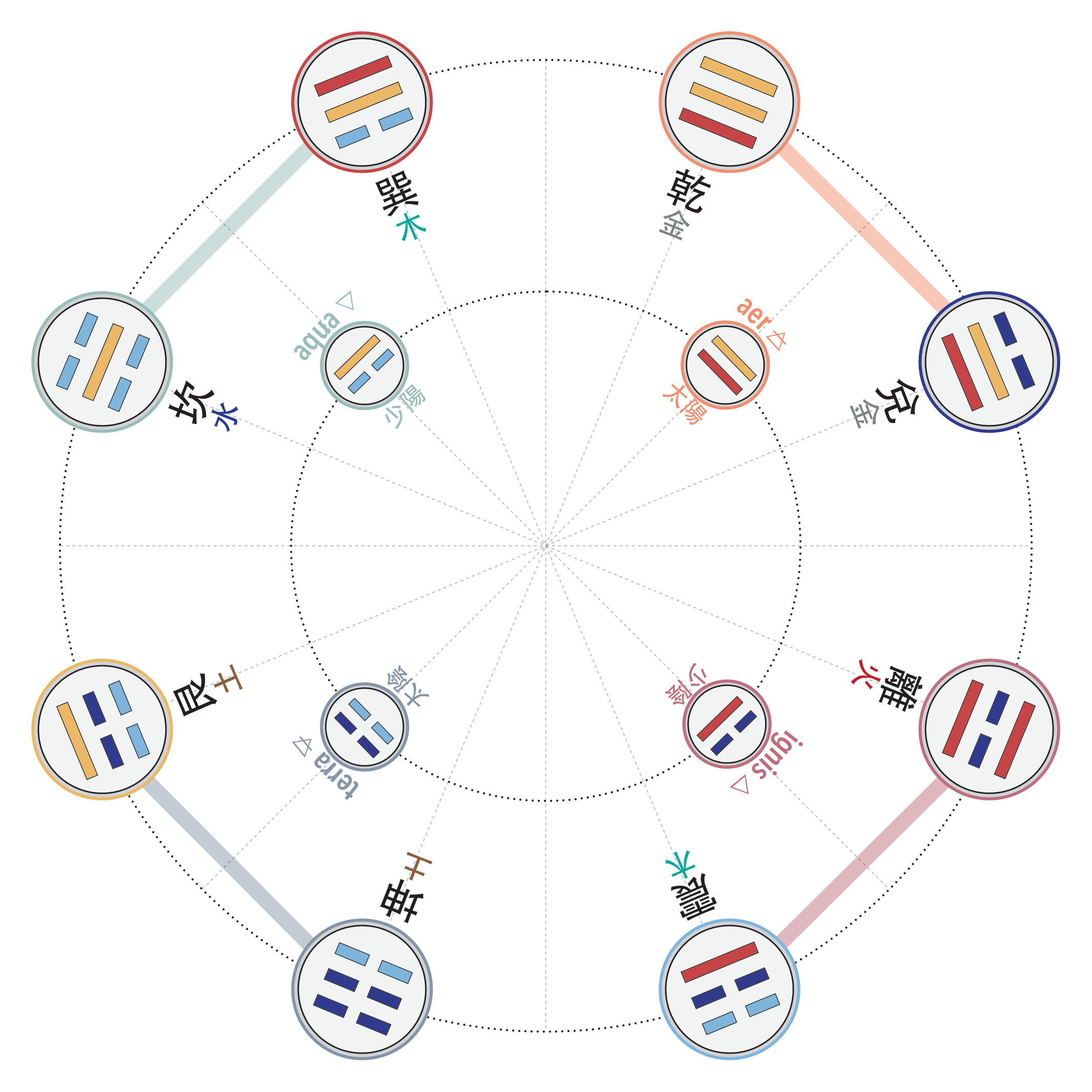
Later Heaven (LH)
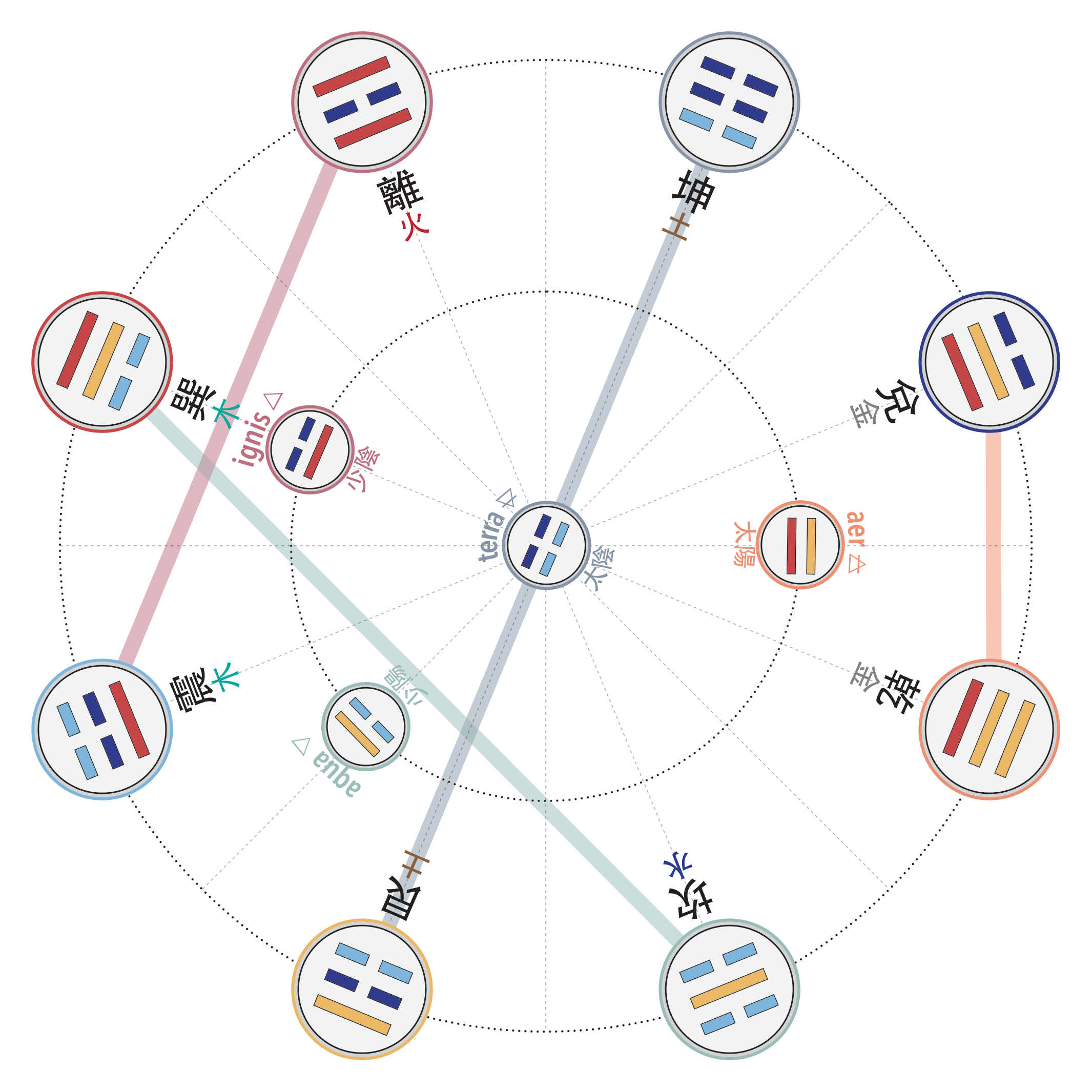
15.4 Four pairings: semantic opposition and binary complementation
The comparison in Section 15.3 extends to \(\mathcal H\) only when its relations are defined from its own source words. Four distinct matchings result (Table 17). A shared-base pair changes which source is repeated: Love and Joy retain Creation–Being. A shared-repeated-pole pair retains that contribution while changing the other constituent: Love and Passion both repeat Creation. In \(\mathcal H\) the selected shared pole is also the literal third contribution; in \(\mathcal G\) those descriptions need not coincide.
Full semantic opposition exchanges both source poles while retaining which source is repeated. These are the manuscript’s four diametric complements: Expansion (Love–Fear), Transformation (Passion–Pain), Correction (Guilt–Shame), and Contentment (Anger–Joy).[29, Coda C6] In calling them opposites, we name their relation within the model; we do not deny that the paired feelings can coexist.
Binary complementation reverses all three line values. Write \(C_{\rm bit}(b)=1-b\) for the same operation defined in Section 4.2. Under the stated encoder it acts as \[\Phi_{\mathcal H}^{-1}C_{\rm bit}\Phi_{\mathcal H}({p_P},{p_A},{\chi})=(1-{p_P},{p_A},{\chi}).\] Participation changes, while Animation and the repeated-source selection persist. In the native layout this is a reflection across the horizontal axis: the four complementary pairs are joined by parallel vertical links (Figure 21, right). Thus semantic opposition pairs Love (CBC) with Fear (EAE); binary complementation pairs Love with Pain (EBE), retaining Being. This consequence of the encoder matters: whenever we speak of “complements”, we need to say which relation we mean.
Each operation is a fixed-point-free involution: it exchanges every state with a different partner and applying it twice restores the original state. The first three matchings share no pairs; binary complementation overlaps the shared-repeated-pole matching at Guilt–Anger and Joy–Shame. Distinct matchings need not be disjoint. Appendix D supplies their formulae and their action on the bits.
| Relation | Four unordered pairs |
|---|---|
| Shared base \(\mathcal B_{\mathcal H}\) | Love–Joy; Passion–Guilt; Fear–Anger; Pain–Shame |
| Shared repeated pole \(\mathcal J_{\mathcal H}\) | Love–Passion (Creation); Fear–Pain (Endurance); Guilt–Anger (Action); Joy–Shame (Being) |
| Full semantic opposition \(\mathcal D_{\mathcal H}\) | Love–Fear; Passion–Pain; Guilt–Shame; Anger–Joy |
| Binary complement \(C_{\rm bit}\) | Love–Pain; Passion–Fear; Guilt–Anger; Joy–Shame |
15.5 The native cycle and the two received orders
Turning at a base applies \(\mathcal B_{\mathcal H}\); crossing the edge associated with the repeated pole applies \(\mathcal J_{\mathcal H}\). Alternating these operations gives the native cycle \[\text{Love--Passion--Guilt--Anger--Fear--Pain--Shame--Joy}.\] Under \(\Phi_{\mathcal H}\) this is \[\Gamma_{\mathcal H}=(111,101,011,100,010,000,001,110).\] It is neither XT nor LH. The eight source words and their trigram assignments can nevertheless be placed in either received order without altering their meanings. Table 18 uses the same shortest cyclic distance as Section 15.3; profiles sort the distances of the four pairs. All transition counts include closure.
| Property | Native \(\mathcal H\) | XT | LH |
|---|---|---|---|
| Shared-base separation \(\mathcal B_{\mathcal H}\) | \((1,1,1,1)\) | \((1,1,3,3)\) | \((1,1,2,4)\) |
| Shared-pole separation \(\mathcal J_{\mathcal H}\) | \((1,1,1,1)\) | \((2,2,4,4)\) | \((1,3,3,3)\) |
| Semantic-opposition separation \(\mathcal D_{\mathcal H}\) | \((4,4,4,4)\) | \((2,2,2,2)\) | \((1,1,2,4)\) |
| Binary-complement separation \(C_{\rm bit}\) | \((1,1,3,3)\) | \((4,4,4,4)\) | \((1,2,3,4)\) |
Full semantic opposition \(\mathcal D_{\mathcal H}\)
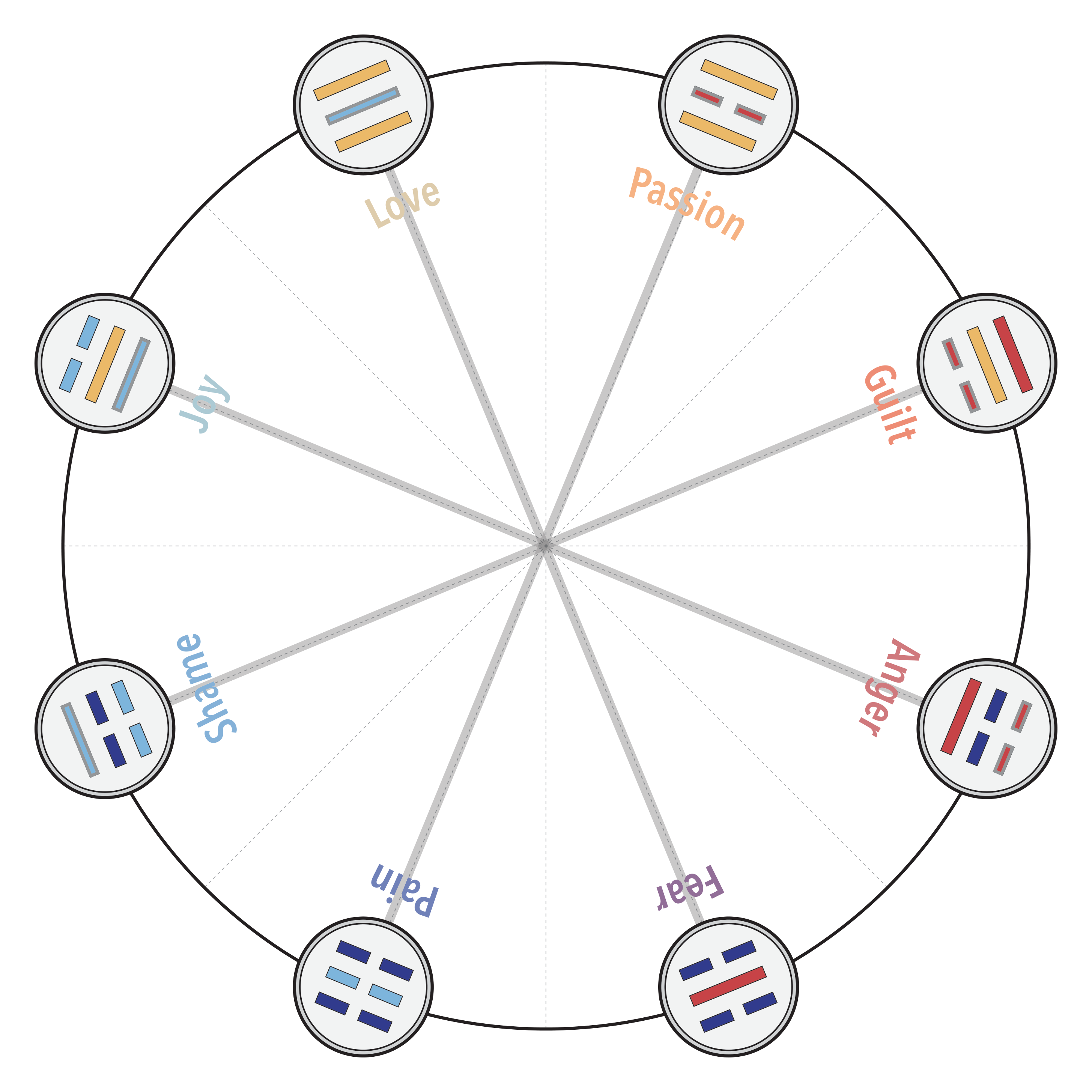
Binary complementation \(C_{\rm bit}\)
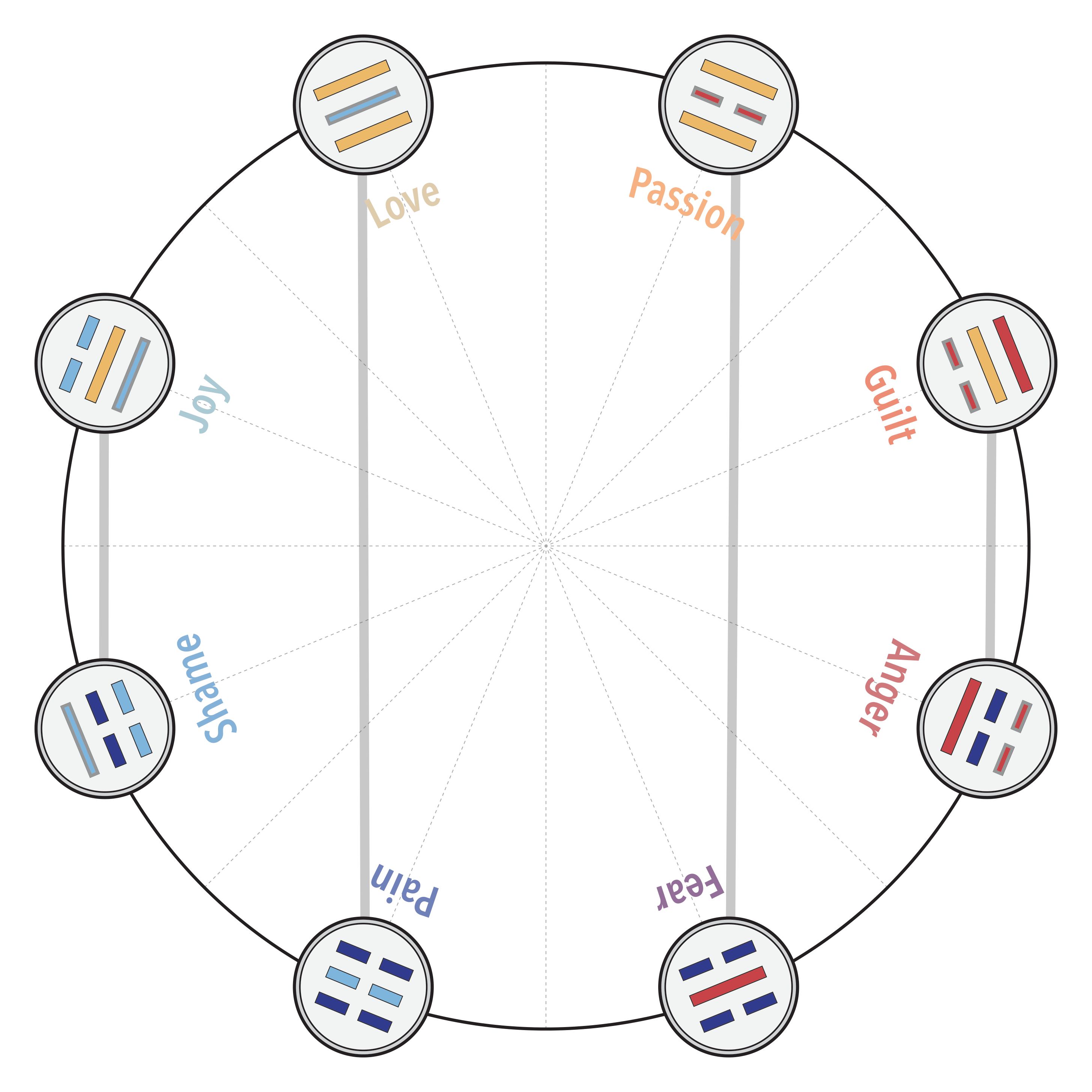
15.6 What the comparison establishes
The native circle makes shared bases and shared repeated poles adjacent, and full semantic opposites diametric. This is the relational pattern that \(\mathcal G\) expresses in XT through \(\mathcal B_{\mathcal G},\mathcal J_{\mathcal G},\mathcal D_{\mathcal G}\), although the two models assign different named trigrams to it. The comparable semantic triple for \(\mathcal H\) is \(\mathcal B_{\mathcal H},\mathcal J_{\mathcal H},\mathcal D_{\mathcal H}\). Binary complementation coincides with full source opposition in \(\mathcal G\), but not in \(\mathcal H\).
The distinction matters when the meanings are rearranged. XT puts \(\mathcal H\)’s binary complements opposite, while its semantic opposites lie two steps apart. LH distributes the binary complements across distances \(1,2,3,4\), but does not do so for the other three matchings. The complete differentiation of all three principal \(\mathcal G\) pairings in LH therefore does not transfer to \(\mathcal H\). Here we encounter a substantive limit to any universal semantic interpretation of LH’s separation pattern. The binary-complement result belongs to the received glyph order; its identification with full semantic opposition depends on the encoder. The atlas retains these different relational profiles when comparing meanings at the same glyph.
15.7 One question put to all three successions
How far apart are the two members of a base? We can ask this of any encoder in any of the three circles. A pair under genesis shares its lower two lines. Under constituent selection it shares its two sourced constituents. Under double qualification it shares its outer frame. Table 19 compares these relationships with the same distance measure throughout.
| Base defined by | XT | LH | Compass |
|---|---|---|---|
| Genesis \(\mathcal G\) | \((1,1,1,1)\) | \((1,2,3,4)\) | \((1,1,2,2)\) |
| Constituent selection \(\mathcal H\) | \((1,1,3,3)\) | \((1,1,2,4)\) | \((1,1,1,1)\) |
| Double qualification \(\mathcal L\) | \((2,2,2,2)\) | \((2,3,3,4)\) | \((1,1,4,4)\) |
Genesis keeps every base pair adjacent in XT, as constituent selection does in the Compass succession. Double qualification gives a different result in LH. Its successor condition changes the outer frame at every step, so two members of any one frame must be separated. In XT each such pair is exactly two steps apart. The same calculation thus discloses three distinct ways in which qualification and succession can bear upon one another.
15.8 The mediator switch as a graph property
Project each consecutive trigram pair through \(\operatorname{ph}\), retaining directed events and loops. For articulation, omit loops and forget direction. A vertex is an articulation when deleting it increases the number of connected components. In this way, I give “mediator” an exact and deliberately limited meaning.
Proposition 5 (Transfer of phase articulation). With the received phase memberships held fixed, the XT phase graph has Mu as its unique articulation; the LH phase graph has Tu as its unique articulation.
Proof. The XT phase word is 水–木–金–金–火–木–土–土. Its nonloop graph consists of the triangles 木–金–火–木 and 木–土–水–木. Their sole shared vertex is Mu. The LH phase word is 水–土–木–木–火–土–金–金. Its triangles are 土–木–火–土 and 土–金–水–土. Their sole shared vertex is Tu. Deleting the shared vertex separates either graph into two edges; deleting any other vertex leaves the graph connected. ◻
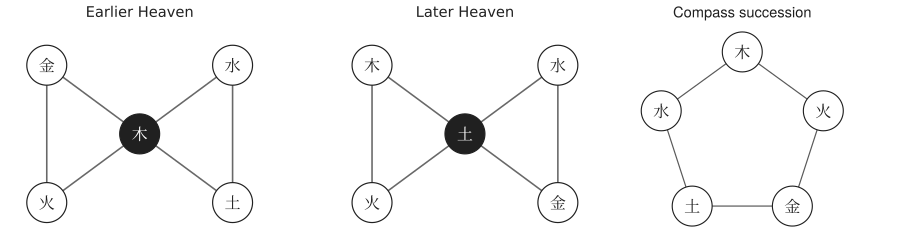
This establishes a comparison of one fixed phase assignment across two orders. The comparison establishes no ancient doctrine of Mu as XT’s mediator, nor does it suggest that Mu loses its elemental composition when Tu becomes the articulation. The composition belongs to the states and valuation; the articulation belongs to their arrangement after projection.
The separation and parity conditions do not alone determine LH. Adding Tu as the unique articulation phase selects its two orientations in an exhaustive enumeration of circles modulo rotation. Appendix A gives the successive counts and procedure. We should keep this conditional classification distinct from a historical explanation of the order.
15.9 The same phase projection in the Compass succession
Keep the received phase membership of each glyph and repeat the projection of Section 15.8 on the native Compass circle. All three pairs within one phase are now neighbours. Suppressing those three loops gives 水–土–金–火–木–水, with the direction shown for the traversal beginning Kan, Kun, Gen. On forgetting direction, the graph is a pentagon. Removing any one vertex leaves a connected path. Earlier Heaven has an articulation at Mu and Later Heaven at Tu because each consists of two triangles meeting at one phase. The Compass circle has none. The thermal contrast within Mu and the two distinct functions of Terra can still be read here. Whether their phase mediates between otherwise separated groups depends on the order in which we place them.
| Phase | Qualified members | XT | LH | Compass |
|---|---|---|---|---|
| 木 | Xun: warming Aqua; Zhen: cooling Ignis | 4 | 1 | 1 |
| 土 | Kun: dry Terra; Gen: moistening Terra | 1 | 4 | 1 |
| 金 | Dui: drying Aer; Qian: moist Aer | 1 | 1 | 1 |
Dui and Qian: a persistent adjacency.
Figure 23 can be read alongside the two received-order plates (Figure 24, p. 67). Its arrows follow the Compass succession, while the individual trigrams retain their elemental readings through genesis. This crossing of an encoder and a different succession is precisely what makes the comparison informative.
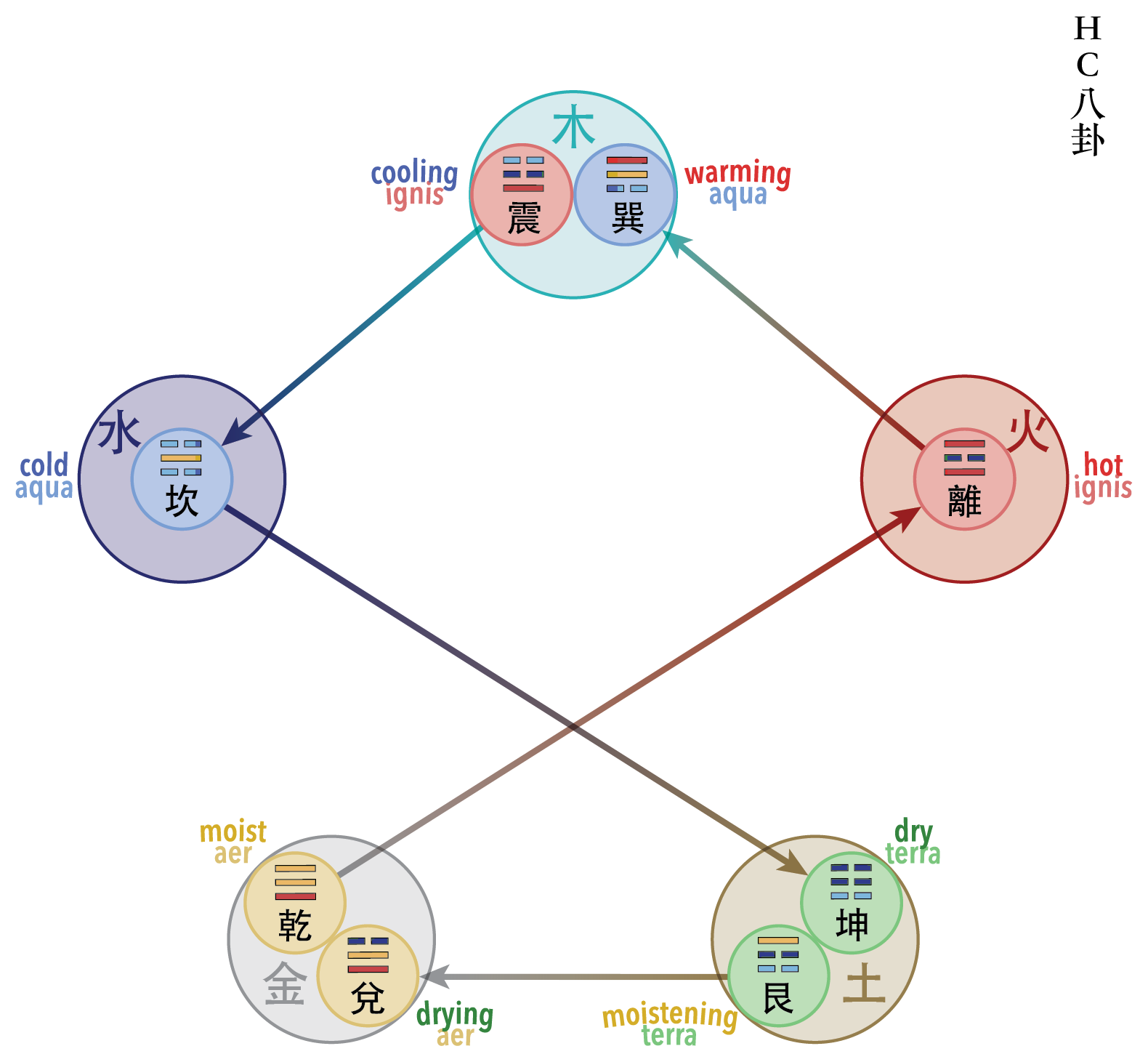
Of the three two-member phases, Jin (金) alone keeps its pair adjacent in all three circles. XT places Qian immediately before Dui. LH and the Compass succession place Dui immediately before Qian. The link persists while the direction changes. In none of the three phase graphs does Jin occupy an articulation. These two facts concern different levels of the comparison: adjacency belongs to the trigrams, articulation to the projected phase graph.
LH gives Dui a more particular position still. Its immediate neighbours are Kun and Qian, the two parents. Across the circle stands Zhen, with Gen and Xun on either side of it. Measured from Dui, the three other vitals are therefore three, four and three steps away. Remove the two parental positions and keep the order of the children: Li–Dui–Kan form one consecutive trio, Gen–Zhen–Xun the other, with Dui facing Zhen at their centres in the original circle. Dui thus sits among the two pure middle children, although, as Pneuma or drying Aer, it is itself a vital. The family names add a different register. The Shuogua calls Qian father and Dui the youngest daughter.[3, ch. 10] A seniority reading which gives the father precedence places the two ends of that scale side by side. Their adjacency is exact whichever social significance we give to that juxtaposition.
15.10 Generation, control, and the two forms of mediation
The articulation test identifies a phase’s connecting position after omitting direction. To explore what mediation might mean, we now ask how a passage is sustained, qualified, or renewed. We restore directed succession and distinguish the qualified trigrams within each phase. Figure 24 brings these levels together: outer enclosures identify the Chinese phases, and inner discs retain the elemental bases.
The common pentagonal frame places the generating cycle on its perimeter and the controlling cycle on its diagonals: \[\begin{aligned} \text{generation: }&\quad \text{木}\to\text{火}\to\text{土}\to\text{金}\to\text{水}\to\text{木},\\ \text{control: }&\quad \text{木}\to\text{土}\to\text{水}\to\text{火}\to\text{金}\to\text{木}. \end{aligned}\] These received relations appear, for example, in Chunqiu fanlu, juan 13, chapters 58–59.[10] They give us a frame within which to read the drawn arrows, whose directions follow the trigram successions. A traversal may follow a received relation or run against it; neither order is simply identical with one of the five-phase cycles.
XT: opposed transformative modes within one phase.
Section 9.7 established Mu’s opposed compositions across Aqua and Ignis. Their positional relation now matters: the pair lies opposite in XT and adjacent in LH. Tu undergoes the reciprocal change, from adjacency to opposition, while Jin remains adjacent (Table 20). These distances add to what the articulation result tells us, although they cannot establish it on their own. The pentagonal enclosures show us membership; to recover separation in the eight-state cycle, we turn to the table.
Earlier Heaven (XT)
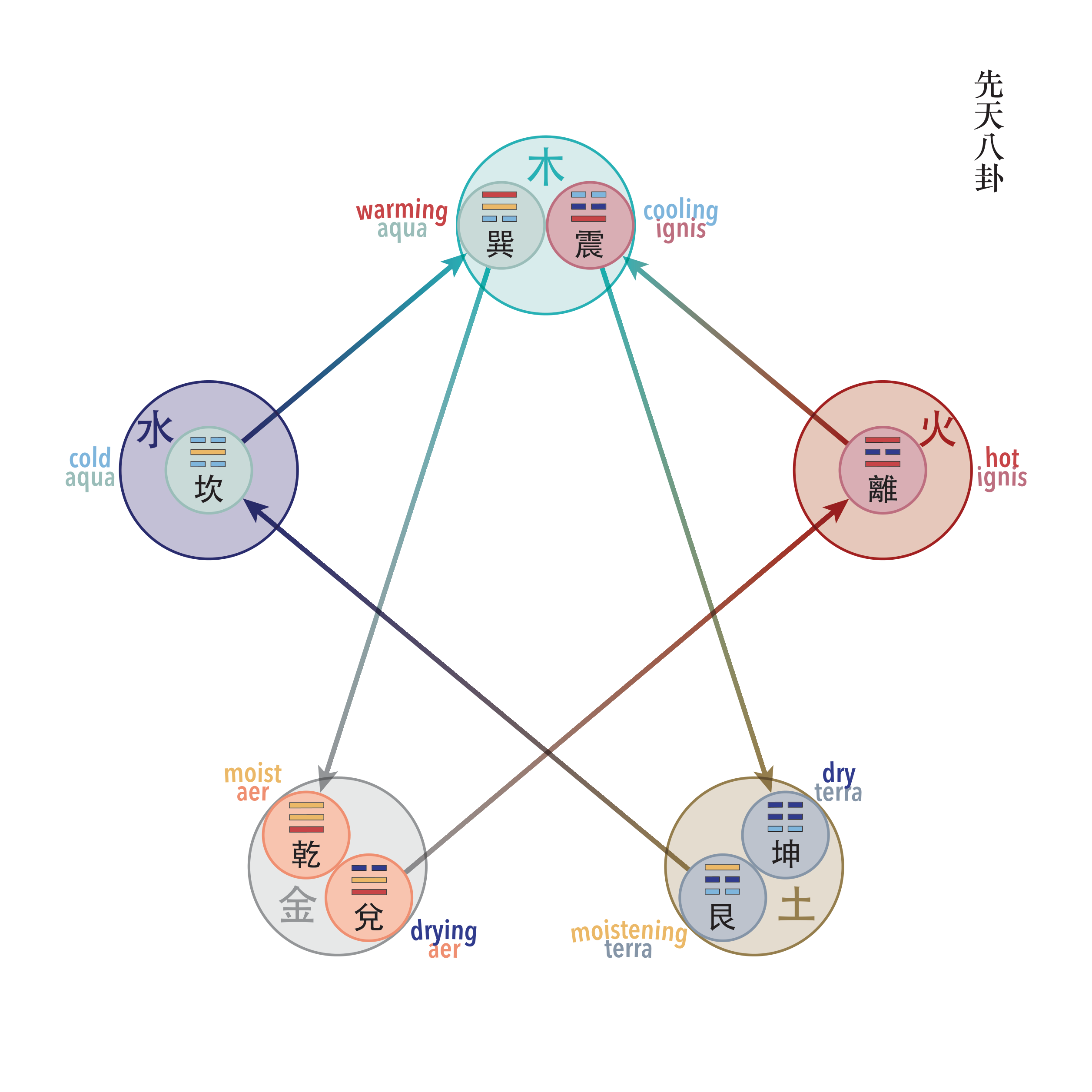
Later Heaven (LH)
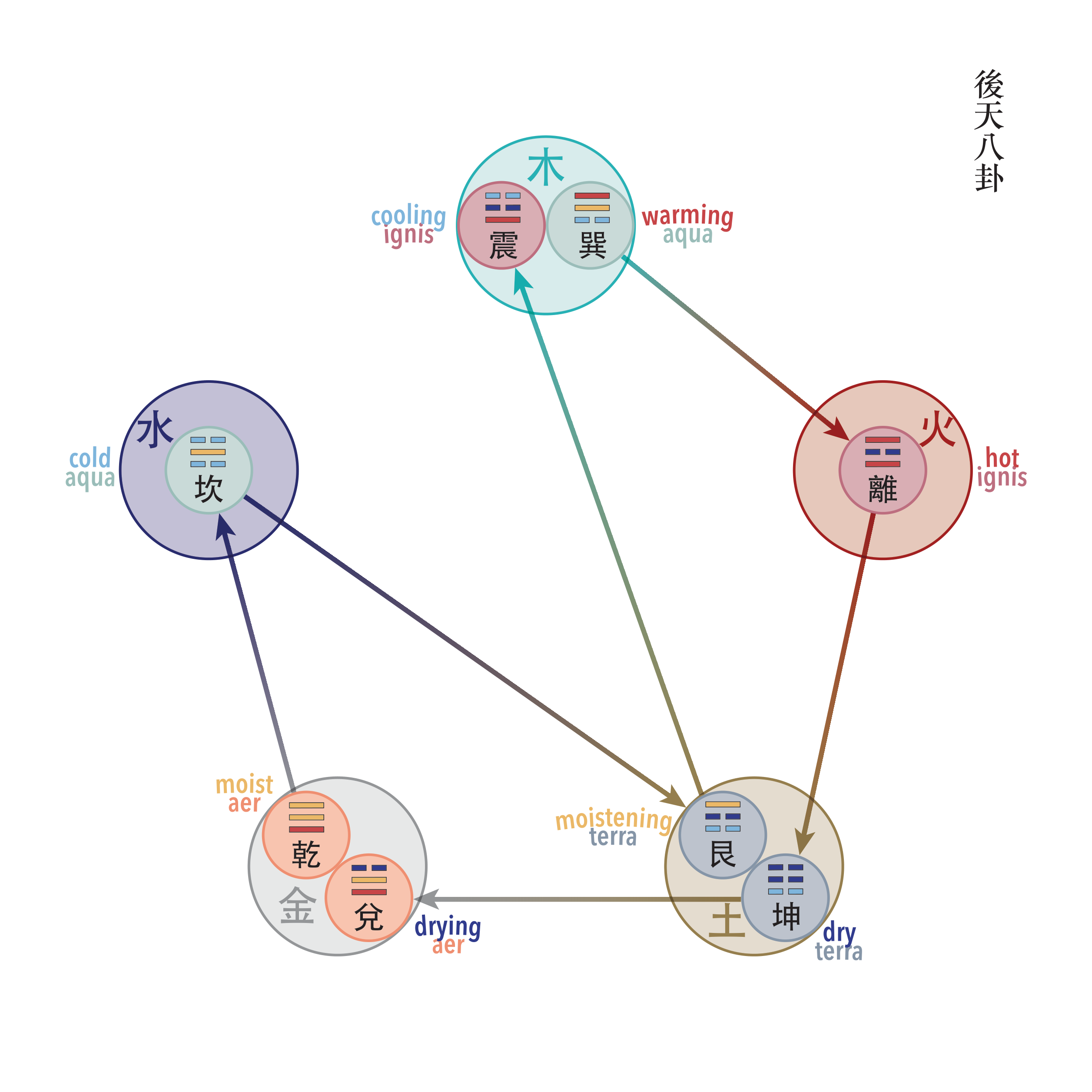
LH: two differently situated Tu passages.
Starting at Zhen and suppressing the two within-phase steps, LH gives \[\text{木}\to\text{火}\to\text{土}\to\text{金}\to\text{水}\to\text{土}\to\text{木}.\] The first four links follow generation. The last two traverse the controlling relationships 土\(\to\)水 and 木\(\to\)土 in reverse. In the orientations declared at the start of Section 15, XT instead has one generating link, one reversed generating link, two controlling links, and two reversed controlling links. Both counts exclude the two within-phase transitions. XT thus mixes the two relations in both directions, whereas LH gathers generation into a four-link passage before returning through two reversed controlling links. “Reversed” describes the traversal; it does not redefine Shui as controlling Tu or Tu as controlling Mu. The two Tu passages are Li–Kun–Dui (火–土–金) and Kan–Gen–Zhen (水–土–木). By recovering the individual members, we can see what the phase-only view conceals.
The Shuogua, chapter 5, associates Kun with the nourishment of all things and Gen with completion and renewed beginning; chapter 7 gives compliance or receptivity to Kun and stopping to Gen.[3] The commentary assembled in Zhouyi Zhezhong, juan 17, develops these different contributions. Xiang Anshi places Kun at the summer–autumn junction and Gen at the winter–spring junction (fol. 12b). Xu Ji (徐幾) follows phase generation as far as Shui, then explains Gen’s insertion: Shui cannot generate Mu without Tu. Gong Huan (龔煥) describes Tu’s nourishment as continuous, although especially conspicuous as things approach completion; completion in turn permits a beginning (fol. 13a).[6]
Hu Bingwen (胡炳文) distinguishes the routes explicitly. Huo would control Jin, but Kun intervenes through two generating steps, 火–土–金. Shui generates Mu, yet Gen intervenes through 水–土–木, the reverse of 木–土–水’s controlling chain (fol. 13b).[6] Xu asks us to attend to the support needed for generation, while Hu distinguishes the directions of generation and control. We can thus begin to see how restraint enters the conditions of emergence. Their explanations illuminate the diagram, although neither reduces to its graph-theoretic definition of mediation.
Kun: dry Terra as a sustaining, consolidating basis.
Li–Kun–Dui reads hot Ignis–dry Terra–drying Aer, or \(\mathtt{hdh}\to \mathtt{cdd}\to \mathtt{hwd}\). Dryness belongs to Ignis’s base, is reinforced within Terra, and qualifies Aer. We can follow one quality through three different compositional roles. Temperature also changes, however, so we cannot describe the passage simply as an increase of dryness.
Read archetypally, dry Terra contributes the capacity for an outcome to settle, retain definition, and become a basis for further development. Nourishment includes providing conditions in which what has developed can acquire coherence and be sustained. It is here that I find a possible resonance with Kun’s nourishment and Gong Huan’s account of approaching completion. I am not translating nourishment as dryness; the comparison concerns the support offered by a determinate basis.
Kun’s receptivity nevertheless asks something further of this reading. A formed basis can receive and carry what develops, but if dryness is understood exclusively as barren rigidity, the comparison fails. What matters here is form-retention, while the destructive possibility of desiccation remains part of what dryness can mean.6
Gen: moistening Terra as bounded renewal.
Kan–Gen–Zhen reads cold Aqua–moistening Terra–cooling Ignis, or \(\mathtt{cwc}\to \mathtt{cdw}\to \mathtt{hdc}\). Gen retains the cold–dry Terra base while moisture qualifies it, allowing what has become determinate to admit further possibility. Moistening does not erase Terra’s delimitations; otherwise the interpretation would simply have replaced Terra with Aqua.
We might recognise this distinction in cultivated ground: its formed medium retains water and makes it available to growth. Boundaries constrain what passes through them while enabling its reception. Xu Ji’s Tu required between Shui and Mu gives a pertinent comparison; Hu’s reverse controlling route adds containment as a condition of emergence. The resonance I am proposing between image and commentary concerns their qualitative function; the code itself establishes no agricultural mechanism.
Nor need stopping mean the extinction of activity. Cheng Yi (程頤) links stopping with the possibility of generation; Yu Yan (俞琰) stresses completion followed by another beginning and warns against treating stopping as the extinction of life (fols. 12a, 13b).[6] Through moistening Terra, we can speak of a boundary that remains available to renewal. The qualifier introduces openness, while the retained basis gives that openness something definite to qualify. Kun reinforces the dry constituent of its Terra base; Gen counterbalances that same constituent within its own Terra base. Under the proposed generative reading of moisture, Gen’s qualifier admits the potential for life. Xiang Anshi’s winter–spring placement gives this distinction a seasonal resonance: what has settled becomes available to another beginning. The corresponding summer–autumn passage through Kun foregrounds sustaining consolidation. In neither comparison are we attributing a moisture encoding to the commentators.
We can now distinguish the two forms of mediation more precisely. In XT, Mu joins the phase graph through opposed transformations across Aqua and Ignis. In LH, Tu joins it through differently qualified expressions of one basis, encountered at separated stages. The former foregrounds transformation across complementary bases; the latter, a basis’s capacities for consolidation and renewal. The contrast arises from the compositions; the directed passages show us where it occurs, and the commentary helps us articulate its proposed qualitative significance.
15.11 XT and LH as two kinds of succession
These comparisons lead me to distinguish two emphases within one account of change: compositional order in XT and recurrent enactment in LH. XT’s next-changing-source circuit is already transformational. LH makes a capacity available in a different succession of encounters, where what has been expressed or provisionally settled can become material for a further passage. To read this as a process is to ask how the circumstances of a capacity’s return have changed through what intervened.
The Chinese commentary offers a direct point of contact. The compiler’s note in the Zhezhong makes the succession of transformation more evident in LH and the principle of reciprocal interaction in XT (juan 17, fol. 16b). Xu Ji describes the trigrams’ functioning and phase generation as circulating without end (fol. 13a).[6] A comparison preserved in the Tianyuan fawei (天原發微) of Bao Yunlong (鮑雲龍) describes the two circles through opposition and circulation while treating those modes as interdependent.[11] We have textual precedents here for contrasting emphases, without grounds for assigning transformation exclusively to LH.
Here iterative means renewed engagement with a repertoire. Formally, either order repeats the same eight labels and records no history between passes. It is through the circumstances of an application that we must supply that history. Section 16 develops a complete exhibition example in which the room, participants, and work change while the semantic capacities retain their meanings. We can thereby give recurrent enactment a concrete reading without making the order an autonomous feedback mechanism.
16 What a changed neighbour contributes
Psychology, creative manifestation and organic life offer three different ways to consider a repeated capacity in a changed setting. Each example retains the meanings already set out in Part III.
Psychology across the two received orders.
XT puts each base’s two expressions together and each selected bridge between adjacent bases. Its original circuit can therefore be read as bodily perception entering felt judgment, felt judgment acquiring conceptual expression, conceptual judgment opening to intuition, and intuition returning to bodily perception. This is a cycle of available relationships, not a psychological timetable.
LH makes a different sequence available: embodied intuition, reflective emotion, psychological intuition, holistic sensation, integrative cognition, analytical cognition, somatic emotion, differentiated sensation. One possible enquiry moves from a bodily hunch to its felt significance, revisits what it suggests, returns to what is actually sensed, and brings the emerging account into judgment. The later transition from analytical cognition to somatic emotion asks how a conceptual judgment is met in felt valuation. That step requires the circumstances of an encounter; neither the word “cognition” nor the binary order makes it inevitable. We can therefore use the two orders to organise the same capacities differently, provided we retain their definitions throughout.
A creative encounter across the two orders.
Consider preparing a shared exhibition. Recognising the actual space, works, and participants expresses Kun; discerning an opportunity offered by an awkward room expresses Gen. Holding that possibility without prematurely deciding expresses Kan; sensing a contribution taking shape within it expresses Xun. Exploring alternative arrangements expresses Qian; relating one to the available space expresses Dui. Carrying it into an installation expresses Li; revising the work in response to an encountered obstruction expresses Zhen. Through these descriptions, we can follow the selected XT circuit without supposing that making an exhibition must proceed once through eight stages.
What makes this circuit more than a list of tasks is the relation carried by each bridge. Contemplation (Gen–Kan) retains Acceptance between actual conditions and open possibility. Inception (Xun–Qian) retains Possibility as receptivity becomes contribution. Formation (Dui–Li) retains Engagement between imagination and expression. Reconciliation (Zhen–Kun) retains Manifestation as active adaptation becomes recognition of what has resulted. Each passage keeps a particular constituent while changing the other.
We can also follow a complete pass through LH in the same exhibition. An installation being adjusted in response to an obstruction expresses adaptive activity (Zhen). A new contribution begins to gather within the unsettled situation: pregnant stillness (Xun). Carrying it into an arrangement expresses executive activity (Li); admitting the resulting space, including unintended effects, expresses recognition of actuality (Kun). Working out a possible response in relation to those conditions expresses strategic imagination (Dui). Discovering that the formulation leaves an opportunity unexplored reopens exploratory imagination (Qian). Allowing the alternatives to remain unresolved expresses patient stillness (Kan); noticing what the altered room now makes possible expresses potential of actuality (Gen). Responding to that opportunity within the ongoing installation returns to adaptive activity (Zhen).
This is an iterative reading because the return meets an exhibition changed by the intervening contributions. The binary Zhen state is unchanged; the room, participants, and work carry the history. The example supplies that history; the eight-state order does not store it. Each transition needs its circumstance: a strategy need not reopen exploration, and holding alternatives need not disclose a new possibility. The narrative lets us explore one coherent possible enactment, without imposing a compulsory timetable or attributing an autonomous feedback law to the order.
The reversal between strategic and exploratory imagination is particularly revealing. XT moves from opening possibilities towards relating them to manifestation. LH moves from a possibility already related to circumstances towards further exploration. Neither order is inherently more creative. Their difference is whether the immediate relation foregrounds bringing possibility into form or reopening what an existing formulation leaves unresolved. Here we can see concretely how a changed succession contributes to interpretation while the dictionary remains unchanged.
Relations and a bounded life-cycle image.
The selected bridges are Renewal (Gen–Kan), Generativity (Xun–Qian), Expression (Dui–Li), and Nourishment (Zhen–Kun). They retain, respectively, Inward, Differentiation, Outward, and Assimilation. In XT, incorporation opens towards processing; processing towards further units; those units towards outward participation; participation towards the integration that sustains a whole. We are organising capacities here, without requiring every organism to instantiate each on the same timescale.
A perennial plant offers one way to explore LH while preserving the eight modes. Receptive participation can attend to establishment within an environment; productive digestion to mobilisation of resources for growth; contributive participation to outward flourishing; consolidating incorporation to internal provisioning. Consolidating reproduction can attend to offspring development, multiplicative reproduction to their increasing distinction or dispersal, conservative digestion to resource recovery, and differentiating incorporation to preparation for renewal. I have selected aspects of a complex life through which to read the sequence; I have not deduced botanical stages from the trigrams. Several occur concurrently, and another organism may make the image less useful.
The Dui–Qian passage helps us recognise a constraint on this reading. LH places consolidation of reproduction before its multiplicative emphasis; seed development followed by dispersal can illustrate that reading. XT reverses those emphases. It cannot thereby be said to reverse the same botanical events: a dispersed seed does not go back to its earlier development. At the more general level of the fixed modes, however, the formation of distinct units raises a question about the coherence required within them. We can examine that relation without presenting either ordering as a universal temporal law.
The Tu pair gives another comparison with the preceding discussion. Kun attends to sustaining incorporation; Gen to the differentiation that makes renewal possible within it. Their LH separation places the first after contributive participation and the second before receptive participation. This recalls, at the level of the organic proposal, the difference between supporting what has formed and preparing another beginning. Because we have declared the constituents, this semantic affinity can tell us something definite. It does not, however, turn the Chinese commentary into a biological mechanism.
Across these applications, we keep returning to the same question: what does qualification change when we preserve the basis? The model helps us pursue that question with discipline. The same respect of meaning must survive a changed neighbour, a reverse traversal, or a difficult example. Where it does not, we need to revise the interpretation openly; assigning a new label at each transition would merely protect it from examination.
Part V · An atlas of eight portraits
17 Towards an archetypal sememe atlas
The companion reads from a schema through an encoder to eight meanings. Here I begin with one glyph and follow it across the maps. Table 21 gives the historical starting vocabulary for each portrait. The remaining cells of Table 5 let us ask a harder question. What part of the proposed emphasis still speaks when even the way of composing that glyph has changed?
| Trigram | Elemental qualities | Psychology | Creative manifestation | Organic life | Human Compass |
|---|---|---|---|---|---|
| Kun 坤 | Terra Dry Terra |
Sensing Holistic sensation |
Realism Recognition of actuality |
Consolidation Consolidating incorporation |
Pain |
| Gen 艮 | Humus Moistening Terra |
Sensitivity Differentiated sensation |
Opportunity Potential of actuality |
Discernment Differentiating incorporation |
Shame |
| Kan 坎 | Aqua Cold Aqua |
Feeling Somatic emotion |
Acceptance Patient stillness |
Extraction Conservative digestion |
Fear |
| Xun 巽 | Succus Warming Aqua |
Sentiment Reflective emotion |
Anticipation Pregnant stillness |
Mobilisation Productive digestion |
Guilt |
| Zhen 震 | Calor Cooling Ignis |
Inkling Embodied intuition |
Adjustment Adaptive activity |
Exchange Receptive participation |
Anger |
| Li 離 | Ignis Hot Ignis |
Intuiting Psychological intuition |
Enactment Executive activity |
Deployment Contributive participation |
Passion |
| Dui 兌 | Pneuma Drying Aer |
Comprehension Integrative cognition |
Design Strategic imagination |
Composition Consolidating reproduction |
Joy |
| Qian 乾 | Aer Moist Aer |
Thinking Analytical cognition |
Conception Exploratory imagination |
Propagation Multiplicative reproduction |
Love |
In each portrait, I am trying to articulate a qualitative relation or capacity at stake. Recognising that capacity does not assure us that it will be successfully enacted. In Human Compass, affliction can restrict participation around that concern, while intelligence makes its meaning and contribution more available. Both belong to the category. We therefore attend both to what becomes fixed or obscured and to what becomes possible. Affliction and intelligence are possibilities within experience, not types of people or compulsory stages.[29, Chapters 5–12; Coda D3]
The portraits follow binary-complement pairs: Kun–Qian, Gen–Dui, Kan–Li, and Zhen–Xun. This is full source opposition in \(\mathcal G\), but changes Participation alone in \(\mathcal H\) (Appendix G). The portraits distinguish received trigram attributes from doubled-hexagram commentaries.
17.1 Kun and Qian: continuity and generativity
Kun 坤 · Dry Terra · Pain
Provisional emphasis: Receives actuality into a whole that can accommodate it and continue.
Dry Terra’s reinforced containing quality acquires different expressions in Holistic sensation, Recognition of actuality, and Consolidating incorporation. Bodily perceiving admits the given; recognition allows it a place in what counts as actual; incorporation brings it into a continuing organisation. Through these readings, we can begin to see how actuality becomes inhabitable. To continue need not mean preserving an arrangement unchanged; accommodating what has happened may require extensive internal change.
In double qualification, Pain belongs with Fear in Vulnerability. Pain repeats Exposure where Fear brings Investment into the same frame. Loss can reach me precisely at the point where I have let an attachment become part of my life. The question of what can still be accommodated gives this reading contact with dry Terra and with incorporation.
Pain combines Endurance and Being, emphasising Endurance. In the Human Compass, loss questions how life can continue when something valued no longer has its former place. Transfixion keeps participation organised around an arrangement that cannot be restored. Transformation allows meanings, expectations, and relationships to change around the loss. Grief and continuing attachment may remain. It is in admitting changed actuality that I find the resonance with Kun. Neither emotional numbness nor a beneficial outcome is required.
The received associations include earth, receptivity, and nourishment. In the doubled Kun hexagram, the Tuan (彖) and Image emphasise bearing and sustaining things; the Wenyan (文言) explicitly allows yielding to coexist with firmness in movement. We can thus read reception as having consequential power, without claiming a historical identification of Kun with the Human Compass category Pain.[3, Shuogua 5, 7, 11][34, Kun, Tuan, Image, Wenyan][29, Chapter 6; Coda D3]
Qian 乾 · Moist Aer · Love
Provisional emphasis: Sustains generative differentiation through which distinct forms and possibilities become available to encounter.
Moist Aer’s hot–moist generativity combines activity with openness to further differentiation. Analytical cognition makes a distinction apprehensible through judging; Exploratory imagination opens further possible expressions; Multiplicative reproduction develops distinct continuations. The functions differ, yet through each, something can become more particularly expressed. Through judging, a meaning becomes recognisable; through imagination, possibilities beyond the present determination may disclose themselves.
Double qualification gives Love and Passion a common frame of Devotion. Love reiterates Concern. The value of another can remain a concern in its own right and thereby sustain the other’s freedom to become distinct. Passion brings Exposure into that same frame, since pursuing something leaves me open to what the pursuit asks of me. This gives the proposed distinction between Qian and Li a second expression.
Love combines Creation and Being, emphasising Creation. Its nurturing exchange can enable distinct participants to become more fully expressed: being heard may allow an uncertain concern to find words, while another’s response opens an unforeseen possibility. Here, creation takes place through encounter. Infatuation asks a person or connection to supply completion, worth, or confirming identity, restricting what the other can disclose. Intimacy sustains exchange in which neither participant is exhausted by that role. We can recognise differentiation both as a condition of encounter and as something the encounter itself can nurture. In recognising intrinsic value, we reveal what is already there; we do not create that value.
Heaven and vigour are received associations. The doubled Qian hexagram’s Tuan connects beginnings and transformation with things attaining their particular natures within a larger harmony. Here we find a substantive resonance with generative differentiation, while still attending to the cosmological scope of the source text.[3, Shuogua 7, 11][34, Qian, Tuan and Image][29, Chapter 11; Coda D3]
The pair. Kun asks how actuality can be received and sustained; Qian how possibility can become distinct and available to encounter. Neither requires the other to disappear.
17.2 Gen and Dui: differentiation and reception
Gen 艮 · Moistening Terra · Shame
Provisional emphasis: Discloses a further distinction or possibility within a retained actuality.
Moistening Terra brings generative potential into a retained cold–dry basis. The other palettes make that retention significant: Differentiated sensation discerns within bodily encounter, Potential of actuality discovers possibility within an existing condition, and Differentiating incorporation articulates what has been taken in. In none of these readings need we abandon the given to discover a further distinction. What appears as a limit may disclose a viable beginning, rather than exhaust what can be.
In the Compass reading through double qualification, Encounter qualifies Self-reckoning. A look can call my social standing into question. What the encounter makes discernible within that very experience, including a worth that survives the loss of standing, matters more to the proposed resonance than the resemblance of a mountain to an emotion.
Shame combines Endurance and Being, emphasising Being. Here it is particularly important that we attend to the category’s full function. In the Human Compass reading, the encounter with social insignificance can disclose the inalienable, unconditional value of one’s existence. Humiliation makes a condemning assessment of the whole person seem definitive, closing possibility around the encountered limit. In Humility, “I am value” and “I have limits” can coexist. Through moistening, we can image renewed access to the possibilities of an existence whose worth was never conditional. Humility therefore belongs within the full category and the function we are considering.
The received mountain and stopping images can place attention on limits and situatedness. The Shuogua also explicitly locates completion and beginning together at Gen. The resonance I am proposing concerns a beginning discovered within a determinate condition. It does not require us to treat every limit, or every experience of shame, as automatically regenerative.[3, Shuogua 5–7, 11][29, Chapter 5; Coda D3]
Dui 兌 · Drying Aer · Joy
Provisional emphasis: Brings an extending or articulating capacity into relation with conditions that delimit, receive, or give it coherence.
Drying Aer qualifies hot–moist articulation through the contrary moisture pole. Integrative cognition admits perception into that articulation; Strategic imagination considers a possibility in relation to actual conditions; Consolidating reproduction allows distinct continuations to cohere. Across these readings, we encounter a common concern: how an extending capacity acquires a particular fit or coherence. The base matters: strategic imagination still entertains a course rather than executing it, and consolidating reproduction qualifies the formation of further units rather than becoming incorporation.
The double-qualification reading of Joy makes the receiving relation particularly clear. Concern qualifies an Answering frame. An unsolicited kindness can answer something that matters to me before I have done anything to bring it about. Here it is the fit disclosed in receiving that illuminates drying Aer and gives the encounter its particular shape.
Joy combines Creation and Being, emphasising Being. Gratification, in the manuscript’s specialised sense, substitutes repeatable reward or confirmation for a concern that remains unavailable. Gratitude receives the particular significance of an occasion, including its imperfections and limits. We can be more specific here than a general appeal to receptivity: what is encountered can give a valued concern a definite expression without having to fulfil every expectation. Joy need not be unqualified pleasure, and the encounter need not establish a worth that is already one’s own.
Received associations include 澤, delight, and the mouth or speech. Reading 澤 through the meeting of land and water, openness and reception, can be more fruitful here than treating “lake” as an exhaustive physical definition. The more sustained lexical and historical comparison in Section 9.6 distinguishes this contemporary apprehension from a reconstruction of the namers’ intention. For the present comparison, I find the bridge in the articulation and reception of significance.[3, Shuogua 7, 9, 11][29, Chapter 12; Coda D3]
There is also a compositional reason to attend to Pneuma’s place among the children. Dui alone among the four vitals draws on all four source poles across the three encoders. The positive \(y\) pole occurs in every Dui composition. Each of the other three vitals draws on just three poles in total. Kan and Li are the only other children whose compositions, taken together in this way, admit all four. This gives precisely the two trios distinguished by Dui’s position in LH (Section 15.9). For Pneuma, it is tempting to hear in this the capacity of a breath to take a particular course through an open medium. What we can count is the range of source poles the encoders make available. Whether that range deserves the name of fluidity remains a semantic question.
The pair. Gen discerns possibility within the actual; Dui brings possibility into a receiving relation.
17.3 Kan and Li: sustaining capacity and expression
Kan 坎 · Cold Aqua · Fear
Provisional emphasis: Sustains a receptive interior in which what is encountered can be held and worked with.
Cold Aqua sustains receptivity within its cold–moist base. Somatic emotion gives felt significance a bodily register; Patient stillness allows possibility to remain open without premature determination; Conservative digestion retains what is being differentiated within inward processing. Read together, these help us recognise an interior capacity in which an encounter can remain present and be worked with. Such stillness may involve demanding work.
Kan also puts a limit on what source colours alone can tell us. In genesis its literal poles are \(x^0,y^1\). In constituent selection they are \(x^1,y^0\). The two sets are disjoint, so no single pole can be present in all three encoders here. Through double qualification, Aqua reads as activation within a steady substance that holds. An interior may retain what it receives while allowing it to move throughout. A candidate resonance lies in what the interior makes possible. It cannot be read off from a permanent ingredient.
Fear combines Endurance and Action, emphasising Endurance. Its concern is how something valued can remain viable amid danger or uncertainty. Prostration lets the threat dominate the account until available agency becomes obscure. Protection brings risk into relation with the valued concern and the actual conditions: limits, care, assistance, or altered exposure may become possible. Its function extends beyond avoidance to the preservation of the very capacity through which further participation becomes possible.
Water, the pit, and danger supply received images. The doubled Kan hexagram’s Tuan describes water moving through danger without losing reliability; its Image concerns constancy and practice. We cannot, therefore, simply equate Kan with withdrawal. Persistence and skilled passage also belong within its received field.[3, Shuogua 7, 11][34, Kan, Tuan and Image][29, Chapter 7; Coda D3]
Li 離 · Hot Ignis · Passion
Provisional emphasis: Sustains expression through an animating form or concern.
Hot Ignis reinforces heat within a hot–dry basis: activity is sustained within a determinate form. Psychological intuition apprehends an image or pattern through Psyche: a musician may hear the shape of a phrase before judging or playing it. Zhen’s Embodied intuition gives that apprehension a bodily register; Li reinforces its psychological register. Executive activity sustains engagement in manifestation; Contributive participation maintains outward expression within an assimilating whole. Qian opens further forms and possibilities; Li attends to a form through which participation can continue. Perceiving a form and giving it expression remain distinct.
Under double qualification, Intuiting and Thinking both belong to Taking shape. In Li a significance takes shape through Impression, as when the shape of a phrase can already be heard. In Qian it is Articulation that qualifies the frame, as the implications of a distinction become available to thought. The musical intuition makes the phrase perceptible before any decision about performing it.
Passion combines Creation and Action, emphasising Creation. Its function is to pursue what is valued: the phrase heard inwardly becomes a reason to practise, return, and listen again. Commitment keeps effort answerable to that concern, including its costs and conditions; it can be patient and disciplined. Compulsion makes the same effort serve a required identity or confirming reward. Their outward intensity may look alike. What differs is whether pursuit gives a value expression or requires achievement to establish the pursuer’s acceptability.
Fire, brightness, and attachment belong to Li’s received field. The doubled hexagram’s Tuan relates luminaries to heaven and vegetation to earth; its Image stresses continuing illumination. The proposed affinity is expression sustained through relationship: in Passion, this concerns what a pursuit serves; in the Chinese images, illumination belongs within a wider order.[3, Shuogua 7, 11][34, Li, Tuan and Image][29, Chapter 10; Coda D3]
The pair. Kan preserves and works with receptive capacity; Li sustains an orientation towards expression. Care and committed expression can coexist within an encounter.
17.4 Zhen and Xun: responsive agency and contribution
Zhen 震 · Cooling Ignis · Anger
Provisional emphasis: Admits encountered conditions and responses into an already active relation.
Cooling Ignis admits receptivity within an active hot–dry base. Embodied intuition allows an apprehended possibility to acquire somatic immediacy: a felt readiness or limit can enter what is being perceived before it becomes a judgment. Adaptive activity admits encountered conditions into engagement; Receptive participation brings inwardness to outward participation. Across these readings, we see an orientation receiving something it cannot supply through intention alone. Agency may become more viable through precisely this responsiveness.
Double qualification places Anger and Joy in Answering. In Anger it is Encounter that qualifies the answer. A limit that someone has actually crossed can call for a response quite different from the one I had prepared. Here the encounter enters an active stance and helps determine what an answer would mean.
Anger combines Endurance and Action, emphasising Action. Embitterment allows grievance, retaliation, or another’s defeat to substitute for effective participation. Empowerment clarifies the challenged concern and the scope for boundaries or change. It can involve negotiation and collective action, while recognising other people’s powers and limits. We need not read cooling Ignis as the suppression of anger. I find in it an image of agency becoming responsive enough to act within a shared world.
Thunder and movement are received associations. The doubled Zhen hexagram’s Image connects shock with apprehension and self-examination. Here we encounter an apparent crossing of the Human Compass emotion labels: the text invokes fear at Zhen. The resonance I am proposing concerns the awakening of responsive agency, rather than an exclusive historical correspondence between Zhen and Anger.[3, Shuogua 7, 11][34, Zhen, Image][29, Chapter 8; Coda D3]
Xun 巽 · Warming Aqua · Guilt
Provisional emphasis: Articulates a contribution within what is being received and worked through.
Warming Aqua admits engagement within a cold–moist basis. Reflective emotion makes felt valuation psychologically articulable; Pregnant stillness brings contribution into receptive possibility; Productive digestion gives inward processing an outward qualification. Together, these readings draw our attention to a contribution taking shape through significance received and worked through. That contribution can be articulated or revised while the bases persist: receptive possibility does not become executive activity, nor inward processing outward participation. Through the qualification, we specify where contribution takes shape; we have not prescribed when it must occur in a process.
Under double qualification, Guilt brings Investment into Self-reckoning. What I have done, or failed to do, can give a value I encounter a claim on my own conduct. In creative manifestation, Latitude enters Emergence: sensing what a phrase affords can alter what I am preparing to contribute. Both leave the contribution open while giving it a bearing.
Guilt combines Creation and Action, emphasising Action. It brings one’s contribution and its consequences into relation with what is valued. A discrepancy can be received and worked through before, during, or after action, giving direction to an actual change in participation. Reprimand substitutes condemnation or punishment for examining that relation. Repentance allows remorse to motivate changed behaviour, amends, or reconsideration of a pattern; the standard itself can also be examined. Integrity does not purchase intrinsic worth or require permanent self-condemnation.
Wind and entering are received images. In the doubled Xun hexagram, repeated instructions and carrying out affairs connect understanding with enacted order. We need to keep their political setting in view. What I find resonant is meaning entering conduct, without reducing the historical image to a modern account of conscience.[3, Shuogua 7, 11][34, Xun, Tuan and Image][29, Chapter 9; Coda D3]
The pair. Zhen admits reception into activity: agency becomes responsive to encountered conditions. Xun admits contribution into reception: participation is articulated or revised through significance received.
17.5 Reading across the map
We can make the portraits more discriminating by reading horizontally across them. Reception, expression, coherence, and continuity recur across the map; each acquires specificity from what is retained as a basis and what its qualifier changes. Table 22 gathers those contrasts without replacing the fuller portraits.
| Base | Reinforced mode | Counterbalanced mode |
|---|---|---|
| Terra | Kun receives and incorporates actuality. | Gen discovers distinction or possibility within that actuality. |
| Aqua | Kan sustains receptive capacity and inward processing. | Xun articulates a contribution within that reception. |
| Ignis | Li sustains an orientation through which expression continues. | Zhen makes that orientation responsive to encountered conditions. |
| Aer | Qian develops differentiated forms and possibilities. | Dui relates that articulation to conditions that delimit or give it coherence. |
Kun and Kan both receive: Kun incorporates actuality into a continuing whole, while Kan sustains an interior in which something can remain held and worked with. Qian opens differentiated forms or possibilities; Li maintains an orientation through which expression continues. Gen discovers possibility within actuality; Xun articulates contribution within reception. Dui gives an articulating capacity a particular fit with conditions, where Kun begins from actuality to be admitted. The \(\mathcal H\) readings sharpen another distinction: Qian’s nurturing exchange enables further expression, Dui appreciates particular significance, and Gen encounters worth that neither expression nor appreciation has to confer. Through such contrasts, we can distinguish the portraits more precisely than a general appeal to “integration” would allow.
One meaning, different relations.
We can make sense of the different relational profiles by returning to Kan (Appendix G). Under \(\mathcal G\), its shared-base partner is Xun: Cold Aqua and Warming Aqua retain receptivity while distinguishing the sustaining of inward capacity from a contribution articulated within it. In \(\mathcal H\), Kan’s shared-base partner is Zhen. Fear and Anger retain Endurance–Action, distinguishing adjustment around what is threatened from the agency through which encountered conditions may change. Both can serve the viability of something valued.
These pairings ask different questions of Kan. The first asks how a receptive basis is qualified; the second asks which constituent of a difficult encounter is foregrounded. A common proposed capacity—sustaining an interior in which a valued concern can remain viable and be worked with—can participate in both relations. Changing the partner need not erase that meaning. Nor does the resonance make the pairings interchangeable: through them, different aspects of Kan’s relation to neighbouring capacities become visible.
The portraits in the two orders.
The atlas also brings the XT–LH comparison back to lived meaning. Kun and Gen retain the accommodation of actuality and the discovery of possibility within it. In XT their adjacency makes the two Terra qualifications directly comparable. In LH, Kun follows Li, while Gen precedes Zhen: consolidation after expression and renewed possibility before activity occupy separate passages. Section 15.10 develops their Chinese and seasonal context. Here we can see how a stable portrait contributes differently when we rearrange the succession. The iterative reading concerns how capacities revisit and reopen one another, not a change of their meanings or a prescribed sequence for every experience.
17.6 What the atlas proposes across encodings
The portraits take their historical starting point in the four genesis palettes and the original Compass assignments. The companion register places all five repertoires under all three constructions.[37] Holding a name fixed there poses a question about continuity of meaning. The eight portraits draw on returning-source qualification, constituent emphasis and outer-frame qualification. The same glyph can acquire a different neighbour within its new base. Each such change gives a specific comparison through which a proposed resonance may hold, acquire a different emphasis or fail. Formal reinforcement and counterbalance do not assign intelligence or affliction to a glyph.
We still need to keep two claims distinct. The formal claim is that the declared encoders organise meanings differently on the same eight glyphs. The interpretive claim is that those meanings can resonate with a shared qualitative essence at each glyph. Through the portraits, I develop the latter claim by articulating bridges and contrasts with neighbouring meanings. Whether a sememe belongs intrinsically to the glyph under every admissible encoding remains an open question.
The four genesis palettes share constructive commitments, and \(\mathcal H\)’s original trigram assignments were themselves guided by resonance. We cannot, therefore, count the fifteen readings as independent confirmations. Equally, we must retain the differences between their relational profiles rather than erase them to produce a uniform map. A common essence, if the proposal is sound, must be broad enough to admit these expressions and specific enough to distinguish its neighbours. Received associations that resist the reading, and examples that blur these distinctions, remain part of the material through which we can refine the portraits.
18 Discussion: a cosmological enquiry made explicit
Through this construction, I have made a passage from polarity to meaning available for examination. By retaining provenance, we distinguish the sources of otherwise identical line forms; through qualification, we articulate a relation within a retained base. The philosophical motivation has guided these choices without deciding their mathematical consequences in advance.
18.1 What the rationale explains
The cosmological commitment contributes a discipline of relational differentiation. We can see its practical value where a small source vocabulary allows us to distinguish meanings that an undifferentiated yin–yang tally leaves unresolved. The situating–operative proposal adds a question about why particular sources belong together: do they distinguish a relation and a manner of participating in it? By holding one source fixed in our comparisons, we make that question more discriminating than a generic claim that everything has two aspects.
What remains open is the reach of this rationale. A pair of binary variables does not automatically have those source roles, and a successful decomposition does not establish polarity as the universal form of reality. What I have offered is a worked philosophical construction whose explanatory value we can examine through its particular meanings. Its formal economy is secure; to establish its cosmological adequacy would require a wider argument.
18.2 What the comparisons disclose
The atlas gives the cosmological motivation a concrete interpretive outcome. Its eight portraits distinguish ways of receiving, articulating, sustaining, and qualifying participation in a relational whole. Reading across the vocabularies allows us to see something beyond what each exposition offers separately: Qian’s differentiation becomes appreciable through nurturing exchange, while Xun’s reception acquires a contribution to conduct. By attending to neighbouring contrasts, we can keep these bridges from dissolving into a generic account of openness or integration.
The organic cases give the comparison a practical consequence. Knowing what an activity serves leaves open how it is carried out. The three-encoder register makes a comparable distinction between having the same ingredients and putting them to work in the same roles. Finally, the recovery of a unique Later Heaven succession depends on three explicit transition choices (Appendix I). Each result can be examined even where a reader remains uncertain about a proposed archetypal meaning.
The Dui study and the two Tu passages show how historical interpretation can deepen a reading of these compositions and their arrangements. The exhibition example then makes the rearrangement tangible: the same capacities contribute differently as circumstances change.
18.3 Which conclusions depend on which choices
Table 23 records which choices each conclusion requires, separating finite consequences from the interpretive claims they help articulate.
| Conclusion | Required choices or data | Status and scope |
|---|---|---|
| Situating–operative relationship | Declared source meanings and comparisons holding one source fixed | Proposed semantic rationale; not required by the formal construction |
| Eight qualified states | Two binary base choices; two distinct qualifications at each base | Exact count; does not establish adequacy of the meanings |
| XT circular adjacency | Selected stacking; \(\mathcal G\); next-changing-source circuit; \(\mathrm{rnf}\) before \(\mathrm{ctr}\) | Exact conditional result; compass anchoring remains additional |
| Two directional genesis rules | Every base assigned a returning source; that source changes next; one complete four-base circuit | Exact classification within this family; not a count of all qualified bi-dual models |
| Pair separations in XT and LH | Specified pair matchings and fixed orders | Exact; does not depend on the descriptive word labels |
| Phase articulation | Received memberships projected onto three specified circles | Mu in XT, Tu in LH, no articulation in the Compass circle |
| Provisional sememe atlas | Five retained repertoires, three encoders, and contextual received images | Developed resonance proposal; interrelated readings or an encoding-invariant result |
| Mu as quintessence capacity | \(V_0\), \(\mathcal G\), received Mu membership, and the comparative interpretation | Semantic proposal; not entailed by articulation or historical texts |
| Two Tu functions | Fixed Terra qualifications, LH paths, Chinese commentary, and the proposed comparison | Interpretive distinction informed by exact composition and received relations |
| Unique LH circuit | \(\mathcal L\) source words and three successor conditions | Exact conditional recovery (Appendix I) |
| \(\mathcal H\) glyph and separation results | Constituent-selection words, chosen \(\Phi_{\mathcal H}\), defined matchings and orders | Exact after encoding; another bijection may change glyph-dependent results |
18.4 Further enquiry
We can pursue the enquiry by taking a carefully described encounter across palettes and considering it alongside a historically situated trigram image. Where does each expression clarify the proposed relation? Where does it obscure a significant difference or cease to distinguish its neighbours? Where a particular alternative encoding bears on such a question, it merits examination. We need not exhaustively catalogue the alternatives before developing the selected atlas.
We have arrived at an articulated map of eight qualitative relations, approached through several vocabularies and three ways of organising their contributions. The source distinctions give each portrait specificity; cross-palette resonance gives it reach beyond a single image or label. The two orders show how those meanings can remain recognisable while their relationships and contributions to a succession change. Through complementary polarity, we have a method for making distinctions within a whole; through qualification, we can explore how those distinctions acquire meaning together.
My curiosity about the trigrams began this enquiry, alongside a longstanding inclination to discern patterns of structural and semantic distinction. The Human Compass took shape independently of Chinese traditions; its later encounter with them brought an existing vocabulary into a new field of comparison. The resulting framework of bi-dual semantic distinction can also be explored in its own right: a chosen semantic field can be articulated through distinguishable sources, qualifications, and relations, without requiring agreement with a particular reading of the trigrams. The framework makes it possible to distinguish a changed basis from a changed qualification, and either from a rearrangement of the same meanings. I leave it to the reader to decide whether the correspondences developed here, explicit or implicit, awaken further curiosity about their received meanings. That curiosity need not settle on the same answers for the enquiry to be worth continuing.
A natural progression from this enquiry will be to explore the 64 hexagrams of the Yijing as the dualisation of bi-dual trigrams.
A Reproducibility and source practice
To make the finite claims open to examination, I have accompanied every such statement in this draft with a reproducible enumeration. The eight binary strings are listed in lexicographic bottom–middle–top order, with integer labels \(4b_1+2b_2+b_3\). The accompanying verification calculates every source word, the two directional encoders and the Human Compass inverse, planar and tetrahedral coordinates, complement and reversal actions, pair distances, line changes, qualifier changes, and phase articulation vertices.
For the circle classification, fix Kun at position zero and enumerate the \(7!\) permutations of the other states. Include the closing edge. Filter first for two parity crossings, then for distance multiset \((1,2,3,4)\) in each of \(\mathcal B_{\mathcal G},\mathcal J_{\mathcal G},\mathcal D_{\mathcal G}\), and finally for Tu as the unique articulation of the undirected phase graph with loops omitted. The successive counts are \(5040,576,8,2\). The final two circles are the two LH orientations. Rooting removes rotations, but reversal is retained until this last comparison. I select these conditions for their stated structural interest. Their enumeration alone gives us no historical likelihood model.
A second verification enumerates all sixteen sourced words. It checks the disjoint union of the two return rules, their two-to-one projection onto ordinary binary figures, both directional traversals and the bit-swap relation between them. It enumerates all sixteen base-dependent source selectors and verifies that precisely two generate complete four-base circuits. It checks the elemental base-pair allocations under both stackings, the pure-restacking permutation, and the difference between restacking and return-source exchange. It also checks that the alternate named cycle is not a rotation or reversal of XT, and that the Human Compass word set, after renaming its sources, is exactly the eight reinforcing words. Elemental and psychological registers are compared row by row with the source rule. These checks establish the composition and ordering. Whether the meanings are adequate remains a separate enquiry.
A further verification enumerates all eight combinations of moisture valuation, pure stacking, and complete-circuit return rule, with all eight states in each. It checks their distinct assignments to named glyphs, their reduction to two semantic mode sets when glyph identity and base order are forgotten, the sixteen-mode union, and the condition \(\mu=\rho\) for characteristic qualification. It checks the conjugation identity for elemental cycle direction, every row of the moisture register, the four XT cardinal base matches under \(V_1\), and the two LH cardinal base matches under \(V_0\). In checking schematic placement, we keep it distinct from the metric geometry of signed contributions.
The Human Compass pairing verification conjugates each semantic operation through \(\Phi_{\mathcal H}\) and enumerates all eight states. It checks that the four relations are distinct perfect matchings, their stated pair intersections, the piecewise binary action of full semantic opposition, and every pair-distance and transition count in Tables 18 and 30. Rotating or reversing each circle leaves these distance profiles and undirected counts unchanged. The four supplied pairing views are checked against the enumerated endpoints. The alternate elemental diagram is checked against all eight \(\widehat{\mathcal G}\) words, qualifier colours, glyph identities, phase labels, and the directed cycle.
The return-rule/valuation verification checks base invariance for every named trigram, the eldest–middle child permutation between the directed lists, and all reversal-class run lengths, parity crossings, and complement separations. It checks the three swaps read from the supplied LH figure and computes minimum pair-swap distance over all sixteen rotations/reversals of the target. It verifies all eight identical-word matches between \(V_0,\widehat{\mathcal G}\) and \(V_1,\mathcal G\), uniqueness of their permutation \(T_{\rm sem}\), the identity \(T_{\rm sem}^2(p_x,p_y,q)=(p_x,p_y,1-q)\), directed-cycle transport, and the conjugated swaps \(T_{\rm sem}\Pi T_{\rm sem}^{-1}\). The source script is verify_return_moisture_lh.py; importing its predecessors repeats the earlier checks as well.
The qualification-class verification additionally enumerates the fixed-order literal projection \(L_{\mathcal H}\) of the eight Human Compass words. It records six distinct glyphs, identifies the two collapsed equal-polarity bases, verifies all eight inverse encoder identities, and checks that the \(\mathcal H\) word set intersects each directional genesis word set in four states. A separate sandwich-and-mask enumeration checks the four raw seed fibres, all four class codes and masks, all eight encoded outputs and their inverse, the four signed Participation heights, the symmetry grouping by repeated source, and the mask-reflection and binary-complement identities. It also checks the complete same-glyph genesis–\(\mathcal H\) conversion and the two shared-base pairs common to the encodings. Running verify_h_sandwich.py repeats these checks and the preceding finite verification. The two sourced Tu passages used in Section 15.10 are checked explicitly. Running verify_qualification_classes.py repeats these and all earlier finite checks.
The geometry checks verify injectivity on all eight states, equal squared edge lengths \(8\) for the Klein tetrahedron, and the stated involutions. The planar symmetry check tests the four rotations and four reflections of the coordinate cross. Because the inner and outer radii are distinct and the inner square must be preserved, this exhausts the possible orthogonal symmetries of the point set. The verification also checks the source and qualifier counts independently of the artwork.
| Transition | \(\delta\) | \(\delta_{\uparrow}\) | \(\delta_{\downarrow}\) | Upper contribution |
|---|---|---|---|---|
| Kan \(\to\) Gen | \(011\) | \(001\) | \(010\) | \(x^0\to y^1\) |
| Gen \(\to\) Zhen | \(101\) | \(100\) | \(001\) | \(y^1\to x^0\) |
| Zhen \(\to\) Xun | \(111\) | \(011\) | \(100\) | \(x^0\to x^1\) |
| Xun \(\to\) Li | \(110\) | \(100\) | \(010\) | \(x^1\to x^1\) |
| Li \(\to\) Kun | \(101\) | \(000\) | \(101\) | \(x^1\to y^0\) |
| Kun \(\to\) Dui | \(110\) | \(110\) | \(000\) | \(y^0\to y^0\) |
| Dui \(\to\) Qian | \(001\) | \(001\) | \(000\) | \(y^0\to y^1\) |
| Qian \(\to\) Kan | \(101\) | \(000\) | \(101\) | \(y^1\to x^0\) |
The source package contains the artwork provenance, version history, change log, and complete verification results. The supplied artwork is preserved. Through source letters, words, and codes, we can also read the argument independently of colour. The combined atlas register is checked against all four existing palettes and the original Human Compass assignments. Its eight affliction/intelligence pairs are checked against the book manuscript. The \(\widehat{\mathcal H}\) comparison additionally verifies every assignment, inverse, mask, symmetry class, complementation action, and the involutive reference exchange. The exact atlas relational register is checked against the defined matchings. Running verify_atlas.py repeats these and all predecessor finite checks. We assess semantic resonance through interpretation; enumeration cannot certify it.
Primary texts are cited by work and internal location. Online Chinese transcriptions are accessible witnesses rather than new critical editions. The complete phase assignment and the distinct Tu commentaries are located in Zhouyi Zhezhong, juan 17, fols. 12a–13b; the 澤–水 comparison at fol. 15b; and the compiler’s XT–LH distinction at fol. 16b. A word’s lexical range cannot tell us its intended sense in every passage. In particular, I distinguish my contemporary landscape evocation of 澤 from its documented senses and from Xiang Anshi’s commentary.
Western comparisons retain their particular editions and contexts. Galen’s seasonal qualifications, the pseudo-Lullian attribution, the Rosarium’s anthological character, Maier’s two salamanders, and Vaughan’s Coelum Terrae remain differentiated. Historical medical and astrological correspondences are reported as features of those texts; the paper’s use is archetypal. The Human Compass book is a manuscript in preparation, and State, Flux, and Pattern a completed unpublished manuscript. Their supplied status does not imply acceptance or publication.
The first-person motivation draws on my free-writing document. Although all eight finite states and the complete closing edges are checked, the enquiry into meaning remains open to more exact reading. Before submission, I should collate the retained Chinese quotations and proposed translations against the selected editions, and conform the bibliography to the chosen journal.
The accompanying authoritative notation dictionary records all 75 adopted entries, their scope, and the former aliases. The notation verification checks the renamed definitions against the preceding finite models on all 64 valued genesis branch states, all eight Human Compass states and inverse/crosswalk cases, and all 64 source-indicator transitions. Renaming changes no source composition, semantic assignment, or pairing.
B Geometric symmetries and auxiliary representations
In these supplementary constructions, we give geometric form to relations already defined in the main argument. They offer further ways to display the states without introducing additional semantic premises.
B.1 The eight flags of the base square
We can make the relations underlying this cycle explicit through a second description. A flag of a square is a vertex together with one incident edge. Write it \(({p_x},{p_y},f)\), with \(f=0\) choosing an edge that changes \(x\) and \(f=1\) an edge that changes \(y\). Turning switches the selected edge at the same vertex; crossing follows the selected edge to the other vertex. Both are involutions. Their alternating action visits all eight flags. The encoder \[\Phi_F({p_x},{p_y},f)=({p_x},{p_y},{p_y}\oplus f),\qquad f={p_y}\oplus b_3\] gives exactly the cycle in Proposition 4. The relation between flag and qualifier coordinates is \(\varepsilon={p_x}\oplus {p_y}\oplus f\). The literal source of the upper yao is still supplied by \(\mathcal G\), not by treating the flag selector as a third source.
B.2 Restacking and planar equivalences
With the four pole meanings held fixed, restacking and exchanging the returning source are different operations. Pure restacking moves the two base contributions while preserving the source-specific qualifier: \[(x^{p_x},y^{p_y},\ell^q)\longmapsto(y^{p_y},x^{p_x},\ell^q),\qquad ({p_x},{p_y},q)\longmapsto({p_y},{p_x},q).\] It retains the two semantic constituents and their qualification, but can assign that composition to another named trigram. Kan and Zhen exchange glyphs, as do Xun and Li; the other four glyphs remain fixed. This explains the contrast in Table 8. If we preserve a constructed meaning while moving it to another glyph, we cannot assume that it retains the same fit with that glyph’s received attributes.
The invariant register in Table 12 compares this operation with return-source exchange and reversed traversal. In particular, moving the lower contributions does not change the retained qualifier’s source. Were we also to reapply a positional rule assigning a different source, we would be performing a combined operation. The two directional rules instead exchange the source while retaining the stacking, under the next-changing-source convention of Section 9.9.1.
The opposite-pair-preserving symmetries of the four-pole cross form the eight-element dihedral group: four rotations and four reflections. Up to planar rotation, there are two orientation classes. Exchanging the axes, or reversing only one axis, represents the reflecting class. Arbitrary permutations of four poles need not preserve the designated opposite pairs. The planar exchange \((x,y)\mapsto(y,x)\) has determinant \(-1\) and can be realised on the plane \(z=0\) by the proper three-dimensional half-turn \((x,y,z)\mapsto(y,x,-z)\). Opposite planar handedness consequently does not establish intrinsic spatial chirality. We can recognise these geometric equivalences while still distinguishing restacking from return-source exchange.
B.3 Reflection asymmetry of the planar sum
This eight-point configuration has four rotational symmetries and no planar reflection symmetry. Any symmetry must preserve the inner square because its radius differs from the outer one. Its possible reflection axes are therefore the coordinate axes and diagonals. None preserves the outer square: for example, reflecting \((1,2)\) in those four axes gives \((1,-2)\), \((-1,2)\), \((2,1)\), or \((-2,-1)\), none of which occurs. This proves the planar handedness claim, without claiming spatial chirality.
B.4 The Klein tetrahedron and balance axis
The transformations \(C_{\rm bit}\) and \(R_{\rm line}\) commute and satisfy \(C_{\rm bit}^2=R_{\rm line}^2=I\). Together with \(C_{\rm bit}R_{\rm line}\) they form the Klein four group. Their action separates the eight trigrams into three orbits: \[\{000,111\},\qquad\{010,101\},\qquad\{001,100,110,011\}.\] The first two consist of reversal-symmetric states. The four-state orbit contains the single-change patterns, whose outer lines differ. The action is faithful on all eight states, but only the four-state orbit is free: none of its states is fixed by a nonidentity group element.
For signed lines \((s_1,s_2,s_3)\) define \[{k_1}=\frac{s_1-s_3}{2},\qquad {k_2}=s_1+s_2+s_3,\qquad {k_3}=s_2{k_1}.\] The feature coordinates are \(({k_1},{k_2},{k_3})\). For display, Figure 25 (p. 88) uses \(({k_1},{k_3},{k_2})\) to place \({k_2}\) vertically.
Proposition 6 (A geometric Klein action). The four reversal-asymmetric trigrams form a regular tetrahedron in these coordinates. The other four lie at \((0,{k_2},0)\) for \({k_2}=-3,-1,1,3\). All identities remain distinct, and the three nonidentity Klein operations act as perpendicular half-turns.
Proof. For an asymmetric state, \(s_3=-s_1\), so \({k_1}=s_1\), \({k_2}=s_2\), and \({k_3}={k_1}{k_2}\). The four vertices are \(({k_1},{k_2},{k_1}{k_2})\) with \({k_1},{k_2}\in\{-1,1\}\). Every pair differs in exactly two coordinates by magnitude \(2\), giving squared distance \(8\). For a symmetric state, \({k_1}={k_3}=0\) and the four totals \({k_2}\) are distinct. Direct substitution gives \[C_{\rm bit}:({k_1},{k_2},{k_3})\mapsto(-{k_1},-{k_2},{k_3}),\quad R_{\rm line}:({k_1},{k_2},{k_3})\mapsto(-{k_1},{k_2},-{k_3}),\] \[C_{\rm bit}R_{\rm line}:({k_1},{k_2},{k_3})\mapsto({k_1},-{k_2},-{k_3}).\] Each negates two coordinates and is a proper half-turn. ◻
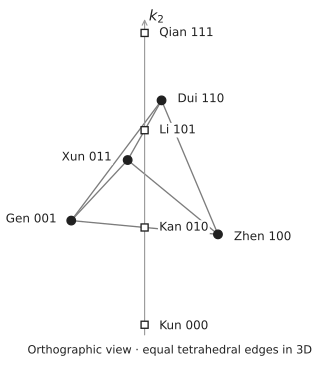
C Alternative branches: registers, calculations, and order comparisons
C.1 A compact specification of the branches
Let \(\sigma=0\) mean \(x\) below \(y\), and \(\sigma=1\) mean \(y\) below \(x\). Let \(\mu\) denote moisture valuation and \(\rho\) returning-source choice as in Section 9.9.2. In source coordinates \(({p_x},{p_y})\) always means the selected \(x\) bit and \(y\) bit, irrespective of which is bottom. Define the source indicator \(r_\rho=p_x\oplus p_y\oplus\rho\), with \(1\) selecting \(x\) and \(0\) selecting \(y\). The source identity \(\ell_\rho\) and its already-present pole bit \(p_{{\rm ret},\rho}\) are \[\ell_\rho({p_x},{p_y})= \begin{cases} x,&{p_x}\oplus {p_y}\oplus\rho=1,\\ y,&{p_x}\oplus {p_y}\oplus\rho=0, \end{cases} \qquad p_{{\rm ret},\rho}({p_x},{p_y})= \begin{cases}{p_x},&\rho=0,\\{p_y},&\rho=1.\end{cases}\] The selected source already has pole \(p_{{\rm ret},\rho}\). Set \(q=p_{{\rm ret},\rho}\oplus\varepsilon\), where \(\varepsilon=0\) reinforces and \(\varepsilon=1\) counterbalances. The sourced word is \[\mathcal W^{\mathcal G}_{\sigma,\rho}({p_x},{p_y},\varepsilon)= \begin{cases} (x^{p_x},y^{p_y},\ell_\rho^{\,p_{{\rm ret},\rho}\oplus\varepsilon}),&\sigma=0,\\ (y^{p_y},x^{p_x},\ell_\rho^{\,p_{{\rm ret},\rho}\oplus\varepsilon}),&\sigma=1. \end{cases}\] The associated binary encoder forgets source labels:
\[\Phi^{\mathcal G}_{\sigma,\rho}(p_x,p_y,\varepsilon)=\begin{cases}(p_x,p_y,q),&\sigma=0,\\(p_y,p_x,q),&\sigma=1,\end{cases}\qquad q=p_{{\rm ret},\rho}\oplus\varepsilon.\] Thus \(\Phi^{\mathcal G}=\Phi^{\mathcal G}_{0,0}\); the alternate retained-stack encoder is \(\Phi^{\mathcal G}_{0,1}\). The sourced word’s semantic interpretation is \(V_\mu(\mathcal W^{\mathcal G}_{\sigma,\rho})\), applied contribution by contribution. Forgetting source labels gives \(({p_x},{p_y},q)\) for \(\sigma=0\) and \(({p_y},{p_x},q)\) for \(\sigma=1\). With this notation, we can distinguish a positional change from a change of source rule, rather than silently pass from one to the other. For either stacking, \(\ell_\rho\) continues to depend on the source bits \({p_x},{p_y}\).
Within this deliberately restricted comparison, the two moisture valuations, two stackings, and two complete-circuit selectors give \(2\cdot2\cdot2=8\) distinct assignments of semantic source compositions to the eight named glyphs before relabelling equivalences. Every assignment includes both values of \(\varepsilon\). In this count, we hold the archetypal meanings themselves fixed. We are neither counting the potentially many respects in which a verbal handle can be understood nor asserting that the eight interpretations are equally plausible. Broader source choices or unrestricted selectors enlarge the family; equivalences that allow named glyphs or meanings to move reduce it.
If the lower two semantic constituents are treated as an unordered basis and named glyphs are forgotten, pure restacking contributes no additional elemental composition. In that comparison the eight specifications reduce to two eight-mode semantic sets: characteristic-source qualification when \(\mu=\rho\), and other-constituent qualification when \(\mu\ne\rho\). Their union contains all sixteen qualified elemental compositions. Retaining the ordered provenance or the received name prevents those identifications. Before we can say “how many schemas” there are, we must therefore specify which of these objects we are counting.
C.2 Complete moisture valuation register and interaction
The main comparison fixes \(x\) below \(y\). In the following register, we can follow every change of qualified meaning while retaining the glyphs, received phases, and reinforcing/counterbalancing relations.
| Trigram | Phase | \(V_0\): moist = yang | \(V_1\): moist = yin | Relation |
|---|---|---|---|---|
| Kun 坤 | 土 | Dry Terra | Moist Aqua | \(\mathrm{rnf}\) |
| Gen 艮 | 土 | Moistening Terra | Drying Aqua | \(\mathrm{ctr}\) |
| Kan 坎 | 水 | Cold Aqua | Cold Terra | \(\mathrm{rnf}\) |
| Xun 巽 | 木 | Warming Aqua | Warming Terra | \(\mathrm{ctr}\) |
| Zhen 震 | 木 | Cooling Ignis | Cooling Aer | \(\mathrm{ctr}\) |
| Li 離 | 火 | Hot Ignis | Hot Aer | \(\mathrm{rnf}\) |
| Dui 兌 | 金 | Drying Aer | Moistening Ignis | \(\mathrm{ctr}\) |
| Qian 乾 | 金 | Moist Aer | Dry Ignis | \(\mathrm{rnf}\) |
Interaction with the returning-source choice.
We can make the two choices independently, although their semantic consequences interact. Write \(\mu=0,1\) for \(V_0,V_1\) and \(\rho=0,1\) for \(\mathcal G,\widehat{\mathcal G}\). At fixed \(x\)-below-\(y\) stacking, the four combinations give Table 26. A characteristic-source rule is obtained exactly when \(\mu=\rho\); exchanging both choices restores characteristic qualification for the newly allocated elements.
| Valuation | Return rule | Qualifier source relative to the element | Directed elemental base cycle |
|---|---|---|---|
| \(V_0\) | \(\mathcal G\) | Characteristic | Aer–Ignis–Terra–Aqua |
| \(V_0\) | \(\widehat{\mathcal G}\) | Other constituent | Aer–Aqua–Terra–Ignis |
| \(V_1\) | \(\mathcal G\) | Other constituent | Aer–Aqua–Terra–Ignis |
| \(V_1\) | \(\widehat{\mathcal G}\) | Characteristic | Aer–Ignis–Terra–Aqua |
To see the direction change algebraically, let \(p_{\rm wet}=1\) mean moist and \(p_{\rm wet}=0\) dry, and write the physical-quality base bits as \(({p_x},{p_{\rm wet}})=({p_x},{p_y}\oplus\mu)\) and let \(F_\mu({p_x},{p_y})=({p_x},{p_y}\oplus\mu)\). Then the base step in these coordinates is \(F_\mu\mathcal R_\rho F_\mu\), where \(\mathcal R_0\) is the original base successor and \(\mathcal R_1=\mathcal R_0^{-1}\). Since \(F_1\mathcal R_0 F_1=\mathcal R_1\), either moisture reversal or return-rule exchange reverses this elemental succession; doing both restores it. The operations still differ: through one we revalue all \(y\) contributions, while through the other we change the third contribution’s source. We can see the difference by holding a named trigram fixed.
The cardinal base alignment under \(V_1\) is independent of the return rule, but the reinforced modes and the construction’s named eight-state cycle are not. In particular, \(\widehat{\mathcal G}\) does not generate the XT named adjacency, as Section 9.9.1 established. Putting its meanings into the received XT positions is a subsequent arrangement choice. Conversely, the \(V_1,\mathcal G\) construction retains XT’s undirected adjacency while its elemental succession runs oppositely to the spring–summer–autumn–winter reading. Agreement of placement therefore gives us no assurance that the directed traversals agree.
The exactness claimed here is combinatorial and schematic. The square-frame overview can be reflected and compass-anchored to the XT placements; the unequal angular intervals in the signed-contribution plot do not become a regular compass octagon by rigid rotation. By retaining this distinction, we keep the exact correspondence of identities and cyclic order from becoming an unsupported claim about metric geometry.
The two other-constituent branches in Table 26 have the same eight qualified meanings and directed semantic succession, but attach them to different named trigrams; Appendix C.5 records the exact correspondence and distinguishes it from the positional swaps giving LH.
C.3 Equivalences and their limits
Table 12 states the invariants of each operation; Appendix B proves the planar equivalences. Two interactions between branches call for particular care.
A simultaneous reversal of moisture valuation and returning-source selector restores the characteristic eight-mode semantic set, but it does not preserve its allocation to named trigrams. The map \({T_{\rm sem}}\) in Appendix C.5 states exactly how the two other-constituent branches match across their different named allocations. Likewise, the equality of the alternate named cycle with a bottom–middle bit permutation of the first is not an identity of sourced meanings. We can therefore relate rotation, reflection, relabelling, restacking, and source exchange, while recognising that each preserves different things. They cannot serve as interchangeable explanations of a single reversal.
C.4 Base invariance, child exchange, and LH adjacency
Exchanging the return rule leaves the elemental base of each named trigram invariant. Kan and Xun still have Aqua as their base; Zhen and Li still have Ignis; Kun and Gen retain Terra; Qian and Dui retain Aer. Only the upper contribution’s source changes. In the two directed lists rooted at Qian, however, the middle and eldest children exchange their places: \[\Sigma=(\mathrm{Kan}\ \mathrm{Zhen})(\mathrm{Xun}\ \mathrm{Li}),\qquad \Gamma^{\mathcal G}_1=\Sigma\Gamma^{\mathcal G}_0.\] Parents and youngest children remain fixed in this comparison. The same bit permutation describes pure restacking, but its appearance here is an equality between aligned lists, not a change to the retained \(x\)-below-\(y\) source allocation. Nor should we read this as a claim that just those two pairs exchange physical positions in the fixed source-frame drawing. The construction now traverses that frame in the other direction.
We can also follow the change through reversal symmetry. Write \(\mathscr S_{\rm rev}=\{\mathrm{Kun,Kan,Li,Qian}\}\) for the reversal-symmetric quartet and \(\mathscr A_{\rm rev}\) for the other four. A run is a maximal group of consecutive members of one class, including the closing edge of the circle.
| Order | \(\mathscr S_{\rm rev}\) run sizes | \(\mathscr A_{\rm rev}\) run sizes | Crossings |
|---|---|---|---|
| \(\Gamma^{\mathcal G}_0\) (XT adjacency) | \(1,1,1,1\) | \(1,1,1,1\) | 8 |
| \(\Gamma^{\mathcal G}_1\) (alternate rule) | \(2,2\) | \(2,2\) | 4 |
| LH | \(2,2\) | \(3,1\) | 4 |
Thus the alternate rule divides each quartet into two adjacent pairs. In \(\Gamma^{\mathcal G}_1\), the symmetric pairs are Kan–Kun and Li–Qian; the asymmetric pairs are Dui–Xun and Gen–Zhen. We can recognise a particular resemblance to LH here, without identifying the two organisations. Binary complements remain diametrically opposed in \(\Gamma^{\mathcal G}_1\), whereas their LH separations are \(1,2,3,4\). Likewise, both construction cycles have six parity crossings, while LH has two.
The three exchanges marked in Figure 26 (p. 92) give a more exact connection. Let \[\Pi=(\mathrm{Xun}\ \mathrm{Kun})(\mathrm{Kan}\ \mathrm{Li}) (\mathrm{Gen}\ \mathrm{Zhen}).\] These are disjoint swaps, so their order does not matter. Applied to the alternate cycle, they give \[\Pi\Gamma^{\mathcal G}_1=(\mathrm{Qian,Dui,Kun,Li,Xun,Zhen,Gen,Kan}),\] which is LH read in the reverse of the orientation used in this paper. The two Jin trigrams remain fixed. In making this rearrangement, we move each trigram together with its entire assigned meaning. We do not recalculate its base from the destination it reaches on the source-frame diagram.
(a) The three exchanges
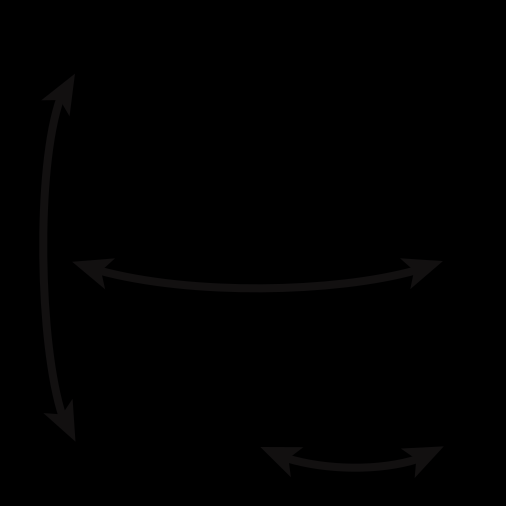
(b) The resulting arrangement
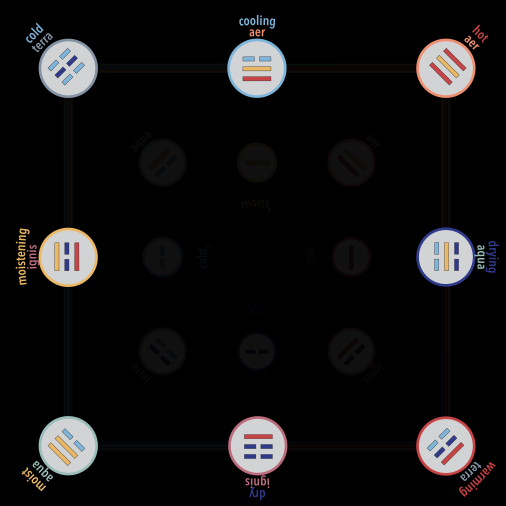
The three-swap route is minimal under a specified comparison: arbitrary pair exchanges are allowed, and rotations and reversal of the target LH circle are treated as equivalent. For any fixed alignment, the minimum number is \(8-\operatorname{cyc}(\pi)\), where \(\operatorname{cyc}(\pi)\) counts all cycles, including fixed points, of the required permutation. Testing LH’s sixteen alignments gives a minimum of three from \(\Gamma^{\mathcal G}_1\), uniquely attained by the alignment above, and four from \(\Gamma^{\mathcal G}_0\). We therefore have a shortest route in this metric. This gives us no historical derivation of LH, and if we restrict the allowed moves differently, we define a different comparison. Appendix C.5 distinguishes these positional swaps from the permutation that matches identical meanings under \(V_1\).
C.5 Meaning correspondence between the alternate branches
The alternate return rule at \(V_0\) and the original rule at \(V_1\) generate exactly the same eight qualified elemental terms. Table 28 matches them without treating named trigram identities as interchangeable. Let \[\mathcal E_{\mu,\rho}(b)=V_\mu\bigl(\mathcal G_\rho(b)\bigr),\qquad \mathcal G_0=\mathcal G,\quad\mathcal G_1=\widehat{\mathcal G}.\] The retained elemental reading is \(\mathcal E=\mathcal E_{0,0}\). There is a unique permutation \({T_{\rm sem}}\) satisfying \(\mathcal E_{0,1}(b)=\mathcal E_{1,0}({T_{\rm sem}}b)\) for all eight trigrams.
| Shared qualified term | \(V_0,\widehat{\mathcal G}\) | \(V_1,\mathcal G\): \({T_{\rm sem}}(b)\) |
|---|---|---|
| Hot Aer | Qian \(111\) | Li \(101\) |
| Cooling Aer | Dui \(110\) | Zhen \(100\) |
| Moist Aqua | Xun \(011\) | Kun \(000\) |
| Drying Aqua | Kan \(010\) | Gen \(001\) |
| Cold Terra | Kun \(000\) | Kan \(010\) |
| Warming Terra | Gen \(001\) | Xun \(011\) |
| Dry Ignis | Zhen \(100\) | Qian \(111\) |
| Moistening Ignis | Li \(101\) | Dui \(110\) |
Equality of the first two semantic contributions forces \({p_x}'={p_x}\) and \({p_y}'=1-{p_y}\). The return sources then agree across these two rules. When \({p_x}={p_y}\), the qualifier comes from \(x\), so \(q'=q\); when \({p_x}\ne {p_y}\), it comes from \(y\), whose valuation has reversed, so \(q'=1-q\). Therefore \[{T_{\rm sem}}({p_x},{p_y},q)=\bigl({p_x},1-{p_y},q\oplus({p_x}\oplus {p_y})\bigr).\] In named-cycle notation, \[{T_{\rm sem}}=(\mathrm{Kun}\ \mathrm{Kan}\ \mathrm{Gen}\ \mathrm{Xun}) (\mathrm{Zhen}\ \mathrm{Qian}\ \mathrm{Li}\ \mathrm{Dui}).\] Applying it twice gives \({T_{\rm sem}}^2({p_x},{p_y},q)=({p_x},{p_y},1-q)\), and \({T_{\rm sem}}^4=I\). It is consequently an order-four correspondence, not the three-swap involution \(\Pi\). It also transports the directed semantic cycle: \[{T_{\rm sem}}\Gamma^{\mathcal G}_1=(\mathrm{Li,Zhen,Kun,Gen,Kan,Xun,Qian,Dui}),\] which is \(\Gamma^{\mathcal G}_0\) with its starting point moved to Li. We thus recover the same directed sequence of qualified meanings in both models, although those meanings are distributed differently among the trigrams.
We can state the relation to the proposed LH swaps exactly, while keeping the operations distinct. Expressing the same three exchanges through the matched meanings gives \[\Pi_{\rm sem}={T_{\rm sem}}\Pi {T_{\rm sem}}^{-1} = (\mathrm{Kan}\ \mathrm{Kun})(\mathrm{Gen}\ \mathrm{Dui}) (\mathrm{Xun}\ \mathrm{Qian}),\] and \(\Pi_{\rm sem}{T_{\rm sem}}\Gamma^{\mathcal G}_1={T_{\rm sem}}\Pi\Gamma^{\mathcal G}_1\). This transports the rearrangement consistently. Its result is LH with every trigram relabelled by \({T_{\rm sem}}\), not the received named LH order. The original three swaps concern positions of fixed states; \({T_{\rm sem}}\) concerns identical compositions across different semantic assignments. By keeping these operations separate, we allow the common vocabulary to illuminate the comparison while retaining the received identities that made it interesting in the first place.
D Human Compass derivations and supplementary relations
D.1 Sandwich projection and Participation masks
All triples in this appendix read bottom–middle–top. The fixed-order literal projection of the source word \(\mathcal W_{\mathcal H}\) is \[L_{\mathcal H}({p_P},{p_A},{\chi})=\begin{cases}({p_P},{p_A},{p_P}),&{\chi}=0,\\({p_P},{p_A},{p_A}),&{\chi}=1.\end{cases}\] At \({p_P}={p_A}\), both emphasis choices have the same image: EBE and EBB give \(000\), while CAC and CAA give \(111\). At \({p_P}\ne {p_A}\), the four images are distinct. Hence \(L_{\mathcal H}\) has six images. The sandwich projection instead places the repeated constituent on the outside: \[S_{\mathcal H}({p_P},{p_A},{\chi})=\begin{cases}({p_P},{p_A},{p_P}),&{\chi}=0,\\({p_A},{p_P},{p_A}),&{\chi}=1.\end{cases}\] The map \(S_{\mathcal H}\) has four images, all symmetric, each with two sourced preimages. Table 29 identifies their differentiation under \(\Phi_{\mathcal H}\). From the raw seed, we can read the polarities of the repeated and secondary constituents; their source identities have been erased.
| Raw seed | First sourced preimage and output | Second sourced preimage and output |
|---|---|---|
| Kun \(000\) | EBE (EE) \(\to\) Kun/Pain |
BEB (E) \(\to\) Gen/Shame |
| Kan \(010\) | EAE (EE) \(\to\) Kan/Fear |
BCB (C) \(\to\) Dui/Joy |
| Li \(101\) | AEA (E) \(\to\) Zhen/Anger |
CBC (CC) \(\to\) Qian/Love |
| Qian \(111\) | ACA (C) \(\to\) Xun/Guilt |
CAC (CC) \(\to\) Li/Passion |
Let \(M_{\mathcal H}\) denote the inversion mask, with \(1\) marking a line to flip. The four class instructions give \[M_{\mathcal H}({p_P},{\chi})=\bigl({p_P}{\chi},\;{p_P}(1-{\chi}),\;(1-{p_P}){\chi}\bigr),\qquad \Phi_{\mathcal H}({p_P},{p_A},{\chi})=S_{\mathcal H}({p_P},{p_A},{\chi})\oplus M_{\mathcal H}({p_P},{\chi}).\] Products here are ordinary products of bits, equivalently logical AND; XOR acts componentwise. Define the second class bit \({\kappa}={p_P}\oplus {\chi}\). Then \[\widetilde M_{\mathcal H}({p_P},{\kappa})=\bigl({p_P}(1-{\kappa}),\;{p_P}{\kappa},\;(1-{p_P}){\kappa}\bigr),\] where \(\widetilde M_{\mathcal H}\) writes the same mask in class coordinates rather than \(({p_P},{\chi})\). Thus \(00,01,10,11\) select, respectively, no inversion, top, bottom, and middle inversion. The mask is independent of \({p_A}\): each instruction applies to both Animation poles.
Equivalence with the original encoder. For \({\chi}=0\), the mask is \((0,{p_P},0)\), so \(({p_P},{p_A},{p_P})\) becomes \(({p_P},{p_P}\oplus {p_A},{p_P})\). For \({\chi}=1\), the mask is \(({p_P},0,1-{p_P})\), so \(({p_A},{p_P},{p_A})\) becomes \(({p_P}\oplus {p_A},{p_P},1-({p_P}\oplus {p_A}))\). Consequently \[\Phi_{\mathcal H}({p_P},{p_A},{\chi})= \begin{cases} ({p_P},{p_P}\oplus {p_A},{p_P}),&{\chi}=0,\\ ({p_P}\oplus {p_A},{p_P},1-({p_P}\oplus {p_A})),&{\chi}=1. \end{cases}\] The sandwich-and-mask account is therefore a factorisation of the existing encoder, not a replacement assignment. ◻
For signed-contribution coordinates, align Animation with \(x\) and Participation with \(y\), assigning each source contribution unit magnitude. Then \[X_{\mathcal H}=(2{p_A}-1)(1+{\chi}),\qquad Y_{\mathcal H}=(2{p_P}-1)(2-{\chi}).\] The four heights are \(-2,-1,+1,+2\) in class order EE, E, C, CC. At fixed height, the two Animation poles give opposite horizontal positions. We use these counts to display the construction, without inferring a quantitative scale of emotion.
The row–column identity.
For an encoded glyph \(b=\Phi_{\mathcal H}(p_P,p_A,\chi)\), the same mask polynomial has a second use: \[b\oplus(p_P,p_P,p_P)=M_{\mathcal H}(p_A,\chi), \qquad b=(p_P,p_P,p_P)\oplus M_{\mathcal H}(p_A,\chi).\] Here \(M_{\mathcal H}(p_A,\chi)\) evaluates the existing function at the Animation bit. The mask actually applied to the raw sandwich remains \(M_{\mathcal H}(p_P,\chi)\).
Row–column identity. Subtracting the homogeneous pattern by XOR from the two cases of the encoder gives \[b\oplus(p_P,p_P,p_P)= \begin{cases} (0,p_A,0),&\chi=0,\\ (p_A,0,1-p_A),&\chi=1. \end{cases}\] These are exactly the two cases of \(M_{\mathcal H}(p_A,\chi)\). Each has at most one nonzero bit, so \(p_P\) is the glyph’s majority. A zero mask identifies a parent; a top, middle, or bottom minority line identifies, respectively, a youngest, middle, or eldest child. At fixed \(p_A,\chi\), exchanging \(p_P\) complements every line while retaining that family class. Thus the four columns have precisely the memberships in Table 14. ◻
The coordinates recover their respective inputs: the sign of \(X_{\mathcal H}\) determines \(p_A\) and its magnitude gives \(\chi=|X_{\mathcal H}|-1\); the sign of \(Y_{\mathcal H}\) determines \(p_P\) and its magnitude gives \(\chi=2-|Y_{\mathcal H}|\). Hence admissible row–column intersections satisfy \(|X_{\mathcal H}|+|Y_{\mathcal H}|=3\). This accounts for the eight occupied positions and shows why the row and column classifications share a choice rather than supplying four independent bits.
The masks have a simple reflection identity. In class coordinates, \[\widetilde M_{\mathcal H}({\kappa},{p_P})=R_{\rm line}\bigl(\widetilde M_{\mathcal H}({p_P},{\kappa})\bigr),\] where \(R_{\rm line}\) reverses the first and third positions. The EE and CC masks are fixed; the E and C masks exchange top and bottom. Here we are describing the masks alone. To reflect an entire encoded glyph, we must also consider its source arrangement, as the reversal formula below specifies.
At fixed \({p_A},{\chi}\), changing Participation gives a full binary complement. We can see why without expanding the encoder. For \({\chi}=0\), the raw sandwich changes by \(101\) and the mask by \(010\). For \({\chi}=1\), it changes by \(010\) and the mask by \(101\). Their XOR is \(111\) in both cases. We can thus understand how changing one semantic source reverses every displayed line.
D.2 Inverse encoding and matching operations
The inverse of \(\Phi_{\mathcal H}\) in Section 5 follows by separating the two repeated-source cases.
Proof. If \({\chi}=0\), the outer bits agree and equal \({p_P}\), so they determine the majority. The middle bit \({p_P}\oplus {p_A}\) recovers \({p_A}\) by XOR with the bottom bit. If \({\chi}=1\), the outer bits oppose, so the middle bit determines the majority and equals \({p_P}\). The bottom bit is \({p_P}\oplus {p_A}\), again recovering \({p_A}\). The two cases are disjoint and exhaust all eight trigrams. ◻
We can repeat the comparison in Section 15.3 for the Human Compass, provided we define its relations from its own source words. Four distinct matchings are relevant. A shared-base pair changes which source is repeated: \[\mathcal B_{\mathcal H}({p_P},{p_A},{\chi})=({p_P},{p_A},1-{\chi}).\] A shared-repeated-pole pair retains the repeated contribution and changes the other constituent of the base: \[\mathcal J_{\mathcal H}({p_P},{p_A},{\chi})= \begin{cases} ({p_P},1-{p_A},{\chi}),&{\chi}=0,\\ (1-{p_P},{p_A},{\chi}),&{\chi}=1. \end{cases}\] Full semantic opposition exchanges both source poles while retaining the repeated source: \[\mathcal D_{\mathcal H}({p_P},{p_A},{\chi})=(1-{p_P},1-{p_A},{\chi}).\] The semantic pair names and examples are given in Section 15.4.
Binary trigram complementation, \(C_{\rm bit}(b)=1-b\), instead reverses all three broken/unbroken line values. Under the Human Compass encoder it gives \[\Phi_{\mathcal H}^{-1}C_{\rm bit}\Phi_{\mathcal H}({p_P},{p_A},{\chi})=(1-{p_P},{p_A},{\chi}).\] It exchanges Participation alone, retaining Animation and the repeated source.
For completeness, semantic opposition acts on the encoded bits by \[\Phi_{\mathcal H}\mathcal D_{\mathcal H}\Phi_{\mathcal H}^{-1}(b)= \begin{cases} b\oplus101,&{\chi}=0,\\ b\oplus010,&{\chi}=1, \end{cases} \qquad {\chi}=b_1\oplus b_3.\] It is not a uniform three-bit complement. All four operations are fixed-point-free involutions and therefore each partitions the eight states into four pairs. The first three matchings have no pairs in common. Binary complementation overlaps \(\mathcal J_{\mathcal H}\) at Guilt–Anger and Joy–Shame, while remaining a distinct matching. We can distinguish the relations without requiring them to be disjoint.
D.3 Additional transition counts
The following counts use the three cycles in Section 15. A repeated-pole change compares both source and sign; source selection belongs to \(\mathcal W_{\mathcal H}\), rather than literally to the encoded top line. The binary statistics agree with Table 16 because XT and LH contain the same named glyphs in both comparisons.
| Property | Native \(\mathcal H\) | XT | LH |
|---|---|---|---|
| Repeated-source changes | \(4\) | \(8\) | \(4\) |
| Repeated-pole changes, with provenance | \(4\) | \(8\) | \(7\) |
| Bottom/middle/top bit-change totals | \((4,6,4)\) | \((2,2,6)\) | \((6,4,6)\) |
| Binary parity crossings | \(6\) | \(6\) | \(2\) |
| Hamming weights of successive changes | \(1^{\times4},2^{\times2},3^{\times2}\) | \(1^{\times6},2^{\times2}\) | \(1,2^{\times6},3\) |
Shared base \(\mathcal B_{\mathcal H}\)
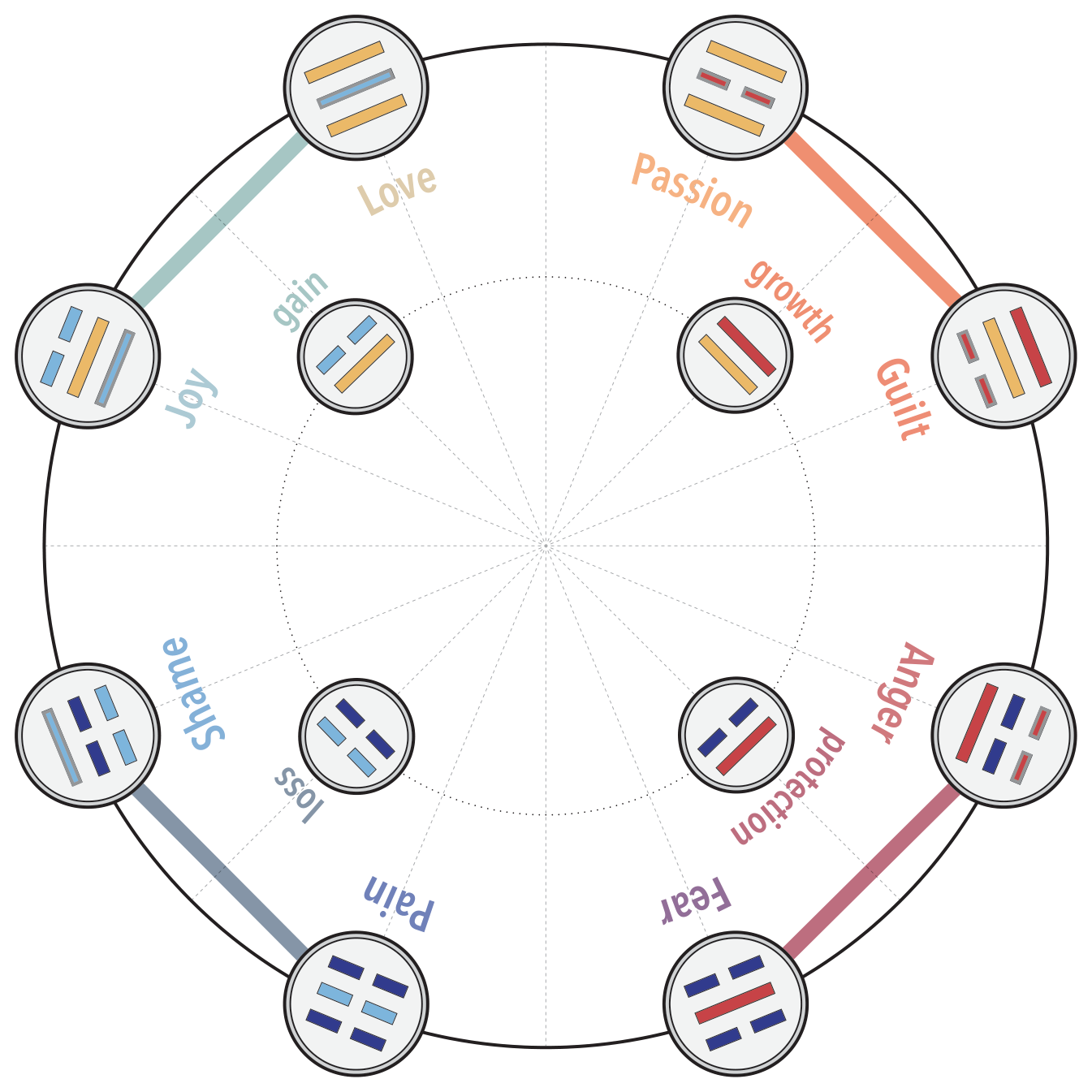
Shared repeated pole \(\mathcal J_{\mathcal H}\)
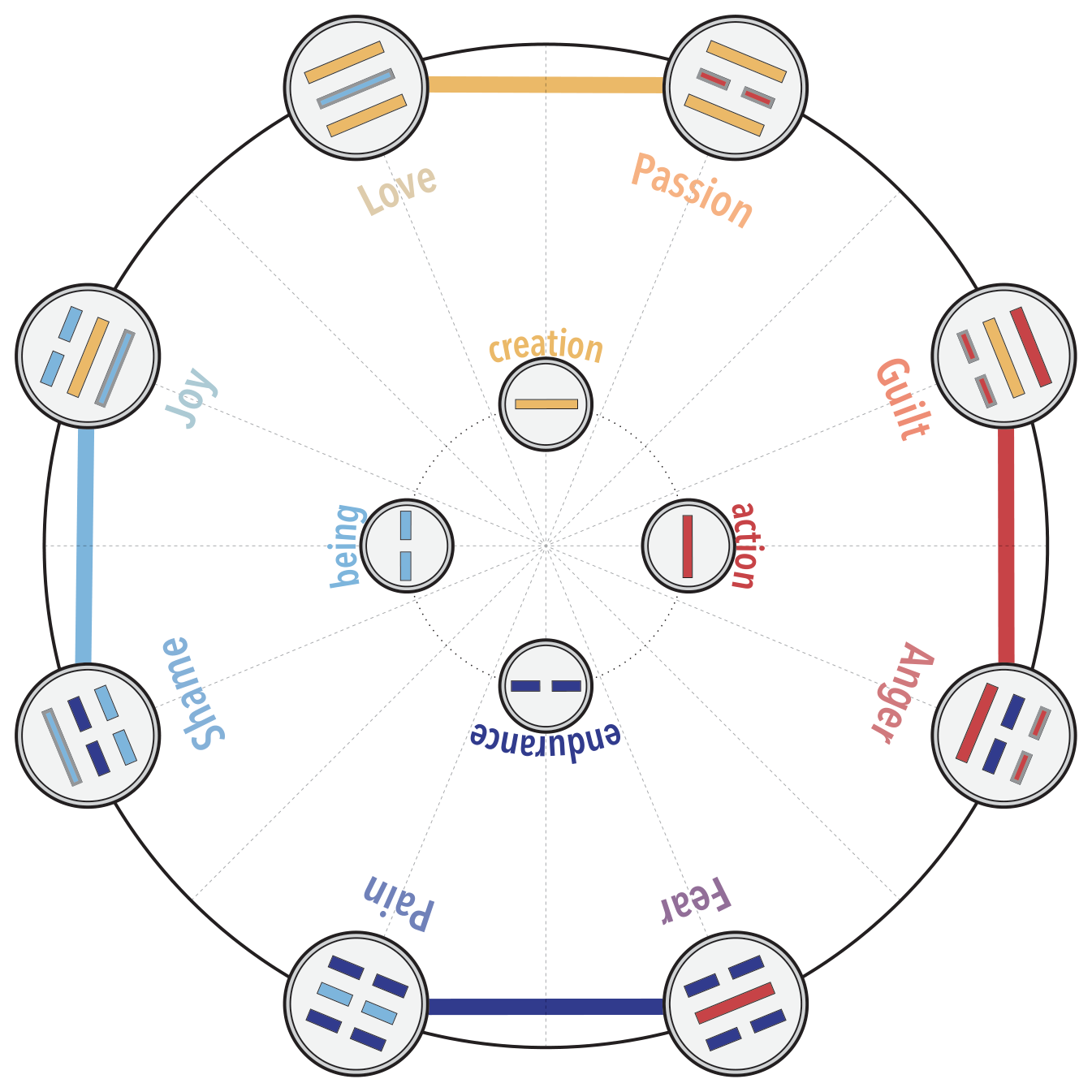
D.4 Further comparisons
Received phase memberships remain fixed when \(\mathcal H\) is rearranged. Mu contains Guilt and Anger; Tu contains Pain and Shame. XT and LH articulation therefore collect different emotional pairs. This follows from membership and adjacency. It does not tell us, as a psychological doctrine, which experiences mediate emotional life.
Reversal \(R_{\rm line}\) of the binary lines acts in \(\mathcal H\) coordinates as \[\Phi_{\mathcal H}^{-1}R_{\rm line}\Phi_{\mathcal H}({p_P},{p_A},{\chi})=({p_P},{p_A}\oplus {\chi},{\chi}).\] It exchanges Action and Being when Animation is repeated, pairing Guilt with Joy and Anger with Shame. The Participation-repeated states—Love, Passion, Fear, and Pain—remain fixed. These reversal pairs differ from the four complementary pairs in Figure 21. As with complementation, we discover what reversal means compositionally through the encoder.
D.5 The same-glyph genesis–\(\mathcal H\) conversion
Write a genesis trigram as \(b=({b_1},{b_2},{b_3})\). Let \({r_0}={b_1}\oplus {b_2}\) record its returning source (\({r_0}=0\) for \(y\), \({r_0}=1\) for \(x\)), and let \({\varepsilon}={b_1}\oplus {b_3}\) record reinforcement (\({\varepsilon}=0\)) or counterbalancing (\({\varepsilon}=1\)). The returning source’s present pole has bit \({b_1}\): when it is \(y\), \({b_1}={b_2}\); otherwise it is \(x\). Decoding the same glyph through \(\mathcal H\) gives \[{p_A}={r_0},\qquad {\chi}={\varepsilon},\qquad {p_P}={b_1}\oplus({r_0}{\varepsilon}).\] The conversion is invertible: \[{b_1}={p_P}\oplus({p_A}{\chi}),\qquad {b_2}={b_1}\oplus {p_A},\qquad {b_3}={b_1}\oplus {\chi}.\] For \({\varepsilon}=0\) the outer bits agree, so the majority is \({b_1}\). For \({\varepsilon}=1\) the majority is the middle bit \({b_2}={b_1}\oplus {r_0}\). This proves the formula for \({p_P}\) and shows why the conversion is conditional rather than a single fixed permutation of source positions.
| Trigram | Bits | Genesis sourced word | \(\mathcal H\) sandwich | Experience |
|---|---|---|---|---|
| Kun | \(000\) | \(x^-y^-y^-\) | EBE |
Pain |
| Gen | \(001\) | \(x^-y^-y^+\) | BEB |
Shame |
| Kan | \(010\) | \(x^-y^+x^-\) | EAE |
Fear |
| Xun | \(011\) | \(x^-y^+x^+\) | ACA |
Guilt |
| Zhen | \(100\) | \(x^+y^-x^-\) | AEA |
Anger |
| Li | \(101\) | \(x^+y^-x^+\) | CAC |
Passion |
| Dui | \(110\) | \(x^+y^+y^-\) | BCB |
Joy |
| Qian | \(111\) | \(x^+y^+y^+\) | CBC |
Love |
The common glyph map preserves only two shared-base pairs: Kun–Gen and Qian–Dui. Genesis also pairs Kan–Xun and Zhen–Li, whereas \(\mathcal H\) pairs Kan–Zhen and Xun–Li. Even a common pair need not retain the same source constituents under the overlay’s \(P=y\), \(A=x\) alignment. Qian–Dui has base \(x^+y^+\) in genesis; Love–Joy has Creation–Being, hence \(x^-y^+\) in the comparison palette. We therefore need to distinguish the claim of shared pair membership from that of shared semantic composition.
To compare the complete source-pair structures, we can instead align their native cycles. One isomorphism of shared-base, shared-pole, and semantic-opposition relations sends \[\begin{array}{c|cccccccc} \text{Genesis}&\mathrm{Kun}&\mathrm{Gen}&\mathrm{Kan}&\mathrm{Xun}&\mathrm{Qian}&\mathrm{Dui}&\mathrm{Li}&\mathrm{Zhen}\\ \mathcal H&\mathrm{Kun}&\mathrm{Gen}&\mathrm{Dui}&\mathrm{Qian}&\mathrm{Li}&\mathrm{Xun}&\mathrm{Zhen}&\mathrm{Kan}. \end{array}\] This is a relabelling between the two semantic structures, not the same-glyph arrow relation in the overlay. It preserves the alternating base/pole cycle and maps full genesis opposition to full \(\mathcal H\) semantic opposition. In establishing this isomorphism, we have not equated the respective emotional and elemental meanings.

D.6 Animation-reference \(\widehat{\mathcal H}\)
The alternative \(\widehat{\mathcal H}\) exchanges the formal reference roles of Participation and Animation while retaining each category’s semantic constituents and its emphasised source. With \({p_P},{p_A},{\chi}\) defined as in Section 5, its encoder is \[\Phi_{\widehat{\mathcal H}}({p_P},{p_A},{\chi})=\Phi_{\mathcal H}({p_A},{p_P},1-{\chi}).\] The change in \({\chi}\) expresses the same semantic emphasis in the exchanged reference roles. We are not asking each category to emphasise its former secondary constituent. The inverse can be read directly from a glyph: \[{p_A}=\operatorname{maj}(b_1,b_2,b_3),\qquad {p_P}=b_1\oplus b_2,\qquad 1-{\chi}=b_1\oplus b_3.\] The reference classes are BB, B, A, AA: repeated Being, single Being, single Action, and repeated Action. Their masks, in bottom–middle–top order, are respectively \(000\), \(001\), \(100\), and \(010\). A displayed inversion continues to encode a relation, without changing the semantic polarity of its sourced contribution.
| Category | Original \(\mathcal H\) | Animation-reference \(\widehat{\mathcal H}\) |
|---|---|---|
| Pain | Kun 坤 | Gen 艮 |
| Shame | Gen 艮 | Kun 坤 |
| Fear | Kan 坎 | Dui 兌 |
| Guilt | Xun 巽 | Li 離 |
| Anger | Zhen 震 | Qian 乾 |
| Passion | Li 離 | Xun 巽 |
| Joy | Dui 兌 | Kan 坎 |
| Love | Qian 乾 | Zhen 震 |
Both maps are bijective. The reference exchange \(({p_P},{p_A},{\chi})\mapsto({p_A},{p_P},1-{\chi})\) squares to the identity, so its induced permutation of glyph assignments is involutive. Under \(\mathcal H\), reversal-symmetric glyphs record Participation emphasis; under \(\widehat{\mathcal H}\), they record Animation emphasis. Binary complementation exchanges Participation alone in \(\mathcal H\) and Animation alone in \(\widehat{\mathcal H}\), retaining the other source pole and semantic emphasis.
Through this bounded comparison, we can identify what follows from the reference choice without developing a second series of semantic portraits for the atlas. A particular claim about the chosen encoding or its uniqueness can give us a reason for further exploration. The hats denote different operations: \(\widehat{\mathcal H}\) exchanges \(\mathcal H\)’s reference roles, whereas \(\widehat{\mathcal G}\) exchanges the returning-source rule in genesis.
E Supplementary semantic applications
E.1 The psychological register
The source meanings are Soma–Psyche and Synthesis–Analysis, with Analysis understood as judging and Synthesis as perceiving. Section 11 states this use of the Jungian distinction.
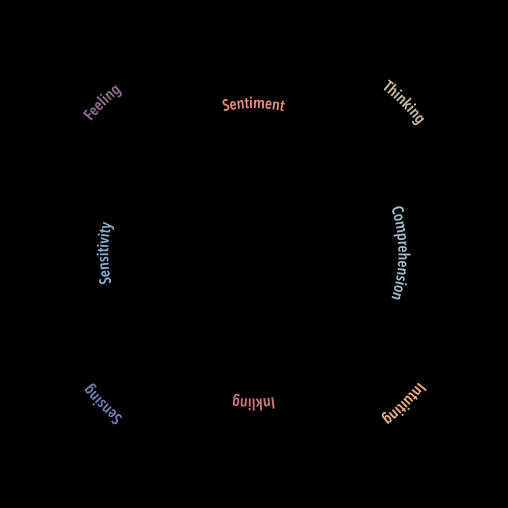
E.2 The psychological meaning of the other direction
The alternate base order is Cognition–Emotion–Sensation–Intuition–Cognition: conceptual judgment, felt valuation, bodily perception, and intuitive perception. At one step the Soma–Psyche emphasis changes while judging or perceiving persists; at the next, judging and perceiving exchange while Soma or Psyche persists. Table 33 retains the initial labels and offers provisional interpretations of the qualifiers.
| Code | Qualifier | Initial label | Proposed reading |
|---|---|---|---|
| \(111\) | Psyche | Psychological cognition | Judgment sustained in conceptual or symbolic experience. |
| \(110\) | Soma | Somatising cognition | Conceptual judgment acquiring bodily resonance and felt significance. |
| \(011\) | Analysis | Analytic emotion | Felt valuation reinforced as judgment: what matters, fits, attracts, or repels. |
| \(010\) | Synthesis | Synthesising emotion | Felt valuation opened to perceiving what is present, without immediately deciding its value. |
| \(000\) | Soma | Somatic sensation | Bodily perception emphasised in its immediate sensory presentation. |
| \(001\) | Psyche | Psychologising sensation | Bodily perception acquiring an imaginal or psychological dimension. |
| \(100\) | Synthesis | Holistic intuition | Intuitive apprehension reinforced as perception, before a judgment is settled. |
| \(101\) | Analysis | Analysing intuition | What intuition apprehends brought into evaluation or judgment. |
Through the opposed qualifiers, we can discern four possible passages. Somatising cognition brings conceptual judgment towards felt valuation while retaining judging as their shared function. Synthesising emotion opens felt valuation towards bodily perception while retaining Soma. Psychologising sensation opens bodily perception towards intuitive apprehension while retaining perceiving. Analysing intuition introduces judgment into intuitive apprehension, approaching Cognition while retaining Psyche.
We can thus make sense of “analytic emotion” without turning it into intellectual scrutiny of an emotion: feeling itself can judge. Likewise, “synthesising emotion” need not mean combining several emotions: its proposed emphasis is a receptive openness within a valuing experience. “Analysing intuition” need not dissect an intuition into parts; it can assess what is intuited. We are using the two functional poles here, rather than moving between the presence and absence of mental activity.
We nevertheless need to keep each base distinct from its qualifier. A perceiving qualification of Emotion is still a mode of felt valuation; the next Sensation base centres perception itself. A judging qualification of Intuition still begins with an intuitive apprehension; the next Cognition base centres judgment. We can understand the sequence as a shift of emphasis without requiring one mode to disappear completely before another becomes available.
Read together, these passages suggest judgment becoming embodied, valuation opening to perception, perception acquiring an imaginal dimension, and intuition entering judgment. This is a proposed cycle of relationships among capacities, not a compulsory temporal mechanism. We still need to explore whether examples allow us to distinguish every qualified mode without forcing their description. Jung’s judging–perceiving distinction supports the functional vocabulary; it does not establish this source decomposition, trigram assignment, or cyclic sequence.
The two directions therefore give all sixteen compositions formal places, while their psychological meaning remains an archetypal enquiry. We should accept neither the original nor the alternate eight merely because we can arrange their labels into a fluent story. Source fidelity is the first constraint: judging must remain judging, perceiving must remain perceiving, and a qualifier must not silently redefine its base.
E.3 The organic register
Inward–Outward and Assimilation–Differentiation supply the four bases used in Section 13. The eight modes remain fixed when their order changes.
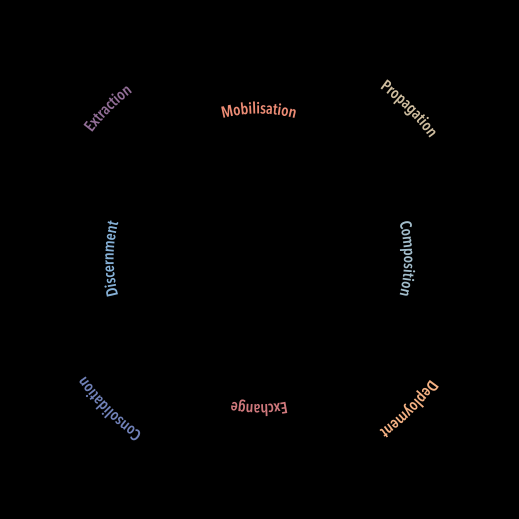
| Trigram | Code | Base | Qualified mode |
|---|---|---|---|
| Kun | \(000\) | Incorporation | Consolidating incorporation |
| Gen | \(001\) | Incorporation | Differentiating incorporation |
| Kan | \(010\) | Digestion | Conservative digestion |
| Xun | \(011\) | Digestion | Productive digestion |
| Zhen | \(100\) | Participation | Receptive participation |
| Li | \(101\) | Participation | Contributive participation |
| Dui | \(110\) | Reproduction | Consolidating reproduction |
| Qian | \(111\) | Reproduction | Multiplicative reproduction |
F Supplementary XT–LH pairing views
Earlier Heaven (XT)
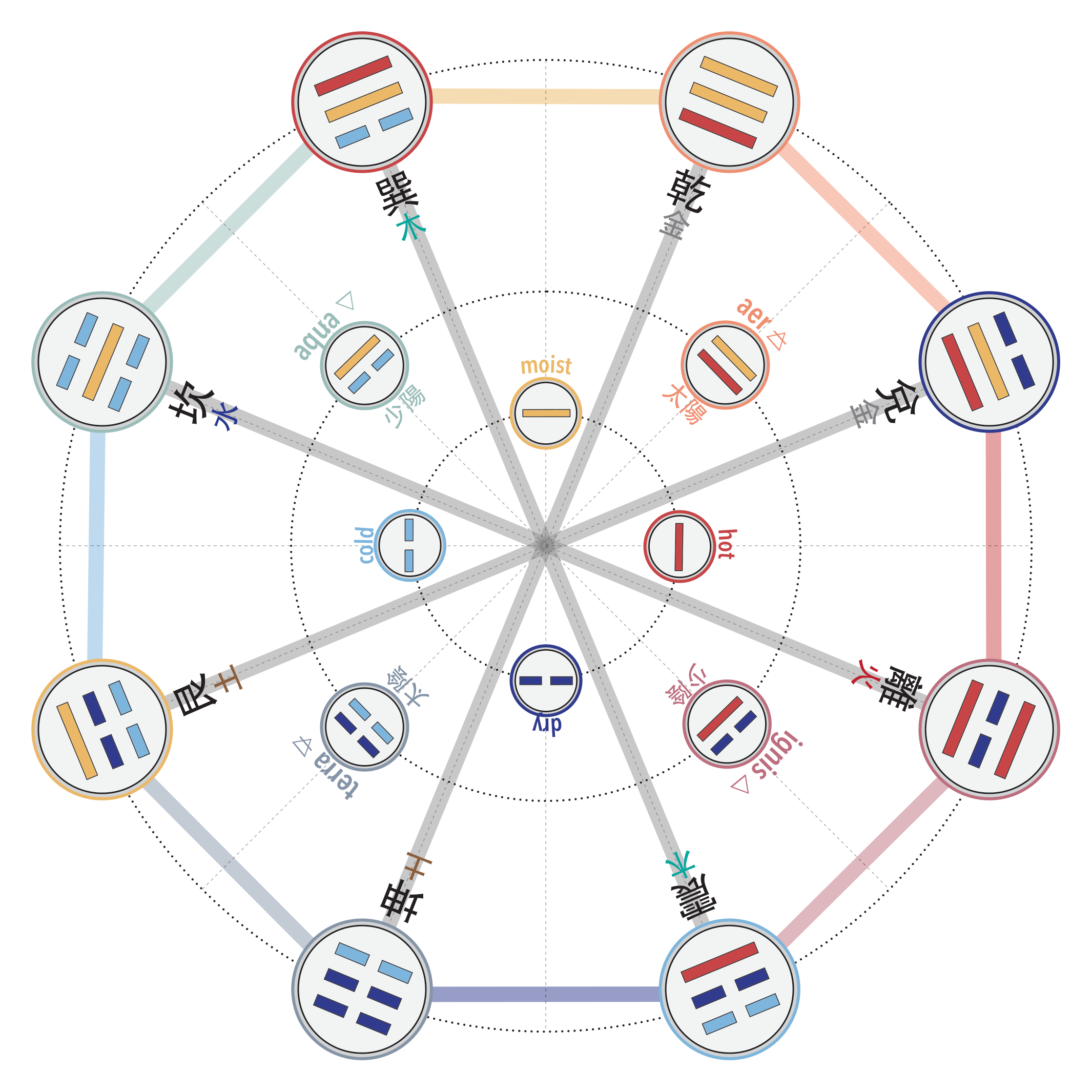
Later Heaven (LH)
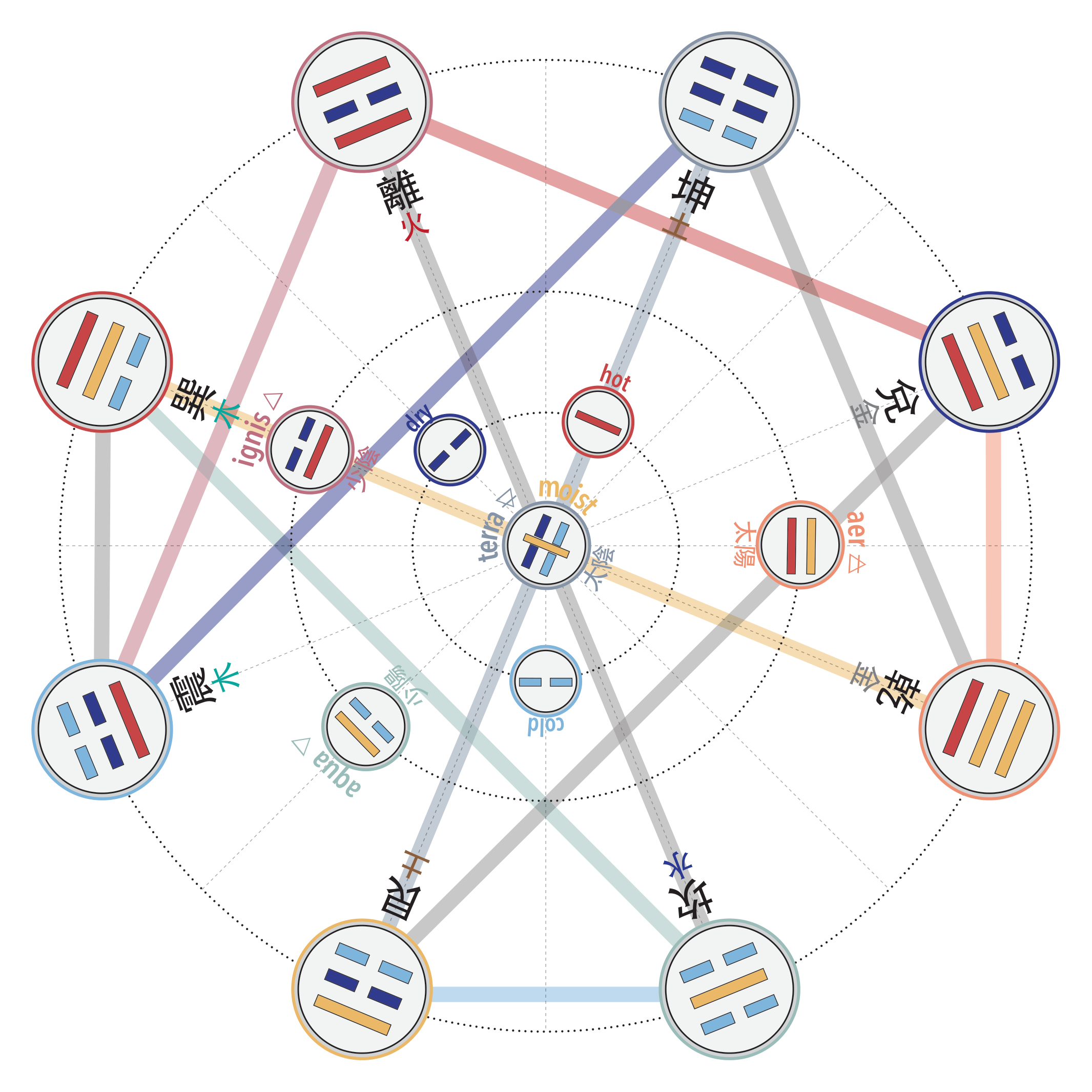
Earlier Heaven (XT)
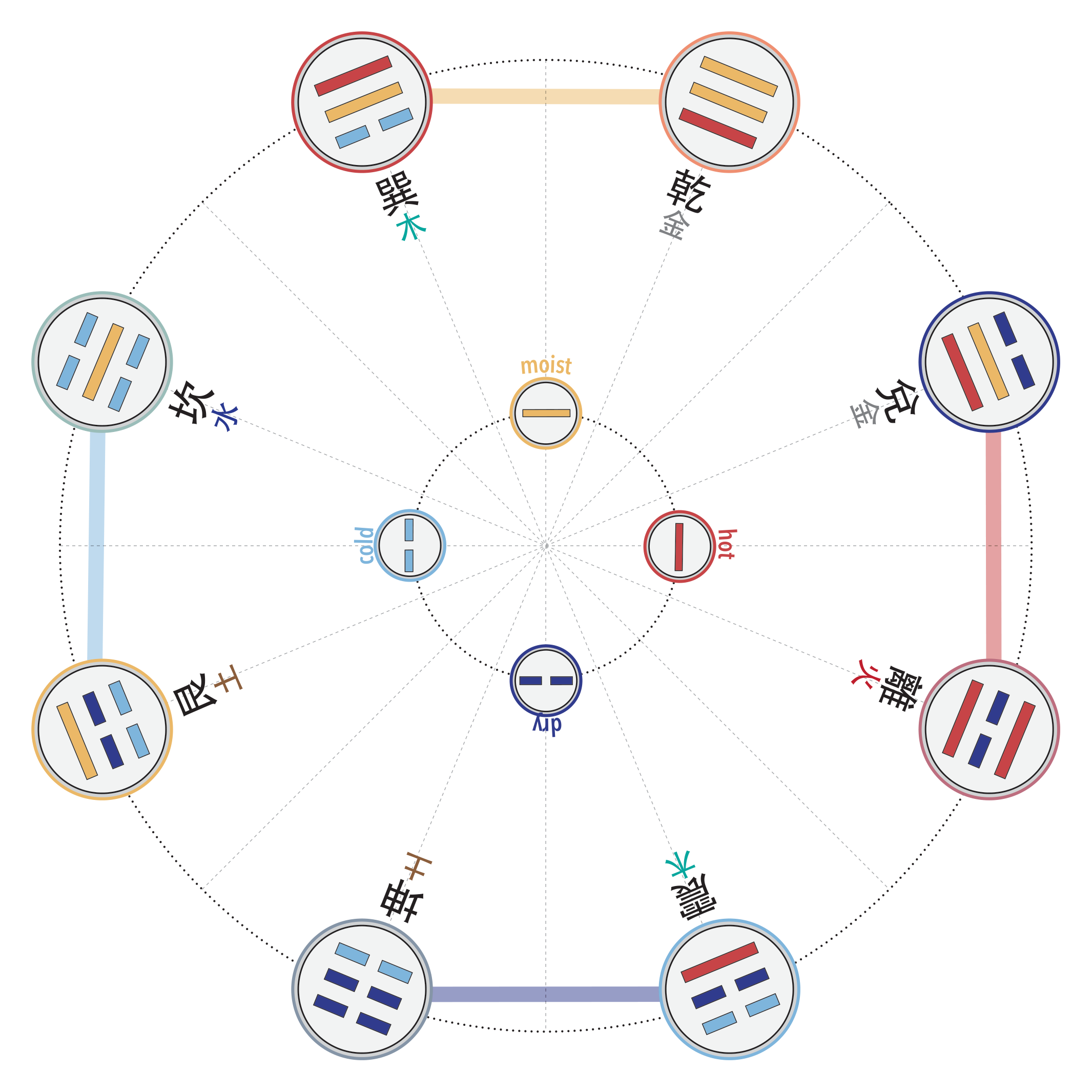
Later Heaven (LH)
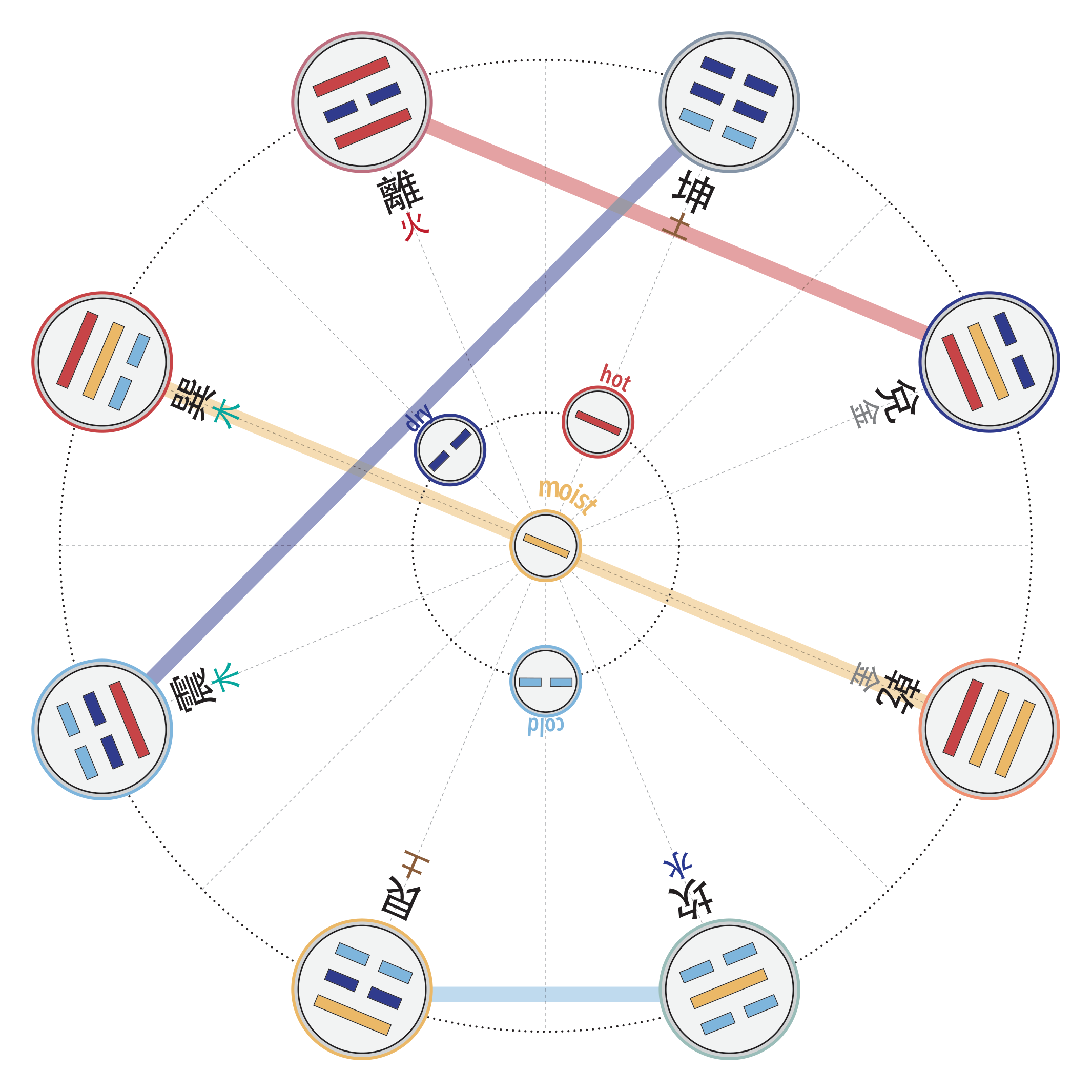
Earlier Heaven (XT)
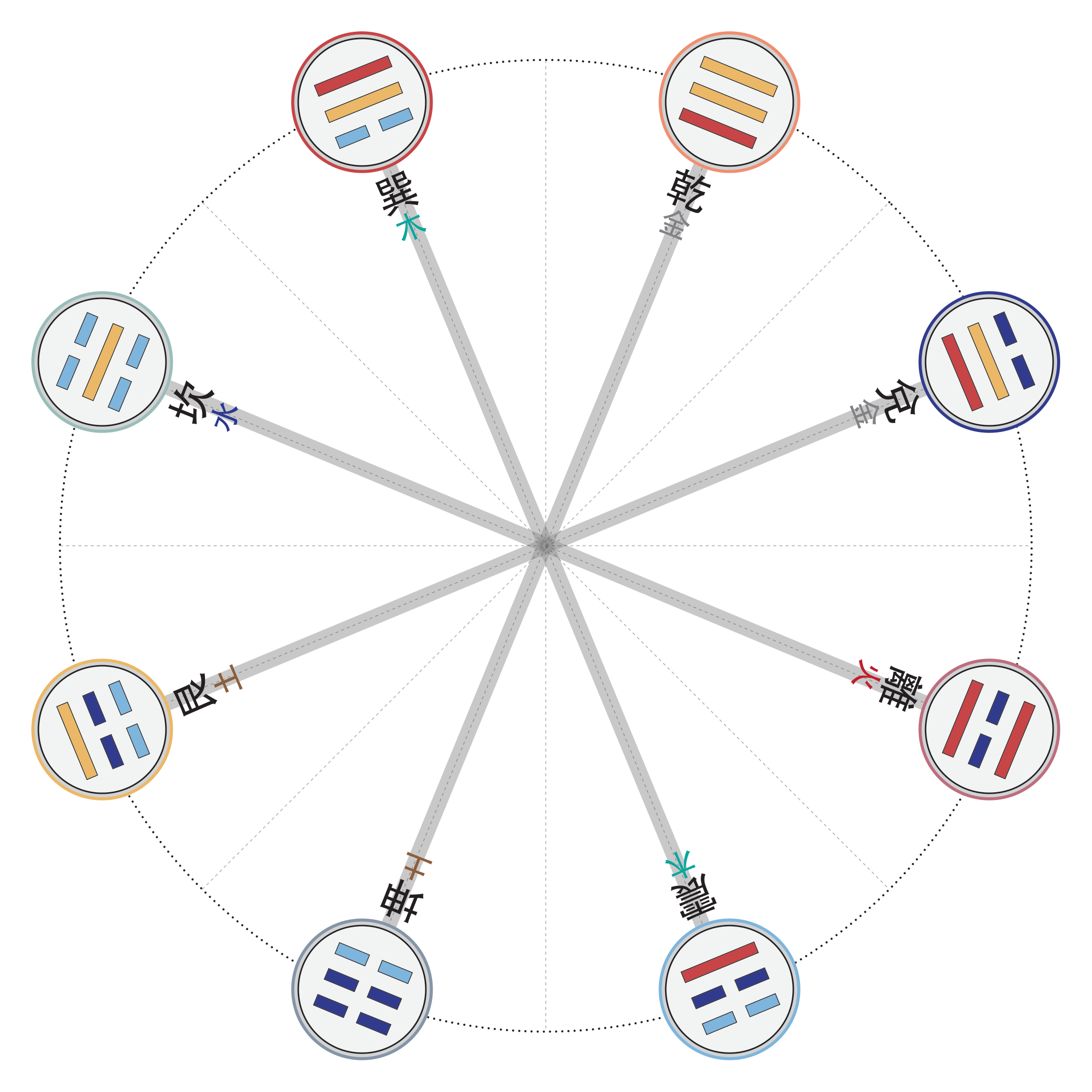
Later Heaven (LH)
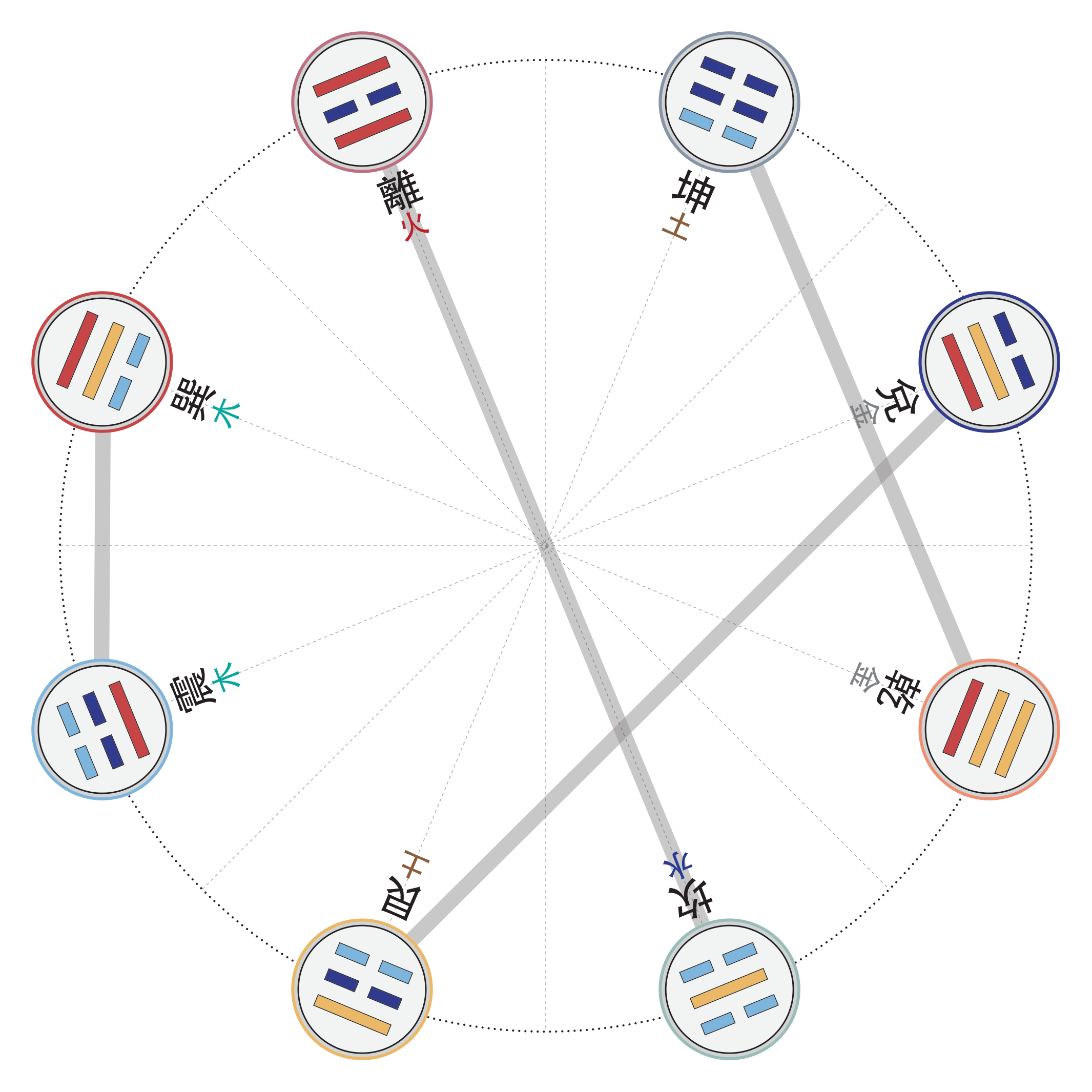
G Relational profiles for the semantic atlas
In each cell below, we can find the partner of the row’s trigram under a declared relation. These finite results stand independently of the provisional sememe phrases. Binary complementation flips all three glyph bits. In genesis it also reverses every semantic pole; in \(\mathcal H\) it reverses Participation alone.
G.1 Genesis under the original rule
| Trigram | Shared base | Selected shared pole | Full opposition / bit complement |
|---|---|---|---|
| Kun 坤 | Gen 艮 | Zhen 震 | Qian 乾 |
| Gen 艮 | Kun 坤 | Kan 坎 | Dui 兌 |
| Kan 坎 | Xun 巽 | Gen 艮 | Li 離 |
| Xun 巽 | Kan 坎 | Qian 乾 | Zhen 震 |
| Zhen 震 | Li 離 | Kun 坤 | Xun 巽 |
| Li 離 | Zhen 震 | Dui 兌 | Kan 坎 |
| Dui 兌 | Qian 乾 | Li 離 | Gen 艮 |
| Qian 乾 | Dui 兌 | Xun 巽 | Kun 坤 |
G.2 Original Human Compass \(\mathcal H\)
| Trigram | Shared base | Shared repeated pole | Full semantic opposition | Bit complement |
|---|---|---|---|---|
| Kun 坤 | Gen 艮 | Kan 坎 | Li 離 | Qian 乾 |
| Gen 艮 | Kun 坤 | Dui 兌 | Xun 巽 | Dui 兌 |
| Kan 坎 | Zhen 震 | Kun 坤 | Qian 乾 | Li 離 |
| Xun 巽 | Li 離 | Zhen 震 | Gen 艮 | Zhen 震 |
| Zhen 震 | Kan 坎 | Xun 巽 | Dui 兌 | Xun 巽 |
| Li 離 | Xun 巽 | Qian 乾 | Kun 坤 | Kan 坎 |
| Dui 兌 | Qian 乾 | Gen 艮 | Zhen 震 | Gen 艮 |
| Qian 乾 | Dui 兌 | Li 離 | Kan 坎 | Kun 坤 |
Genesis relations. Shared-base pairs retain both lower sourced yaos and change the qualifier polarity. The selected shared-pole matching used in this project is Kun–Zhen (\(y^0\)), Gen–Kan (\(x^0\)), Xun–Qian (\(y^1\)), and Dui–Li (\(x^1\)). We need to retain the word “selected”: sharing a pole alone need not determine a unique partner, and the relation differs from literal qualifier provenance.
\(\mathcal H\) relations. Shared-base pairs retain Participation and Animation and exchange the emphasised source. Shared-repeated-pole pairs retain the emphasis and change the secondary pole. Full semantic opposition reverses both source poles while retaining which source is emphasised. Binary complementation retains Animation and emphasis while reversing Participation. We can distinguish the four complete matchings even though an individual pair may belong to more than one.
Cycles. Alternating the first two relations gives a complete eight-state circuit in each construction. One genesis traversal is Kun–Gen–Kan–Xun–Qian–Dui–Li–Zhen–Kun. One \(\mathcal H\) traversal is Qian–Li–Xun–Zhen–Kan–Kun–Gen–Dui–Qian. Mathematically, both are cycles. To read their successions semantically, we need a further argument.
H Chinese terminology and pronunciation
This register brings together the Chinese characters and tone-marked pinyin for the principal names and terms used in the paper. The readings are modern Mandarin pronunciation guides, not reconstructions of historical pronunciation.[35] In the prose, captions, and table labels, pinyin remains unmarked; quotations and published bibliographic spellings retain their source forms.
| In the paper | Chinese | Tone-marked pinyin |
|---|---|---|
| Trigrams | ||
| Qian | 乾 | Qián |
| Kun | 坤 | Kūn |
| Zhen | 震 | Zhèn |
| Xun | 巽 | Xùn |
| Kan | 坎 | Kǎn |
| Li | 離 | Lí |
| Gen | 艮 | Gèn |
| Dui | 兌 | Duì |
| Mu | 木 | Mù |
| Huo | 火 | Huǒ |
| Tu | 土 | Tǔ |
| Jin | 金 | Jīn |
| Shui | 水 | Shuǐ |
| yin | 陰 | yīn |
| yang | 陽 | yáng |
| yao | 爻 | yáo |
| bagua | 八卦 | bāguà |
| qi | 氣 | qì |
| Xiantian / Earlier Heaven (XT) | 先天 | Xiāntiān |
| Houtian / Later Heaven (LH) | 後天 | Hòutiān |
| Yijing | 易經 | Yìjīng |
| Zhouyi | 周易 | Zhōuyì |
| Xici | 繫辭 | Xìcí |
| Shuogua | 說卦 | Shuōguà |
| Laozi | 老子 | Lǎozǐ |
| Daodejing | 道德經 | Dàodéjīng |
| Taijitu shuo | 太極圖說 | Tàijítú shuō |
| Suwen | 素問 | Sùwèn |
I Source incidence and conditional recovery of Later Heaven
Figure 3 (p. 9) uses the same four pole colours throughout. A grey mark in the Compass column concerns the displayed polarity of a line. Its colour still gives the constituent carried by that line. Thus an inventory of source poles must count the coloured word before any inversion. Bits in the register are written bottom–middle–top. The four pole counts below use the order \(x^0,x^1,y^0,y^1\).
| Encoder | Occurrences | Incidences | Two distinct poles | Three distinct poles |
|---|---|---|---|---|
| \(\mathcal G\) | \((6,6,6,6)\) | \((5,5,5,5)\) | 4 | 4 |
| \(\mathcal H\) | \((6,6,6,6)\) | \((4,4,4,4)\) | 8 | 0 |
| \(\mathcal L\) | \((6,6,6,6)\) | \((5,6,5,5)\) | 3 | 5 |
There is a short way to reconstruct the comparison from any glyph \((b,m,t)\). For \(\mathcal G\), take \((x^b,y^m)\) and attach pole bit \(q=t\) on \(y\) if \(b=m\), on \(x\) otherwise. For \(\mathcal H\), the horizontal pole bit is \(b\oplus m\), the vertical pole bit is \(\operatorname{maj}(b,m,t)\), and the selection bit is \(\chi=b\oplus t\). Repeat the vertical constituent on the outside when \(\chi=0\) and the horizontal one when \(\chi=1\). For \(\mathcal L\) use \((x^b,s^m,y^t)\), where \(s\) denotes the axis selected in Section 6. The counts follow by listing these words for the eight glyphs. In \(\mathcal L\) only Kun, Zhen and Qian repeat a pole, respectively \(x^0,y^0,y^1\). The source pairs at positions \((1,2),(1,3),(2,3)\) have six, four and eight distinct values. The middle and top together therefore identify a unique sourced state here.
Testing the successor conditions
Let \(w_i\) be the ordered source word at state \(i\), \(F_i\) its ordered outer frame, \(c_i\) its middle pole, and \(U_i\) the set of poles in its word. Write \(d_i\) for its repeated pole where one occurs. Admit a directed edge \(i\to j\) exactly when \(F_i\ne F_j\), \(c_i=d_j\) whenever \(d_j\) exists, and \(d_i\notin U_j\) whenever \(d_i\) exists. A successor permutation uses every state exactly once as a destination. The following register traces the permutation that survives.
| Step | Frames, before and after | Middles, before and after | Repetition at the boundary |
|---|---|---|---|
| Zhen to Xun | \(10\to01\) | \(y^0\to x^1\) | Release \(y^0\) |
| Xun to Li | \(01\to11\) | \(x^1\to x^0\) | Neither word doubles a pole |
| Li to Kun | \(11\to00\) | \(x^0\to x^0\) | Enter with \(x^0\) |
| Kun to Dui | \(00\to10\) | \(x^0\to y^1\) | Release \(x^0\) |
| Dui to Qian | \(10\to11\) | \(y^1\to y^1\) | Enter with \(y^1\) |
| Qian to Kan | \(11\to00\) | \(y^1\to x^1\) | Release \(y^1\) |
| Kan to Gen | \(00\to01\) | \(x^1\to y^0\) | Neither word doubles a pole |
| Gen to Zhen | \(01\to10\) | \(y^0\to y^0\) | Enter with \(y^0\) |
To check uniqueness, form the eight lists of allowed destinations and consider every permutation of the destinations. Keep a permutation precisely when all eight of its edges occur in the lists. This gives one permutation, the cycle displayed above. For a stronger comparison, hold every glyph, its bottom \(x^b\) and top \(y^t\) fixed, and allow each of the eight middles independently to come from \(x\) or \(y\). There are \(2^8=256\) assignments. Of these, 36 use each pole six times. Exactly two of the 256 admit every directed edge of the received LH succession. They differ at Zhen alone.
| Zhen middle | Pole occurrences | Admissible permutations | Single eight-cycles |
|---|---|---|---|
| \(y^0\) (selected) | \((6,6,6,6)\) | 1 | 1 |
| \(x^0\) (alternative) | \((7,6,5,6)\) | 16 | 6 |
Thus only one balanced assignment admits the received edges under these conditions. The extra requirement of a single cycle was available as a test after counting permutations. Imposing it beforehand would have obscured the difference between the two assignments. The source package includes the enumeration and the eight words under each encoder. The interpretation of why a repeated pole should be anticipated on entry and relinquished on departure remains a separate question.
References
Zhouyi, “Xici shang” 繫辭上, chs. 5, 11, and 12. Chinese text: Wikisource transcription.
Laozi 老子 (Daodejing), chs. 1, 42, 76, and 78, root text in the Wang Bi received edition. Wikisource transcription; chapter 42 is cited as a philosophical resonance, not as a derivation of the present rule.
Yizhuan, “Shuogua” 說卦, especially chapters 2–7 and 9–11. Chinese text: Wikisource transcription.
Huang Zongxi 黃宗羲, Huang Baijia 黃百家, and Quan Zuwang 全祖望, et al. Song Yuan xue’an 宋元學案, juan 10, “Baiyuan xue’an” 百源學案. Received Shao Yong material on the Earlier Heaven directions. Wikisource transcription.
Zhou Dunyi 周敦頤. Taijitu shuo 太極圖說. Translated by Joseph A. Adler, in Wm. Theodore de Bary and Irene Bloom, eds., Sources of Chinese Tradition, 2nd ed., vol. 1 (Columbia University Press, 1999), ch. 20. Translator’s online presentation: https://www2.kenyon.edu/Depts/Religion/Fac/Adler/Writings/Chou.htm.
Li Guangdi 李光地, compiler. Yuzuan Zhouyi Zhezhong 御纂周易折中, juan 17, Wenyuange Siku Quanshu witness, fols. 12a–13b, 15b, and 16b–17a. Comments attributed to Cheng Yi 程頤, Xiang Anshi 項安世, Xu Ji 徐幾, Gong Huan 龔煥, Hu Bingwen 胡炳文, Yu Yan 俞琰, and Chen Chen 陳琛. Transcription: Wikisource transcription. Machine-readable witness: Kanripo KR1a0117, file
KR1a0117_022.txt.Xiao Ji 蕭吉. Wuxing dayi 五行大義, juan 4, ch. 17, “Lun bagua bafeng” 論八卦八風. Especially the passage quoting Yi tonggua yan 易通卦驗 on directions and seasonal terms. Kyoto University transcription: https://www.zinbun.kyoto-u.ac.jp/~takeda/kyoudou/gogyou/gogyoutaigi/gogyo_gogyo_04_g.html.
Liu Wansu 劉完素. “Lun zao” 論燥, material attributed to Liu Wansu liushu 劉完素六書, preserved in Gujin tushu jicheng 古今圖書集成, digitised volume 442, image 115. Qian/dry Jin and Kun/damp Tu; the same witness also records a context in which dryness is classed with yin. Wikisource transcription and scan.
Hong Kong Observatory. “The 24 Solar Terms.” Solar-longitude table distinguishing seasonal commencements from equinoxes and solstices. Consulted 16 November 2026. https://www.hko.gov.hk/en/gts/time/24solarterms.htm.
Chunqiu fanlu 春秋繁露, traditionally attributed to Dong Zhongshu 董仲舒, juan 13, chs. 58 (五行相生), 59 (五行相勝), and 60 (五行順逆). Chinese text: Wikisource transcription.
Bao Yunlong 鮑雲龍. Tianyuan fawei 天原發微, “Xianhou” 先後, juan 4 lower in the six-juan arrangement, fols. 19a–20a; corresponding material in juan 14 of the eighteen-juan arrangement. Comparison of Earlier/Later Heaven attributed to Zhu Xi in the compilation. Digitised witness: https://commons.wikimedia.org/w/index.php?curid=85361578.
Aristotle. On Generation and Corruption, II.2–4 and II.8. Translated by H. H. Joachim. https://classics.mit.edu/Aristotle/gener_corr.2.ii.html.
Aristotle. On the Heavens, I.2–3. Translated by J. L. Stocks. https://classics.mit.edu/Aristotle/heavens.1.i.html.
Ptolemy. Tetrabiblos, I.5, I.6, and I.10. Translated by F. E. Robbins. Loeb Classical Library 435. Harvard University Press, 1940. Online transcription: https://penelope.uchicago.edu/Thayer/E/Roman/Texts/Ptolemy/Tetrabiblos/1B*.html.
Galen. On Hippocrates’ On the Nature of Man. Translated by W. J. Lewis, with the assistance of J. A. Beach, from Kühn, vol. XV, pp. 1–173. Especially pp. 83–84, 87–91, and 98 (the online paragraph numbers follow Kühn’s pagination). Medicina Antiqua, University College London.
Anonymous. The Book of Quinte Essence or the Fifth Being; That Is to Say, Man’s Heaven. British Library, Sloane MS 73, fifteenth century. Edited by F. J. Furnivall. Early English Text Society, Original Series 16, 1866; revised edition 1889. Especially pp. 2–4, 12–13, and 21. https://www.gutenberg.org/cache/epub/17179/pg17179-images.html.
Aristotle. On the Generation of Animals, II.3, 736b27–737a7. Translated by Arthur Platt. Online primary-text transcription: https://www.intratext.com/IXT/ENG2246/_PQ.HTM.
Cicero. De natura deorum, II.40–41 and II.57–58. Translated by H. Rackham. Loeb Classical Library, 1933. Zeno’s generative fire reported in Balbus’s exposition of Stoic theology. LacusCurtius transcription.
John of Rupescissa. De consideratione quintae essentiae rerum omnium. Basel, 1597. Book I, especially pp. 16–18. Universitätsbibliothek Basel, shelfmark ls 160; Latin facsimile: https://doi.org/10.3931/e-rara-7526. The arguments concerning qualities and preservation are paraphrased from this witness.
Pseudo-Llull. Liber de secretis naturae seu de quinta essentia. Manuscript copied in Venice, 1498. Science History Institute, Othmer Manuscript Collection, MS 7. Manuscript catalogue and digital facsimile: https://digital.sciencehistory.org/works/82ul4ik. The catalogue supplies the attribution and account of the work’s use of Rupescissa.
Anonymous. Rosarium philosophorum. First printed in De alchimia opuscula complura veterum philosophorum, part II (Frankfurt, 1550). Eighteenth-century English translation, MS Ferguson 210, transcribed on Adam McLean’s Alchemy Website. Especially the opening treatment of water and gentle fire (part 1); Conjunction or Coupling and the subsequent Rebis passage (part 2); and Of Our Mercury which is the Green Lion Devouring the Sun (part 5). Translation provenance: https://alchemywebsite.com/rosary0.html.
Maier, Michael. Atalanta fugiens (1618 edition), Emblem 29, epigram and discourse, Latin pp. 124–127. Digital facsimile and seventeenth-century English translation in Tara Nummedal and Donna Bilak, eds., Furnace and Fugue: A Digital Edition of Michael Maier’s “Atalanta fugiens” (1618) with Scholarly Commentary (University of Virginia Press, 2020). https://pfandfcit.services.brown.edu/atalanta-fugiens/emblem29.html.
Vaughan, Thomas (Eugenius Philalethes). Coelum Terrae (1650), in Arthur Edward Waite, ed., The Works of Thomas Vaughan (London: Theosophical Publishing House, 1919), especially pp. 218, 220–222. Scanned edition; additional primary-text transcription.
Böhme, Jakob. Mysterium Magnum, ch. 14, §§6–9. English translation by John Sparrow. Online transcription: https://selfdefinition.org/christian/jacob-boehme/mysterium-magnum/chapter-14.htm.
Eliot, T. S. Little Gidding (1942), parts II, IV, and V; subsequently collected in Four Quartets. Online text hosted by Columbia University: https://www.columbia.edu/itc/history/winter/w3206/edit/tseliotlittlegidding.html.
Schöter, Andreas. “Bipolar Change.” Journal of Chinese Philosophy 35, no. 2 (2008): 297–317. https://doi.org/10.1111/j.1540-6253.2008.00479.x. Consulted alongside the author’s expanded prepublication PDF, supplied as BIPOLAR_CHANGE.pdf.
Hentsch, Patrick. State, Flux, and Pattern: A Structural Analysis of the Later Heaven Bagua and Five Phases. Unpublished manuscript, 2026. Completed author-supplied research paper.
Jung, C. G. Psychological Types. Translated by H. Godwyn Baynes (1923), from Psychologische Typen (1921). Chapter X, especially “Recapitulation of Extraverted Rational Types”, “Recapitulation of Extraverted Irrational Types”, and “The Principal and Auxiliary Functions”. Online primary-text transcription: https://psychclassics.yorku.ca/Jung/types.htm.
Hentsch, Patrick. The Human Compass. Unpublished book manuscript in preparation, 2026. Review master v1, consulted 20 November 2026; especially Chapters 3 and 5–12, and the systematic coda C1–C6 and D3. The atlas uses the full category functions and the affliction/intelligence register.
Hentsch, Patrick. Human Compass. Empowered Maturity PLLC, 2020. One-page chart, supplied as Compass 2020a.pdf. Primary reference for the model’s vocabulary, circular ordering, and native colours; the subsequent trigram formalisation is distinguished in Section 5.
Academia Sinica, Institute of Information Science. Chinese Character Database, entry 澤, especially senses 1–4 and 7. Consulted 18 November 2026. https://chardb.iis.sinica.edu.tw/char/15323. A lexical range, not a claim that all senses apply to Dui.
Huangdi neijing suwen 黃帝內經素問, ch. 2, 四氣調神大論, and ch. 5, 陰陽應象大論. Received text, juan 1–2. Juan 1 and juan 2, Wikisource transcriptions. Cited for historical seasonal and bodily correspondences.
Heindel, Max, and Augusta Foss Heindel. The Message of the Stars, “The Law of Correspondences”, section “Pathogenic Effects of the Twelve Signs”. Early twentieth-century astrological work; online transcription: https://www.rosicrucianu.com/courses/moseng09.htm. Cited for its Gemini–lungs attribution, not for clinical claims or a claim of classical origin.
Zhouyi 周易, doubled hexagrams Kun 坤 (Tuan, Image, Wenyan), Qian 乾 (Tuan, Image), Kan 坎 (Tuan, Image), Li 離 (Tuan, Image), Zhen 震 (Image), and Xun 巽 (Tuan, Image). Chinese primary-text transcriptions consulted for the atlas, November 2026. English descriptions are interpretive paraphrases; these doubled-hexagram commentaries are distinguished from the trigram attributes of the Shuogua.
Ministry of Education, Taiwan. Revised Mandarin Chinese Dictionary 重編國語辭典修訂本, online edition, and Dictionary of Chinese Character Variants 異體字字典, entry 艮. Consulted 19 November 2026 for modern Mandarin readings. https://dict.revised.moe.edu.tw/; https://dict.variants.moe.edu.tw/dictView.jsp?ID=37261.
Blekherman, Grigoriy, Pablo A. Parrilo, and Rekha R. Thomas, eds. Semidefinite Optimization and Convex Algebraic Geometry. MOS–SIAM Series on Optimization, vol. 13. SIAM, 2013. Section 5.2.1, “Vector Spaces and Cones”, especially the discussion of biduality for closed convex cones. Author-hosted volume.
Hentsch, Patrick. Five palettes across three trigram encoders. Companion register to the present working paper, 25 November 2026. Includes the proposed double-qualification readings and their interpretive limits.
I use pinyin without tone marks in the prose, captions, and table labels. Trigram and phase names are capitalised, general terms such as yin, yang, and yao remain lowercase, and text titles are italicised. Chinese characters identify names and terms at their first substantive mention and in the principal registers. Appendix H gives a compact register with tone-marked pinyin. Quotations and published bibliographic spellings retain their source forms.↩︎
This use of bi-duality is distinct from mathematical biduality, which concerns taking a dual twice, as in biduality for closed convex cones.[36, Section 5.2.1]↩︎
The Five Phases are 木 (Mu, conventionally Wood), 火 (Huo, Fire), 土 (Tu, Earth), 金 (Jin, Metal), and 水 (Shui, Water). Characters name phases in formal registers and diagrams; pinyin distinguishes them in prose from Western elements and ordinary materials. English names remain where they belong to a source title or a different use.↩︎
The Liber de secretis naturae seu de quinta essentia belongs to the pseudo-Lullian corpus. The Science History Institute’s account of its 1498 manuscript identifies extensive borrowing from Rupescissa and an extension to metallic transmutation and precious stones. Its relevance is reception, not authorship by Ramon Llull.[20]↩︎
A later literary resonance is Eliot’s Little Gidding: destructive water and fire in part II, destructive and redemptive fire in part IV, and fire’s conjunction with the rose in part V. These differing functions enrich the comparison without establishing a specific alchemical source or the present quintessence interpretation.[25]↩︎
Aristotle states in On Generation and Corruption II.8 that earth lacks cohesion without moisture.[12] Form-retention must therefore not be equated with every kind of cohesion. The Kun–Gen distinction attends to both a delimited basis and what moisture enables within it; it does not deduce a physical account from the trigram words.↩︎